Free Auto Repair Advice by Professional Mechanics
How Does it Work /
Engine Thermostat
How to Test an Engine Thermostat
Inside your car's engine, thousands of controlled explosions called
combustion events caused by igniting fuel/air mixture inside the engine
generate heat. If this heat is not controlled the engine will over heat
and internal damage will occur. These high temperatures are controlled with the help of the cooling
system. A cooling system consists of a water pump, thermostat, radiator hose, hose
clamps, radiator, radiator cap and coolant. The thermostat is designed stop the
flow of coolant through the cooling system while the engine is warming up to
operating temperature. An engine needs to operate at a particular heat range to be
efficient. Once the engine is warm the thermostat will open to allow coolant
flow and cool the engine. Most thermostats are designed to open at about 195°
F but other temperatures are available for a variety of applications. A
thermostat consists of a main housing, a plunger style of valve and a temperature
sensitive mercury filled plunger that acts as the sensing and activating device
with a return spring. A thermostat maintains engine temperature as is opens and
closes throughout the engine operation.

Engine Thermostat
When a thermostat malfunctions it can stick
close not allowing the coolant to circulate causing the engine to overheat.
Or the thermostat could stick open causing the engine to run too cold. In this
case the service or check engine soon light could illuminate, followed by a
trouble code.
Test Procedure:
- To test a thermostat remove unit. Prepare a pan of water deep
enough to cover the thermostat completely. Next install a temperature gauge into
the water along with the thermostat. A cooking thermometer works well for this.
Next, start heating the water while watching gauge, the thermostat should remain
closed until the water reaches 190° at this point the thermostat should start
opening and be completely open at about 195°. If the thermostat stays closed
through the boiling point the thermostat has failed and needs replacing. If the
thermostat is stuck open or broken it has failed and needs replacing. Never run
an engine without a thermostat because the thermostat works as a system flow
regulator as well. What this means is the thermostat has a specific opening that
regulates the flow through the cooling system. If the coolant is allowed to flow
to quickly through the radiator the coolant will not have time to transfer the
heat it has absorbed. This will cause the engine to overheat.
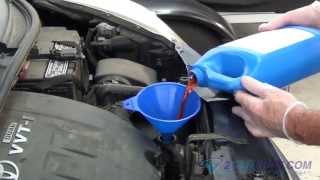
Engine coolant is used to transfer heat from the
engine
to the
radiator by the
cooling
system. The radiator removes heat from the coolant by forcing air through
the radiator fins. Without coolant your engine will over heat and if left
unattended sever engine damage will occur. Coolant colors can vary from
green, orange, blue and yellow each having their own protective properties.
(Note: coolant and antifreeze refer to the same product, in below freezing,
coolant lowers the freeze point hence the name anti-freeze and in warm weather
coolant helps raise the boiling point, "coolant")

Red and Green Engine Coolant
In the beginning, water was used for cooling systems as it is the most efficient
fluid to absorb and dissipate heat. The disadvantage of using water is that it freezes
and will rust. Then water was mixed with ethylene glycol which worked as an antifreeze
element. Not only does the freezing point improve so does the boiling point by adding
ethylene glycol. Ethylene glycol can be heated up to 250°F
before becoming ineffective. The cooling system is pressurized to 18 psi. to
increase coolant boiling point which adds 9 degrees Fahrenheit to the boiling
point of the coolant. Coolant is also used to avoid corrosion. An engine
thermostat is designed to stop the flow of coolant from the engine to the
radiator. This temperature sensitive valve is designed to open when the engine
has reached operating temperature (190°-198°
F). The operating temperature of 190°-210°
F. which is used to help facilitate fuel combustion.
When a
thermostat fails it will either stop the coolant flow at operating
temperature "stick closed" or fail to stop the coolant flow causing the
engine to run colder longer than necessary. If the thermostat fails "open"
it will cause the coolant to continuously flow through the engine creating a
diagnostic trouble code (check
engine light) will be set. When a thermostat sticks it will cause the
engine to overheat quickly, usually within 5 to 15 minutes of operation. To
check for either of these conditions drain coolant and remove thermostat,
(under the thermostat housing) if you are unsure of the location of the
thermostat on your engine consult a
car repair
manual. Once you have removed the thermostat inspect the condition of
the main body check for any cracks or broken pieces and check the valve to
make sure it is closed. If the valve is open the thermostat has failed and
needs to be replaced. To check the operation of the thermostat prepare a pot
of water on the stove deep enough to cover the thermostat completely.
Place the thermostat in the pot of water, turn the stove on a medium/high
flame, the thermostat should open right before the water comes to a boil. If
the water has boiled and the thermostat valve is still closed the thermostat
has failed and needs to be replaced.
Basic Checks
Low levels of coolant can lead to problems related to engine overheating. Always
maintain proper levels of coolant in the overflow coolant reservoir tank. ONLY!
Check the radiator when the engine is cold. Only add antifreeze and reinstall the
cap properly. Always drain and refill your
cooling system regularly.
How Does it Work /
Engine Thermostat
Check Manufacturer Specific
Thermostat
Questions and Answers
Related Subjects
Got Car Repair Questions
we will answer it for FREE!
GET
CAR REPAIR MANUALS
FOR YOUR CAR. Get instant access to your vehicles drive belt routing, wiring
diagrams, trouble code information and other available updates and factory bulletins.
|