Ignition coil primary male spade + terminal voltage?

Tiny
BRUCEDUNCAN
  • MEMBER
  • 2003 CHEVROLET MONTE CARLO
  • 3.8L
  • V6
  • 2WD
  • AUTOMATIC
  • 157,000 MILES
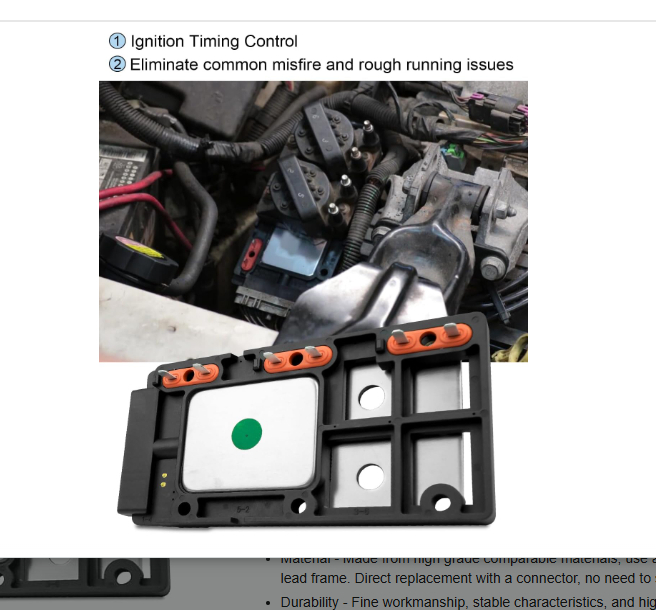
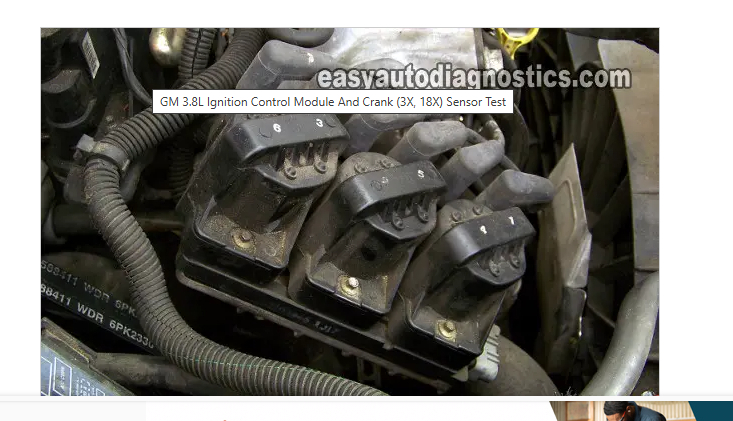
If you remove the coil from the Ignition Control Module it exposes the primary + and - male spade terminals.
I was told on a mechanic site www. Autocodes. Com that the + spade should have 12 volts key on engine off. My car has less than a volt on all three coils. The 2/5 coil had 18 to 20 mv. The 6/3 coil had4 to 5 mv. The1/4 coil had 16 mv.
I grounded the multimeter to battery post - post and primary coil - terminal. I got the same readings at both locations. The primary coil - terminals have less.2 ohms resistance or less to the icm case. The icm mounting base has good ground to the block and the battery - post.
I put my multimeter on the icm harness terminal p pink power and terminal k black/white ground wire which goes to the block and got more than 12 volts. I loaded the circuit with a test light and got over 12 volts. I was told the pink wire feeds the coils.
All 3 coils have no spark. I put my test light to battery post + and primary coil - terminal and got a bright light. While cranking the light went out. No icm triggering.
I put my test light to primary coil + and - while cranking, no blinking hence no triggering.
My car was bucking and jerking in park and blowing a little black smoke. Trouble code P/1374 set. Crank sensor reference circuit. 2 days later I had no spark on any coil.
My 3x rpm on my scan tool showed 0 rpm while cranking once and on many, many retests I have a rpm signal.
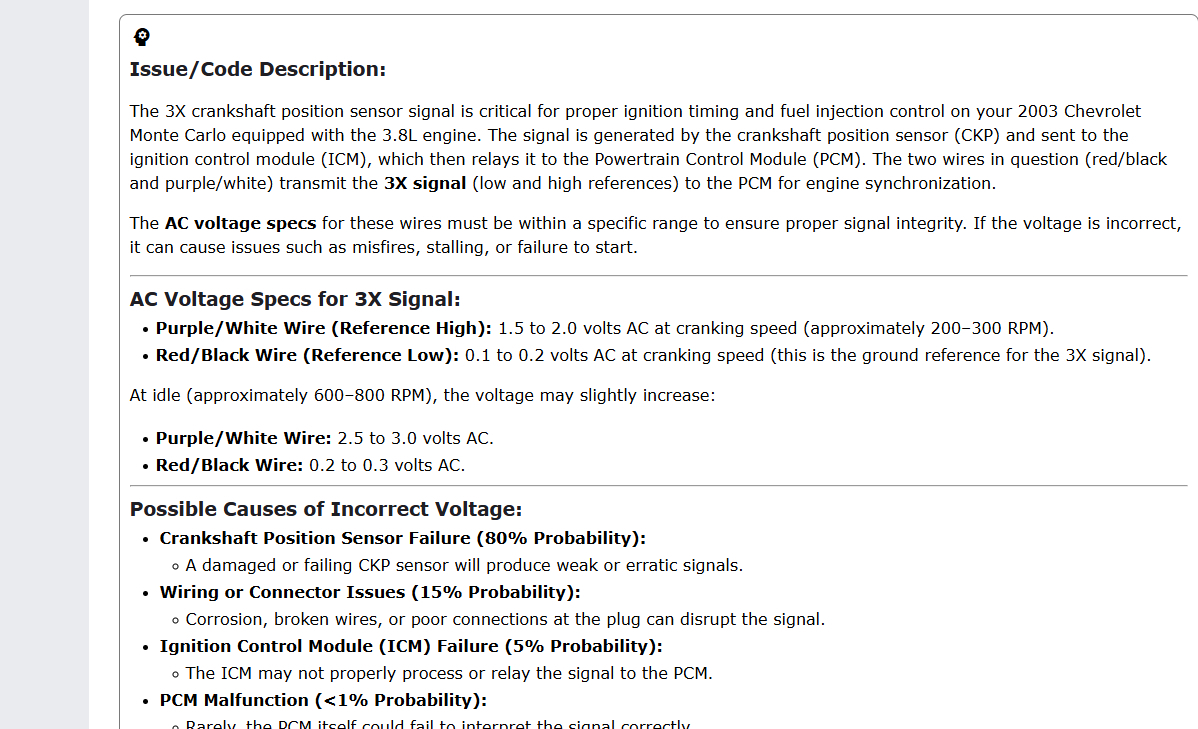
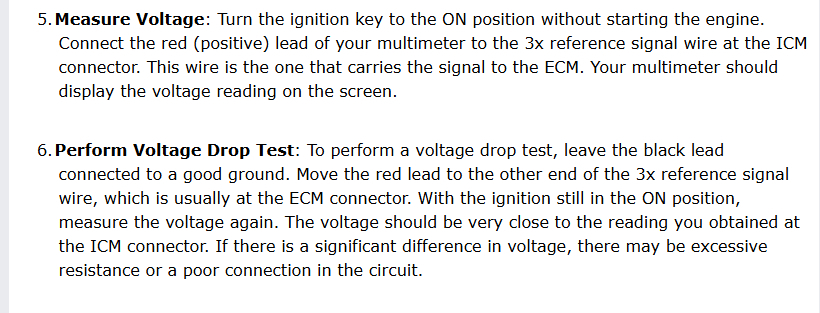
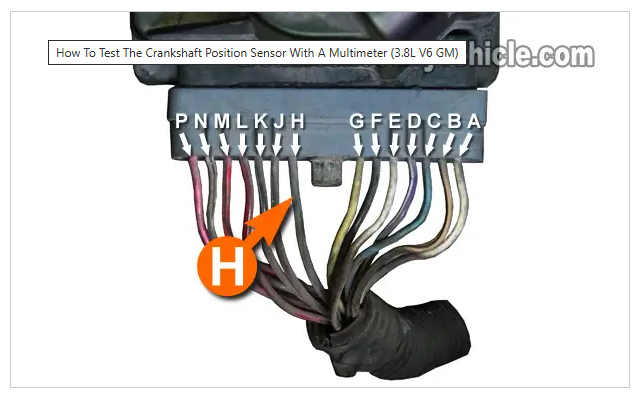
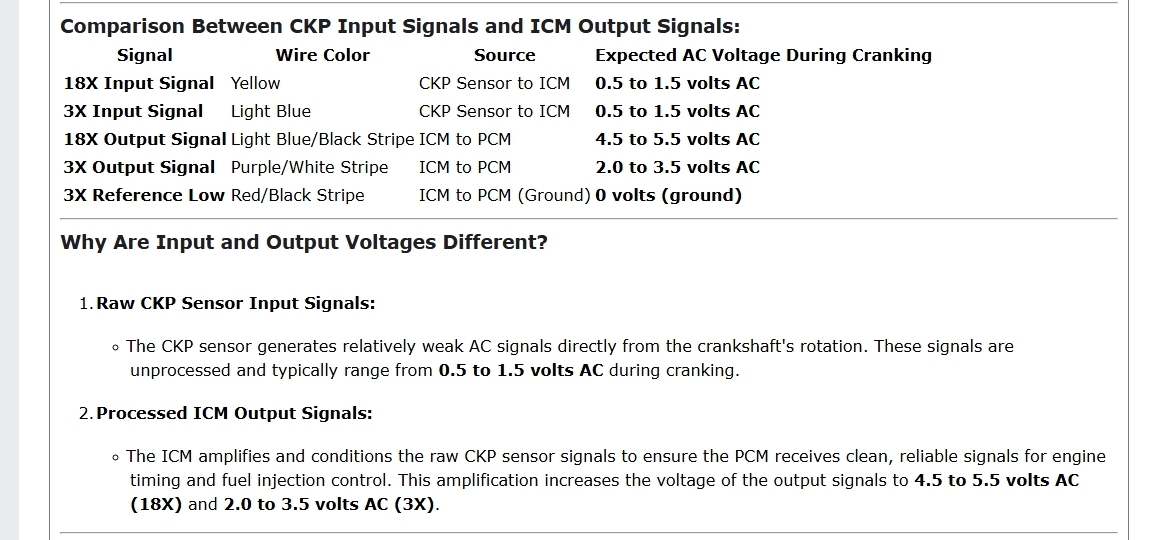
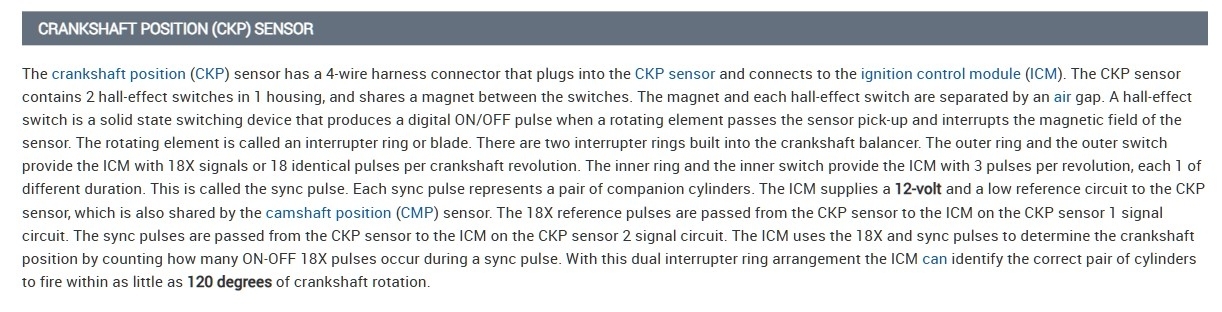
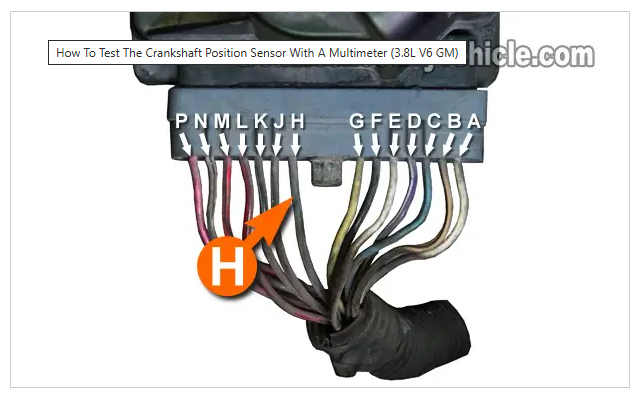
I then measured the 18x crank sensor signal wire going into the icm terminal g yellow wire. I measured at the icm with a multimeter and it shot up 3.5 ac volts while cranking with no minimum voltage. I was told my multimeter is too slow to read it. On the 3x signal wire I got 1.7 to 2.8 ac volts while cranking terminal h light blue/white wire.
I was told the coil primary - terminal switches on and off to do the coil sparking and the + terminal has 12 volts all the time. It sounds like I need an icm.
I may or may not check my 18x and 3x voltages coming out of the icm. I may or may not turn the crank by hand and measure the crank sensor dc volt outputs. But I all ready have a rpm reading and crank sensor outputs.
To summarize should I have 12 volts on the coil primary + terminal. Key on engine off.
I await your reply. Thanks a bunch, Bruce Duncan
Thursday, March 20th, 2025 AT 8:28 AM
53 Replies

Tiny
AL514
  • MECHANIC
  • 5,499 POSTS
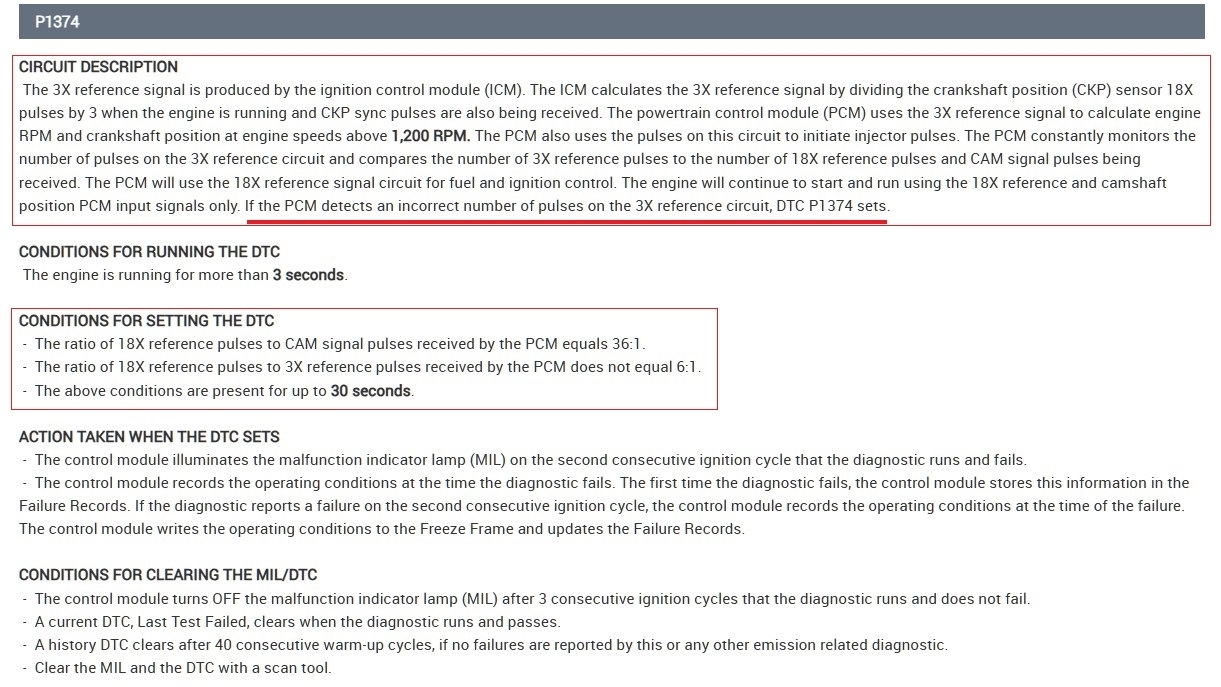
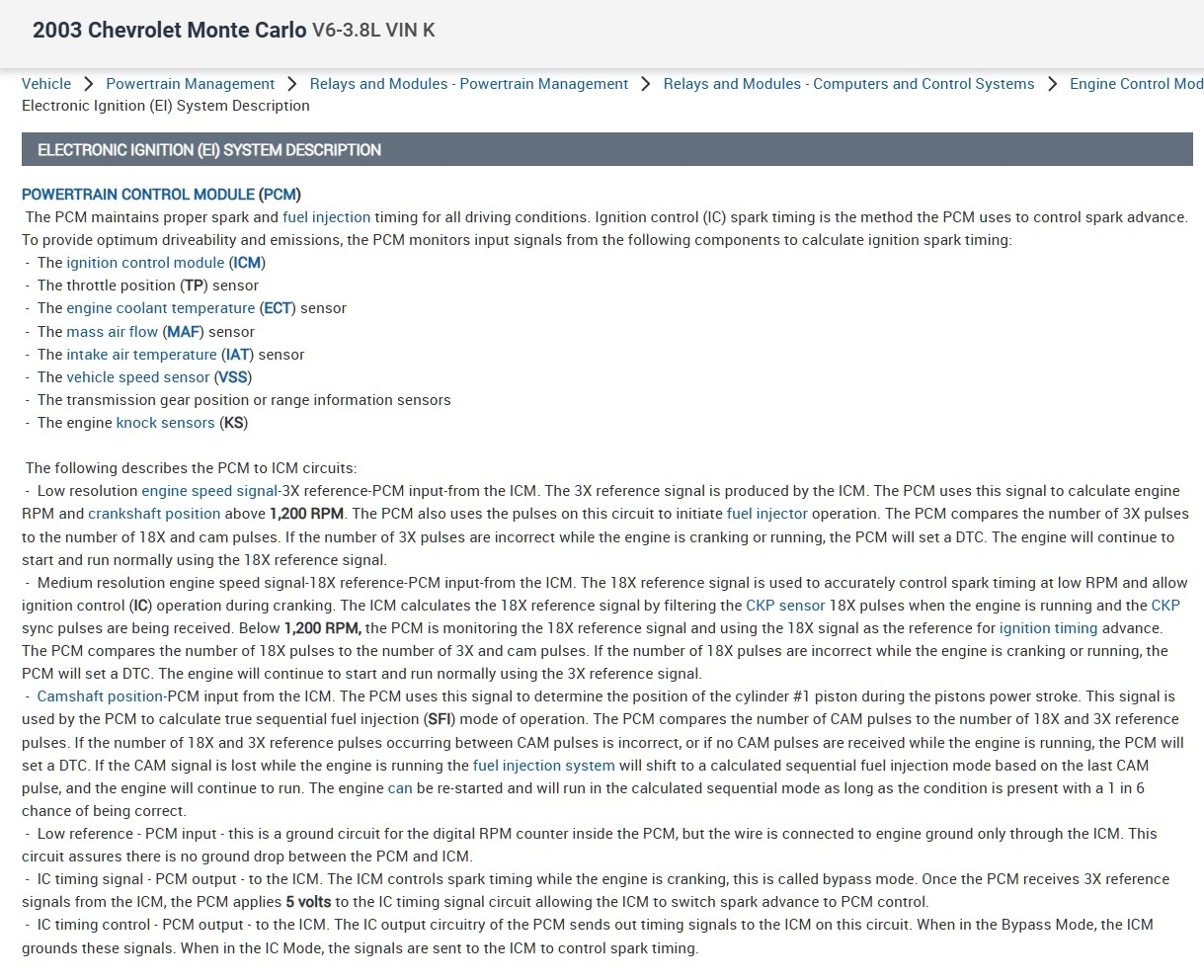
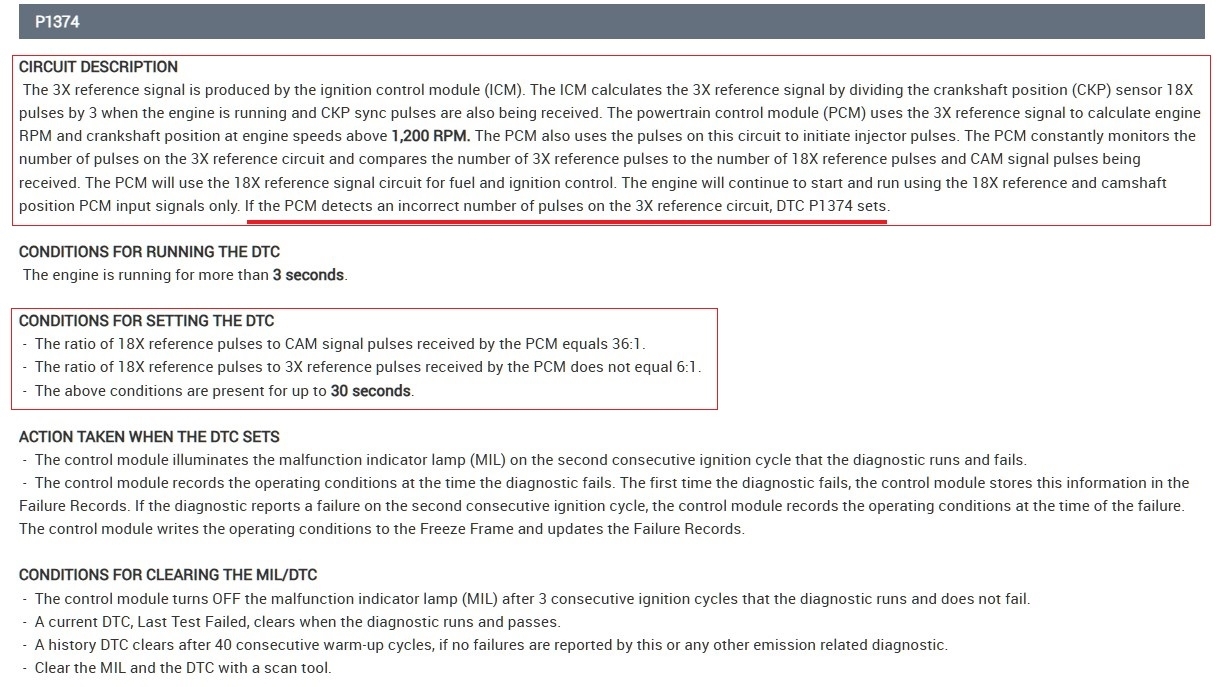
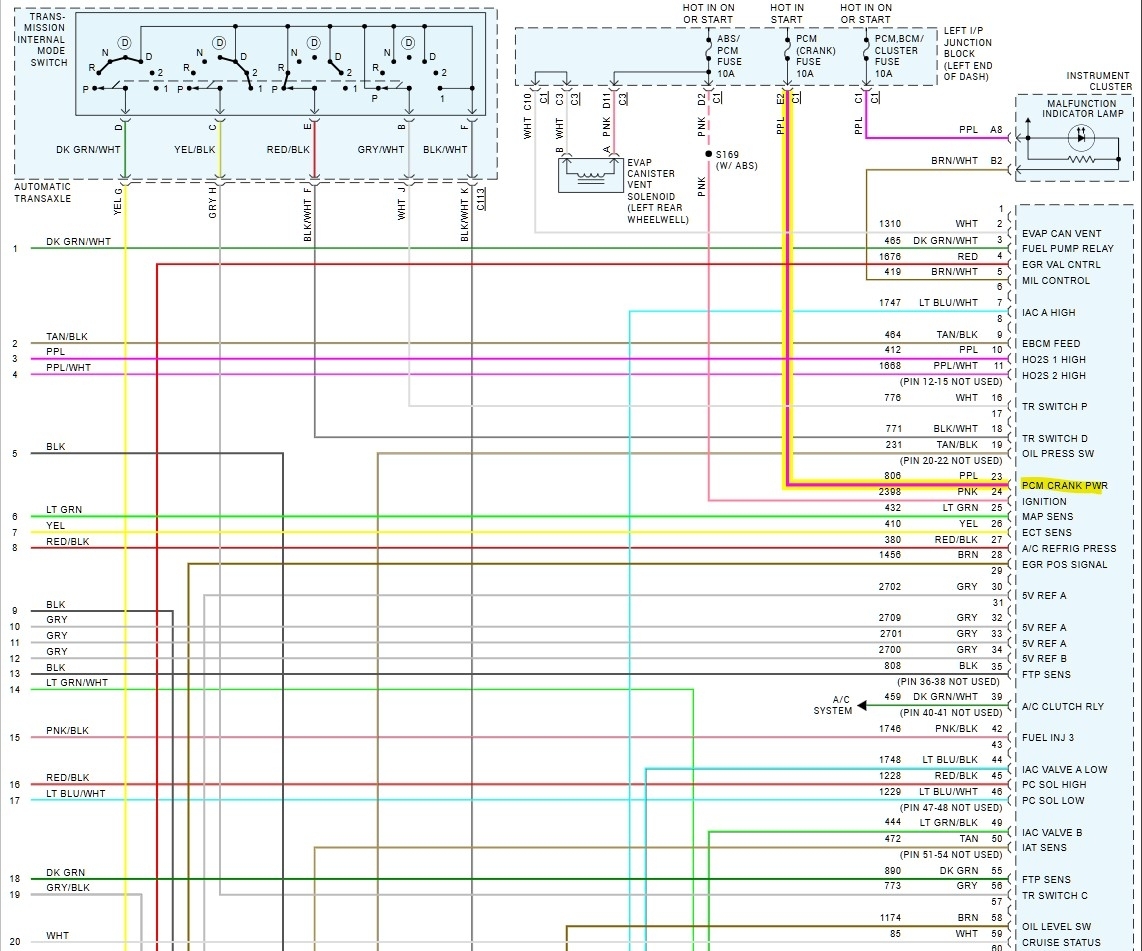
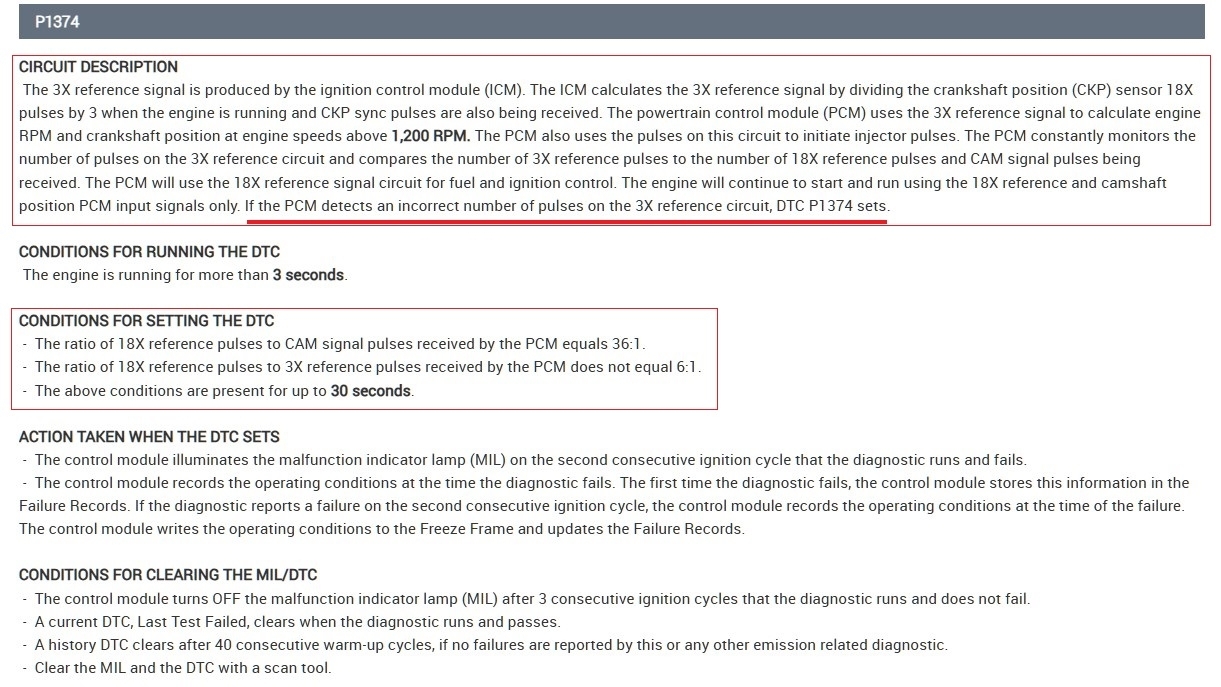
Hello, reading the service information on how the 3x signal is calculated will help. A multimeter is too slow to see the actual waveform the crank sensor produces, this is where using an oscilloscope is very effective and is needed on many modern vehicles, I'll post the service info on the code you are getting. The ICM actually produces the 3x signal by using the 18x crank signal. There is a testing flow chart for this code as well that Ill post along with the ECM/PCM wiring diagrams, so you have them if needed. A test you can do with the multimeter is to check that the cam or crank sensor wiring is not shorted to ground, by unplugging the ICM so the circuits are isolated, key off, you can check each wire of the cam and crank sensor for continuity to ground. I will check the OEM diagrams as well to make sure they are correct, but the wiring diagrams show that all the wires for both sensors go to the ICM, so you technically shouldn't have any continuity to ground on any sensor wires, if the OEM diagrams show anything different I'll post them as well.

Sorry I misread your post, the pink wire at ICM should read 12volts with the Key On engine off, and Ground on the black/white wire, as for power at each coil with them unplugged from the ICM, that I will have to check on, since the ICM has integrated circuits on it, with a code set like this, it may or may not power up the coils. But the wiring diagrams will help, the real issue here is if the ICM has failed or not, because it's responsible for calculating the 3x signal by dividing the 18x signal and outputting the 3x to the PCM which uses it for triggering injectors and engine RPM.
Was this
answer
helpful?
Yes
No
Thursday, March 20th, 2025 AT 10:20 AM
Tiny
AL514
  • MECHANIC
  • 5,499 POSTS
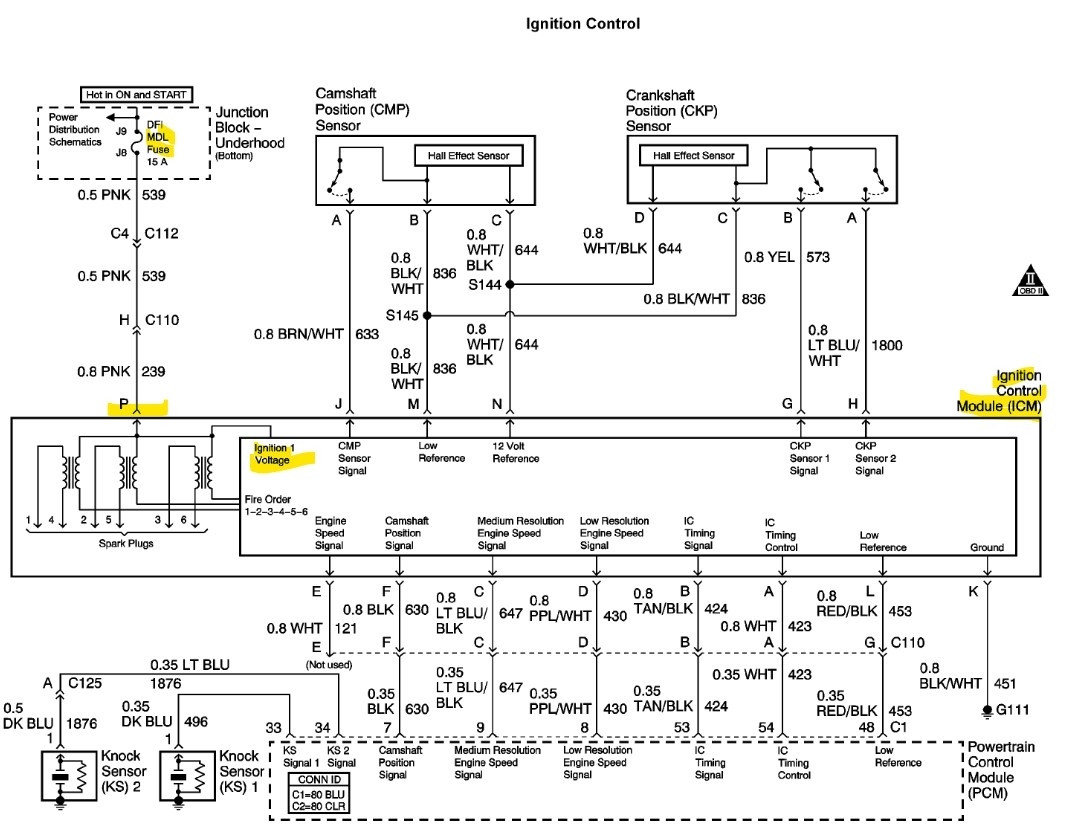
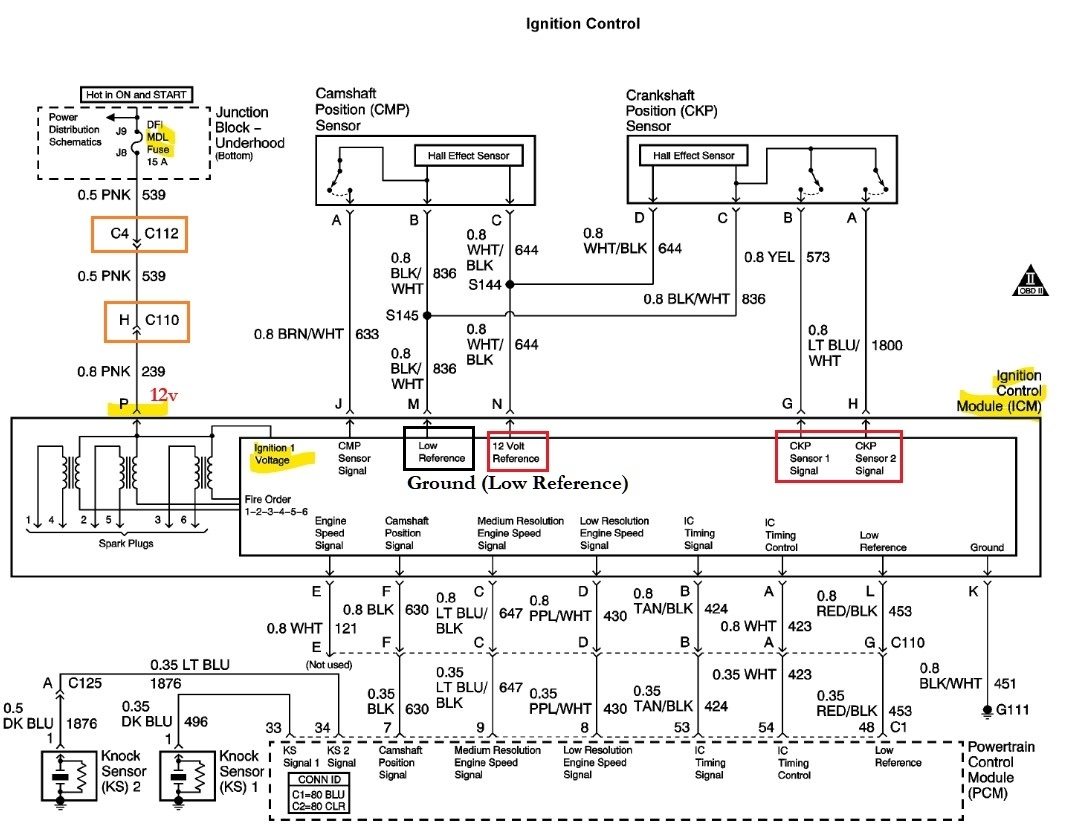
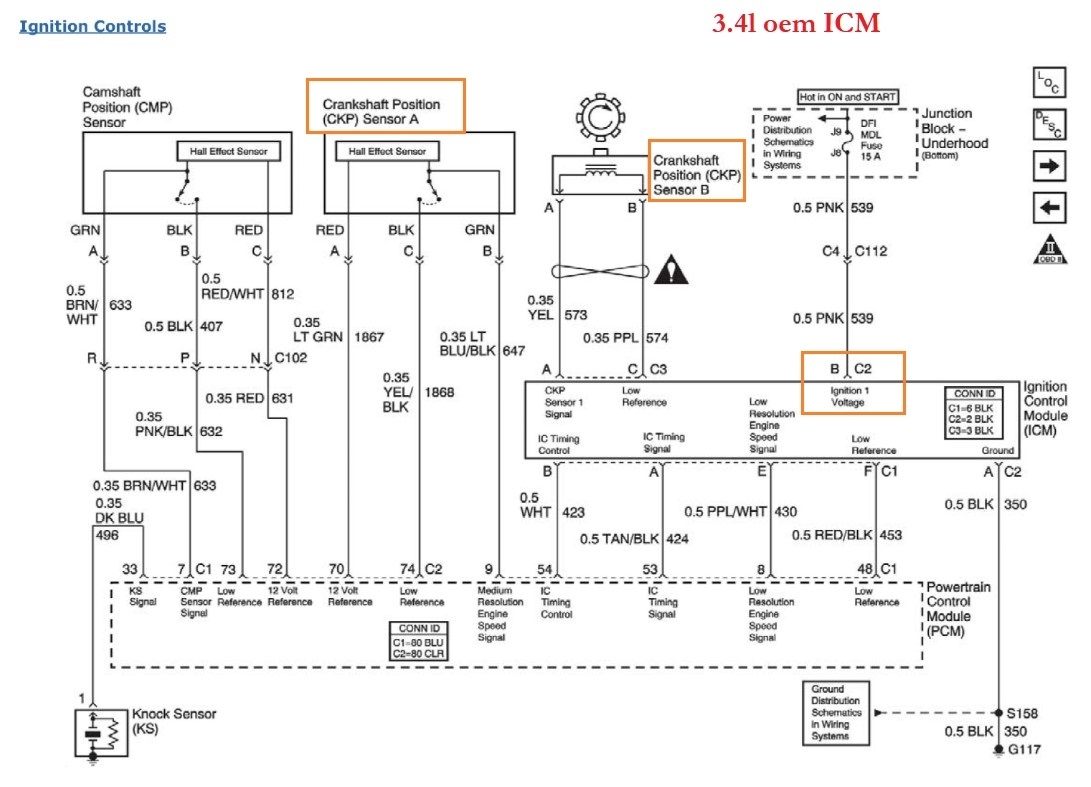
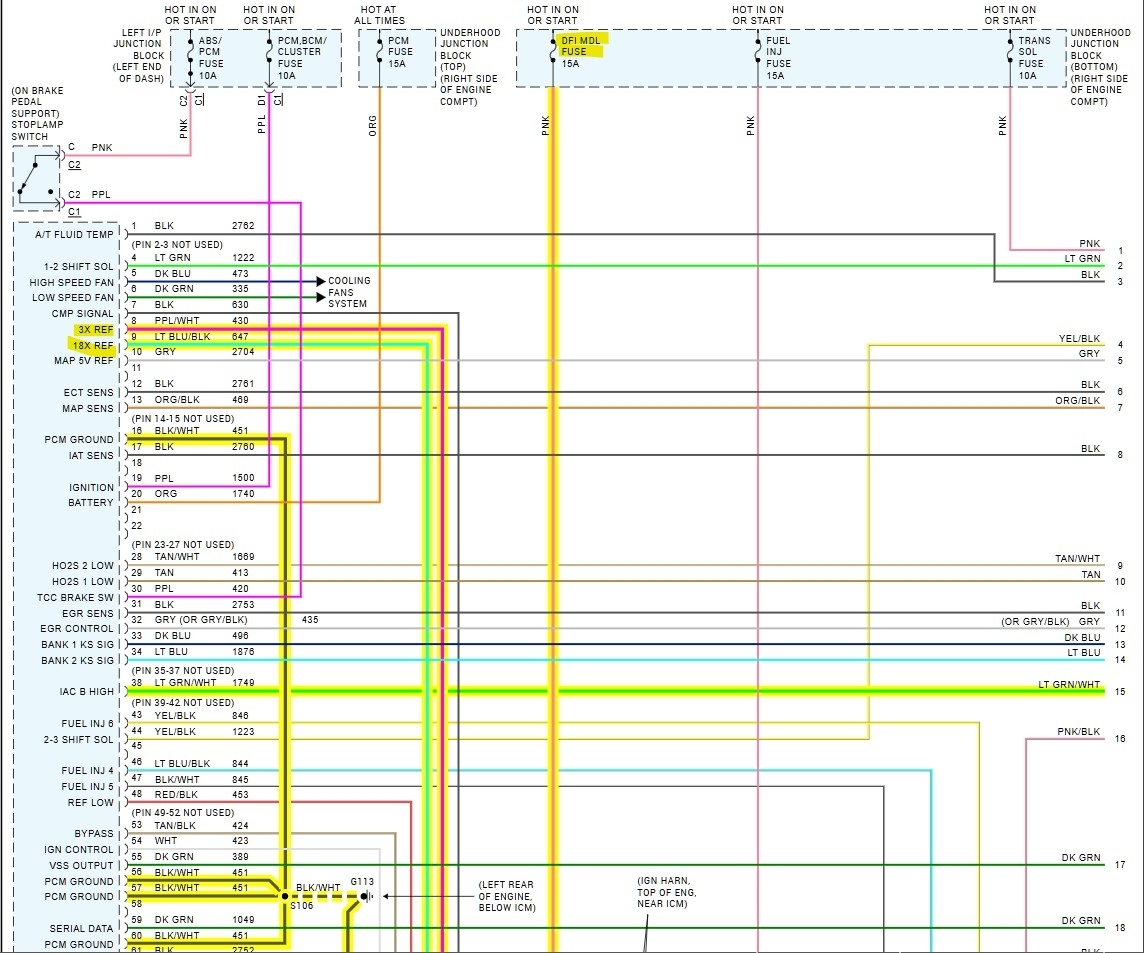
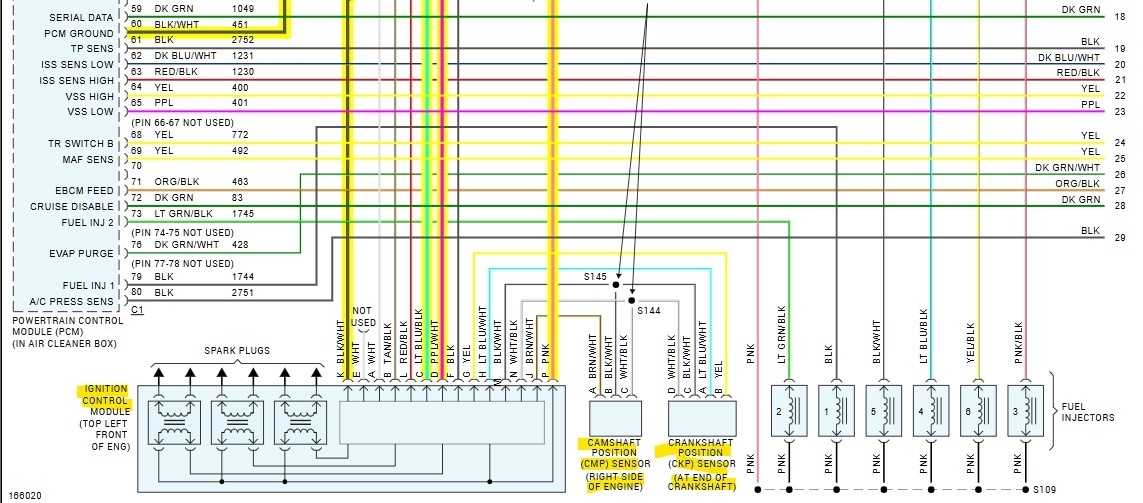
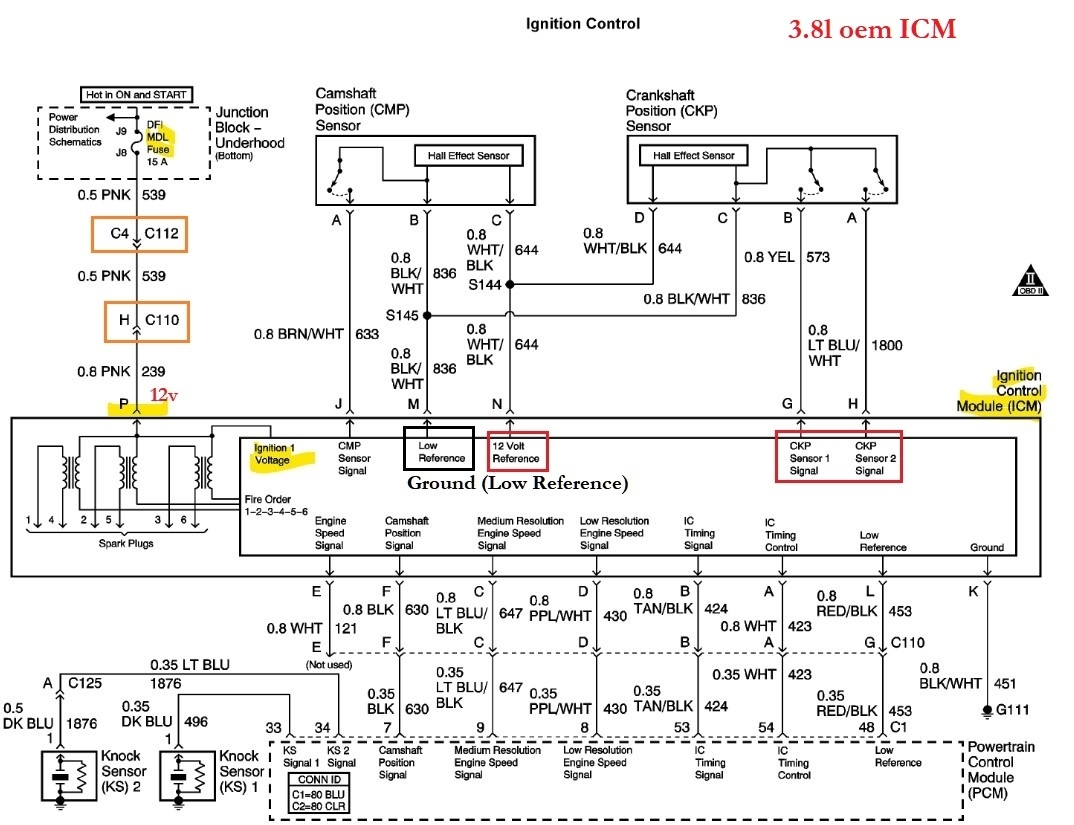
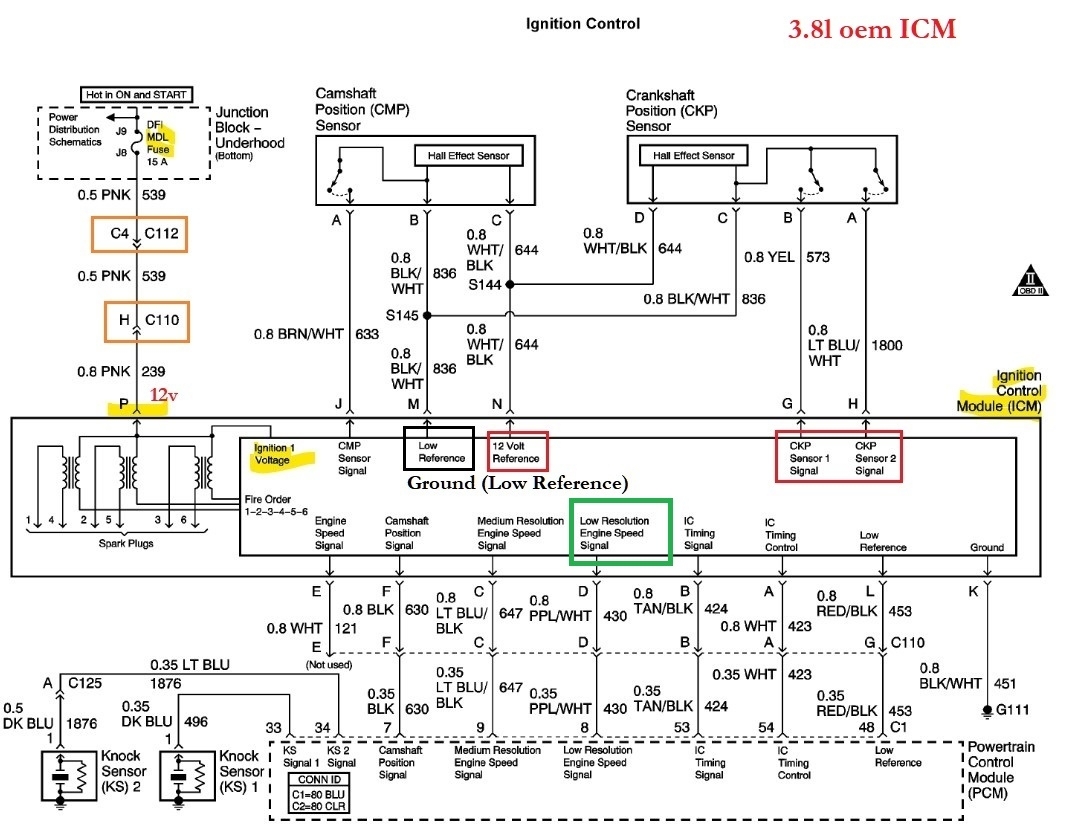
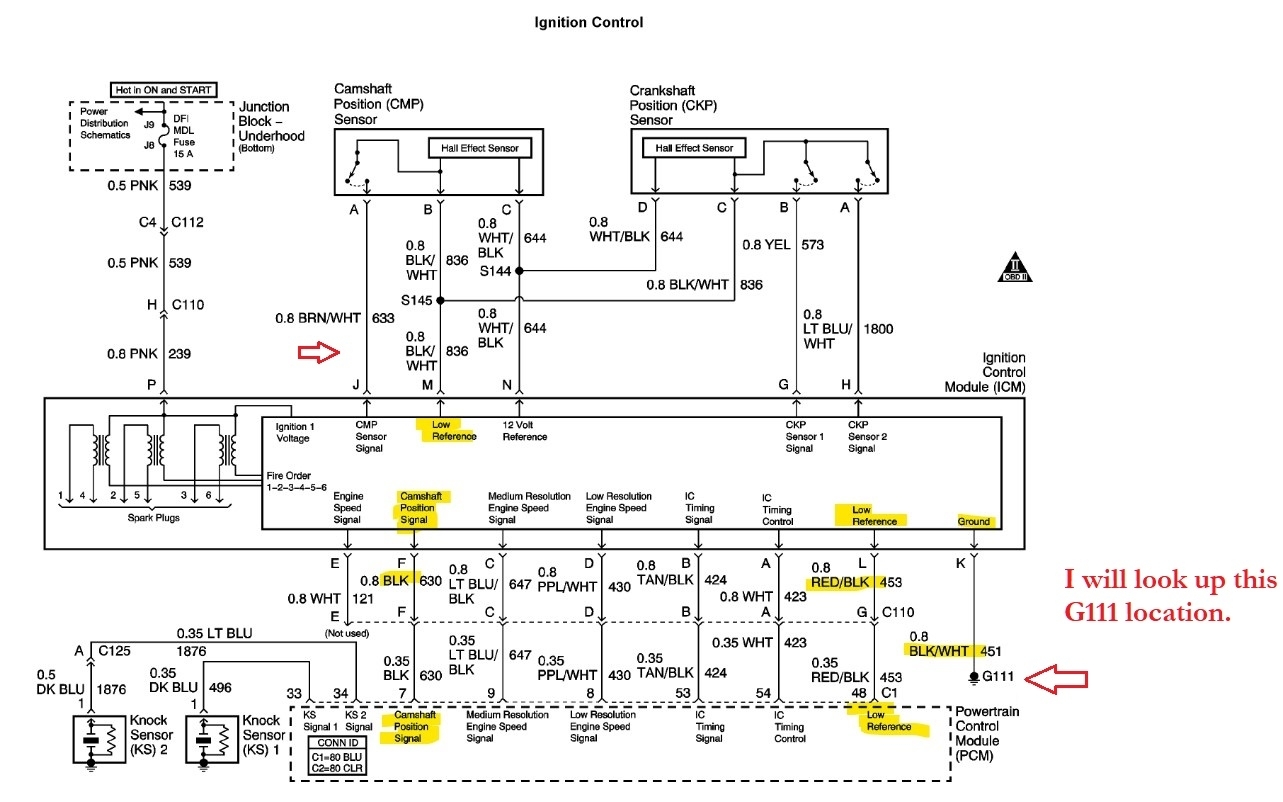
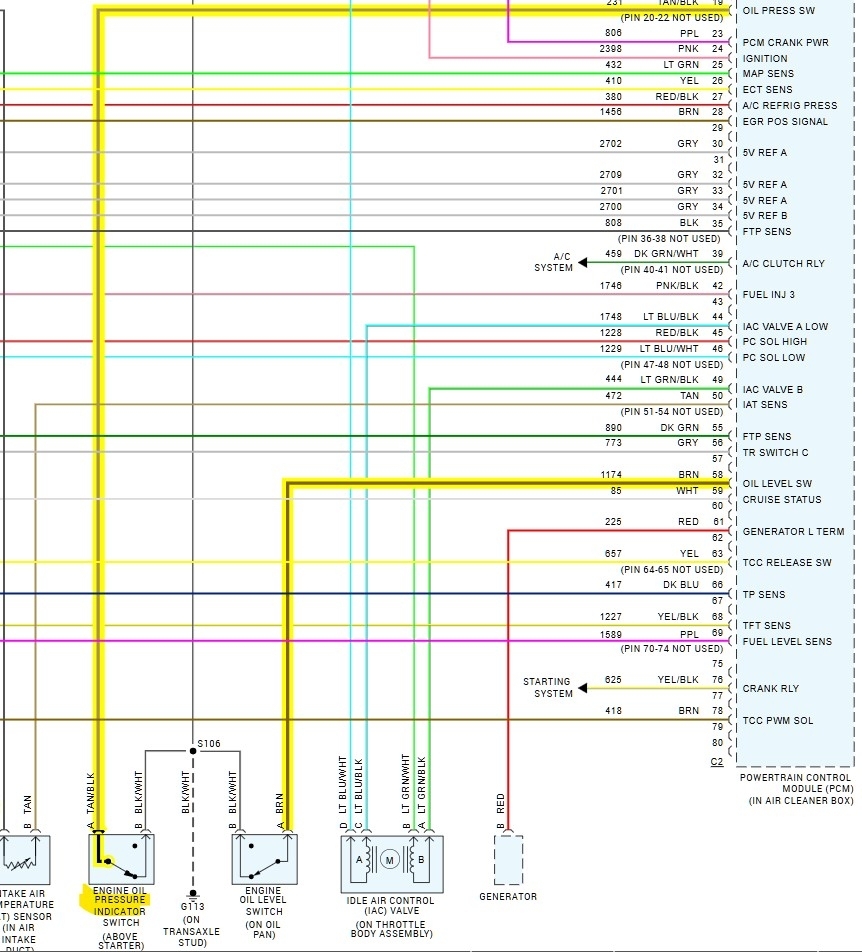
Okay, according the OEM diagram below, it looks like the coils should have 12v to them which is fed by the pink wire from Fuse DFI MDL 15Amp, that wire feeds the coils and ICM, the OEM diagram show much more detail as to the inner workings of the ICM, there are 2 connectors that the pink wires runs through, so if you are missing power on that wire, we can trace it back and check these two connectors (C112 and C110) for possible corrosion/water intrusion or an open circuit somewhere in between the ICM and fuse.
Was this
answer
helpful?
Yes
No
-1
Thursday, March 20th, 2025 AT 10:47 AM
Tiny
AL514
  • MECHANIC
  • 5,499 POSTS
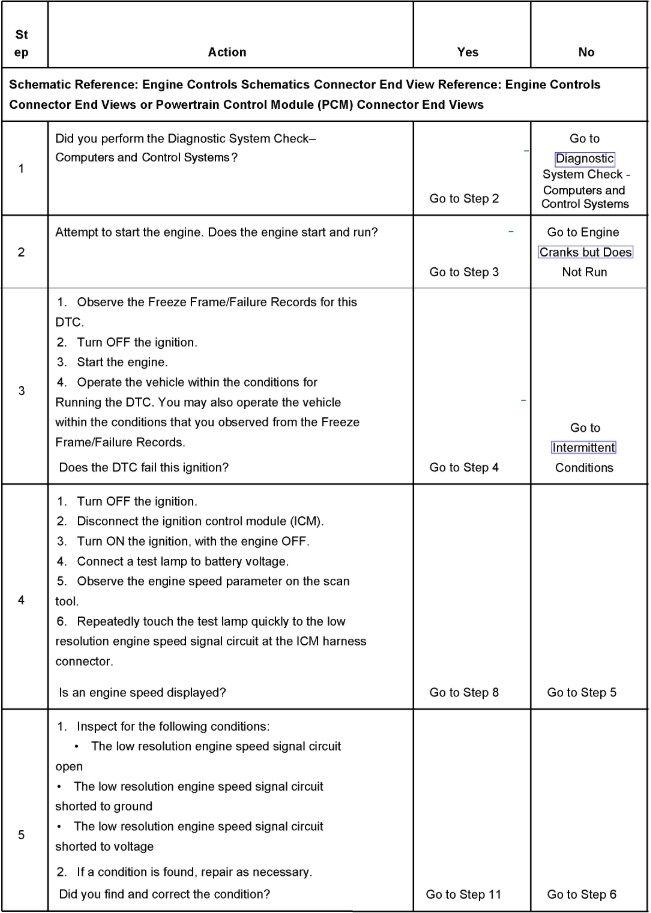
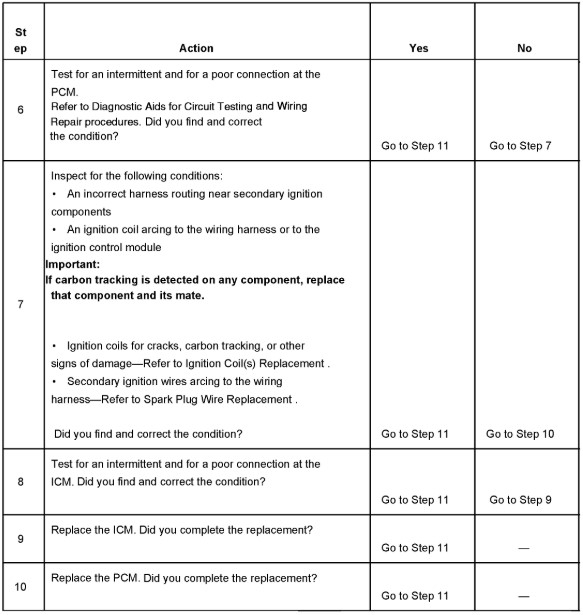
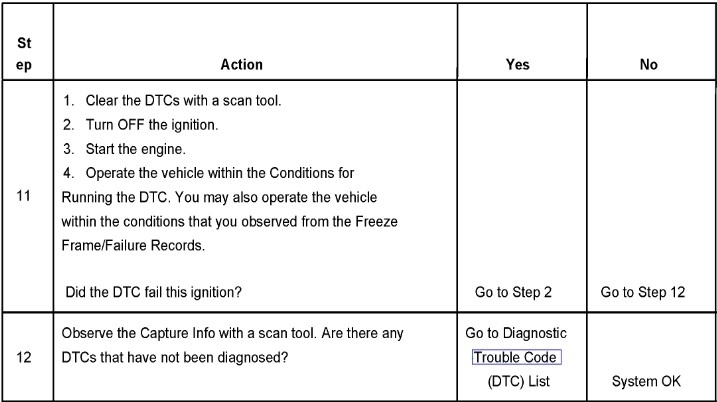
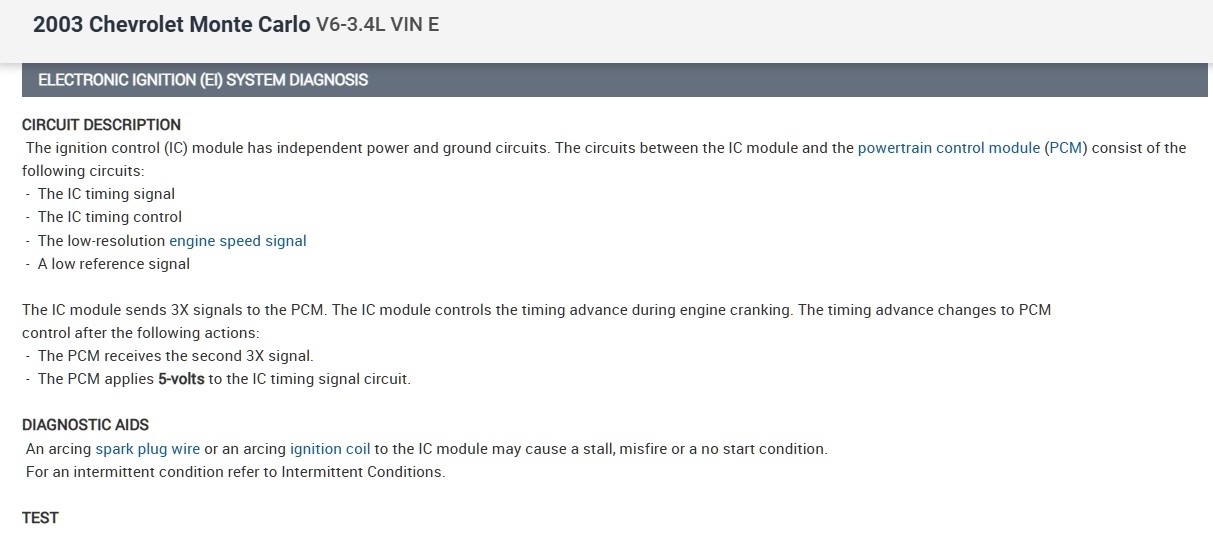
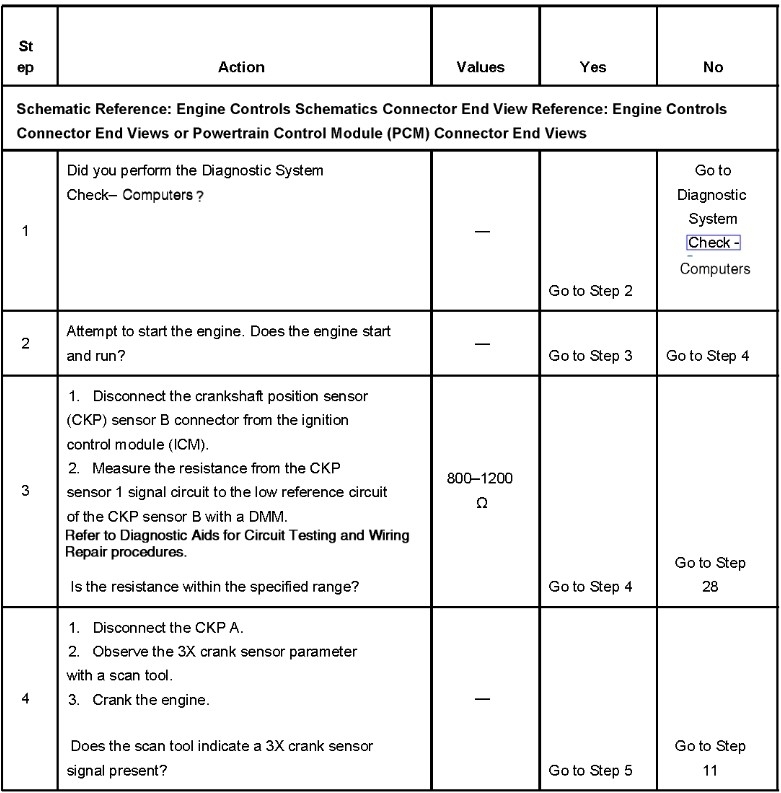
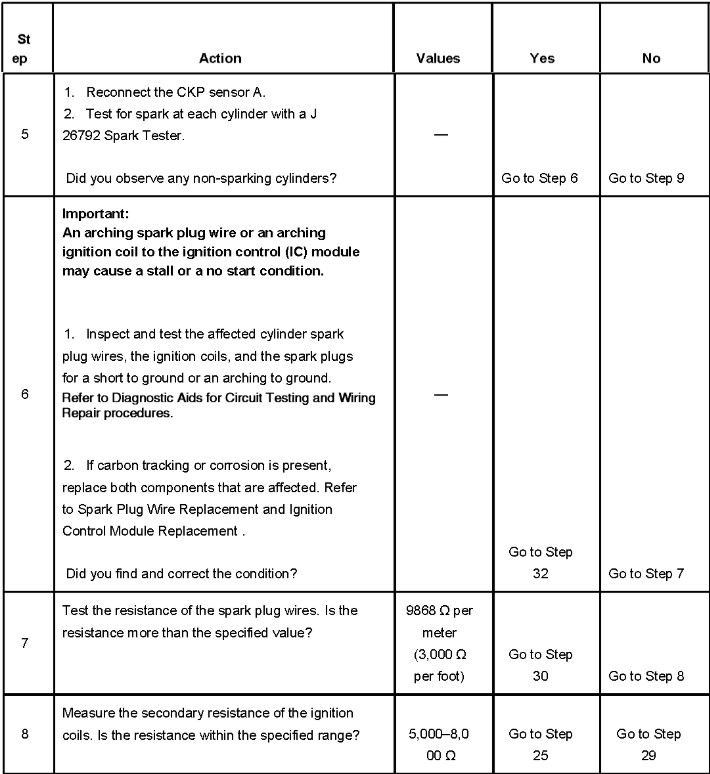
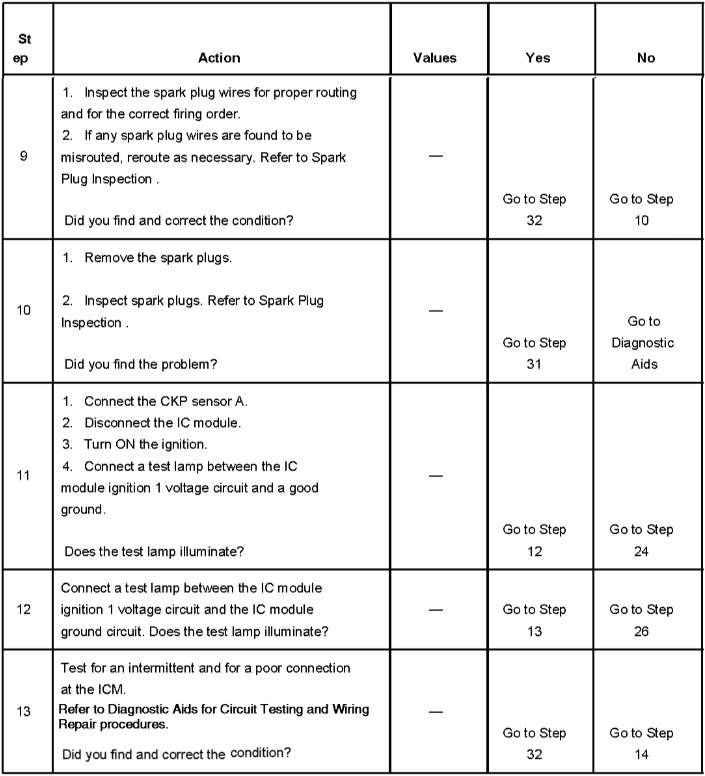
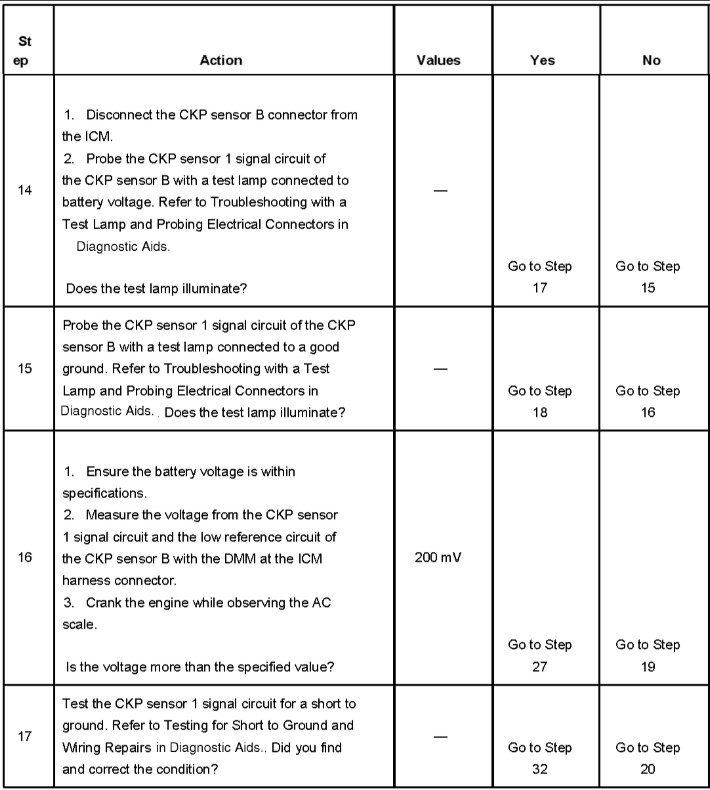
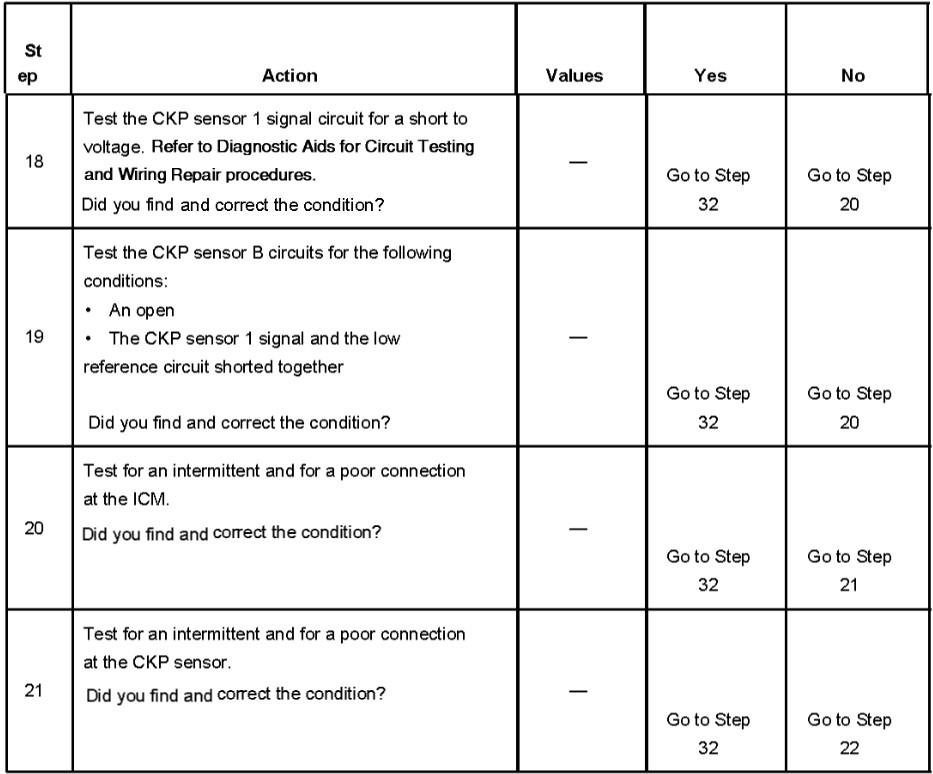
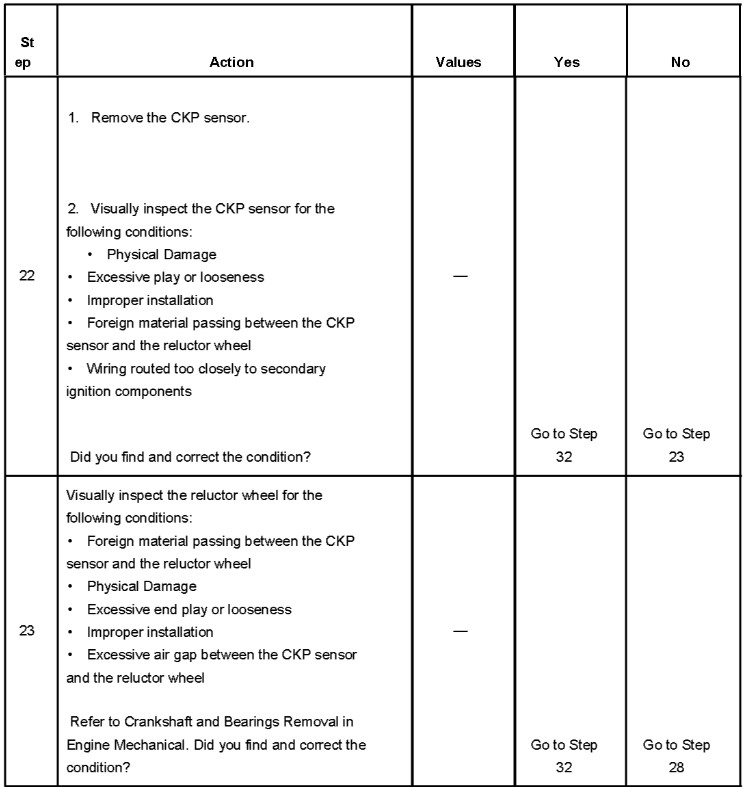
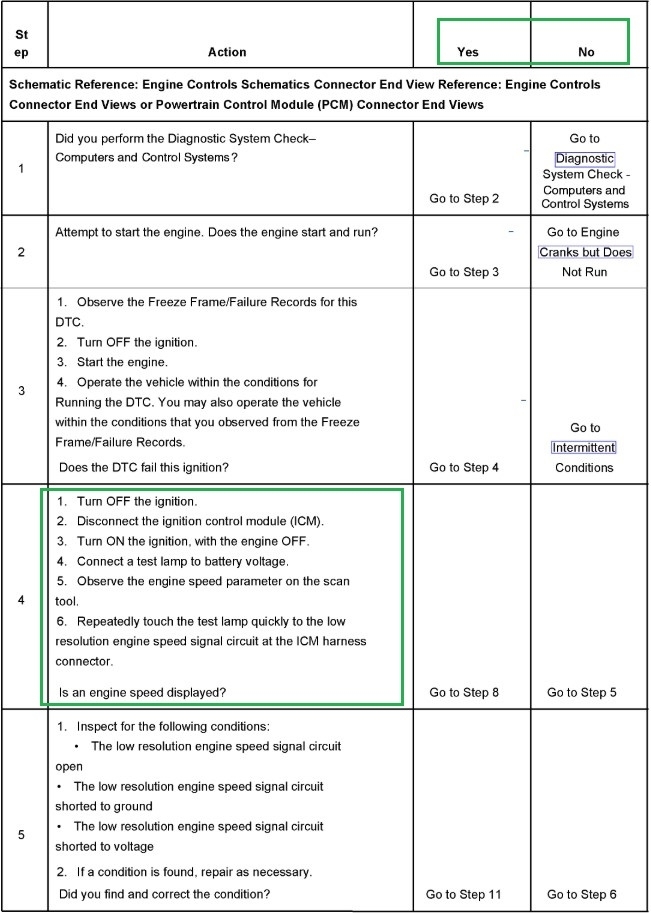
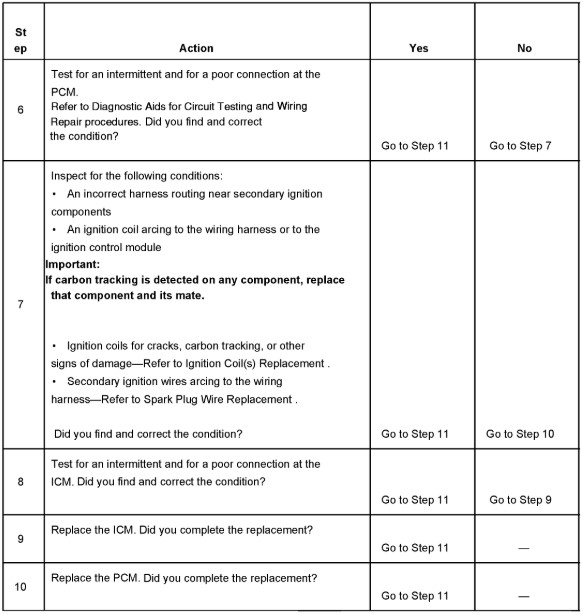
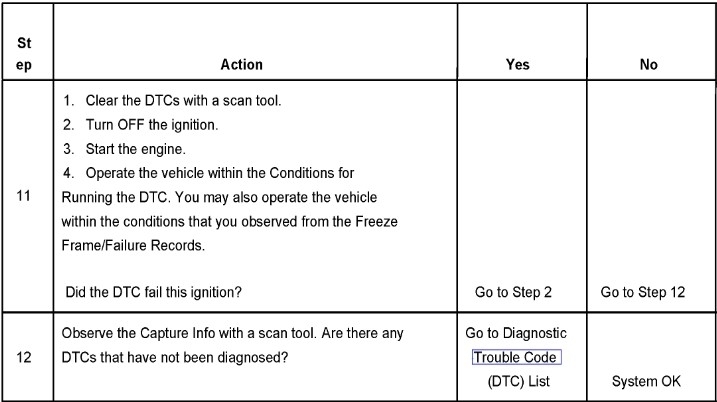
This is the flow chart for diagnosing the P1374 code. As for the sensors, they are hall effect sensors so they won't produce any ac voltage signals, they have a 12v reference feed and will produce an On/Off square-wave voltage signal. So I would make sure both the cam sensor and crank sensor have 12volts on the White/Black wire with the key On, check them using battery negative as your ground reference, and also with the key Off, you can unplug the crank sensor and the ICM, then make sure that both of the signal wires have continuity from the sensor to the ICM, so the Yellow wire and the LtBlue/White wire, and also that they are not shorted to ground. You should read less than 5 Ohms between the sensor and ICM on each wire. Thats the spec service info gives when checking wires, these do not have any connectors between the sensors and ICM either. You can do the same test with the cam sensor.
Being hall effect sensors, you may see a dim flashing of a test light on the two crank sensor signals when cranking the engine since it is a slower rpm, but if you're missing the 12v on the Pink wire, check the fuse first, these wiring diagrams are not always exactly correct, even the OEM ones. So it might be that the power for the coils doesn't come directly from the pink wire as the diagram shows, it might be provided through the ICM, which would explain why you are seeing an rpm signal. If you're using the manufacturers side of the scan tool, try switching over to the global OBD2 generic side and see if you still have an rpm signal.
Was this
answer
helpful?
Yes
No
Thursday, March 20th, 2025 AT 11:48 AM

Tiny
BRUCEDUNCAN
  • MEMBER
  • 29 POSTS
My crank sensor signal wires produced ac voltage; the Haynes repair manual says the crank sensor gets 10 volts from the ICM not 12 volts as you stated. I checked at the crank sensor and I have 10 volts while cranking.
I unplugged the crank sensor and the ICM harness and checked the 18x and 3x for continuity. I had.1 ohms resistance. Full continuity.
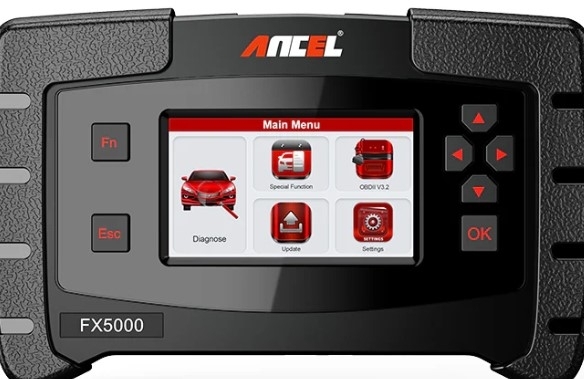
I loaded the ICM harness pink wire terminal and ground terminal k with a test light and measured over 12 volts. All my fuses are good. My ICM and crank sensor plugs are clean with no signs shorting. I have an aftermarket scan tool an Ancel 5000.
I was told turning the crank by hand and measuring the dc volts on the signal wires should be o volts off and 5 to 7 volts on. I may or may not do this test. I will probably check the crank sensor ac signal voltages going out of the ICM towards the PCM. There is a plug on top of the intake manifold I can take a reading. Can I take a dc volt reading or a hz reading on the output side. If I can what are the proper voltages? I got ac output voltage specs on www. Autocodes. Com but I got a different answer and specs on several occasions on this site.
The site also said I should have 12 volts on the coil primary + male spade terminal where the coil plugs in key on engine off. You said you would check on this, please let me know. If it's true my ICM is bad. I have less than 1 volt. My ICM has no triggering at all.
The ICM pink wire pin p shows on your diagram shows a direct route to the coils. It doesn't show the internal workings of the ICM. I don't know if the ICM sends voltage to the coil + terminal upon cranking or if it's hot key on engine off. If it's supposed to have 12 volts key on engine off my diagnosis is over.
In the meantime, I will unplug the ICM harness and check the crank and cam sensor for continuity to ground. I will hook up my ohmmeter to battery ground and the unconnected ICM harness sensor wires. Is this right? I can also hook up my test light to battery + post and probe the unconnected ICM harness sensor wires. If the test light lights I have a short to ground because the ICM grounds the sensors. Is this right?
You guys have been great. I really appreciate your help. Bruce Duncan
Was this
answer
helpful?
Yes
No
Thursday, March 20th, 2025 AT 4:55 PM
Tiny
BRUCEDUNCAN
  • MEMBER
  • 29 POSTS
Hi, Bruce, here, I loaded a photo of the ICM for my car. You can see the coil primary + and - male spade terminals I was checking. I included crank sensor signal input to ICM and output to PCM I got off www. Autocodes. Com do they look accurate for my car?
I look forward to finding out if the ICM primary positive terminal should have 12 volts key on engine off. Thanks a bunch. Bruce Duncan
Was this
answer
helpful?
Yes
No
Friday, March 21st, 2025 AT 4:28 PM
Tiny
AL514
  • MECHANIC
  • 5,499 POSTS
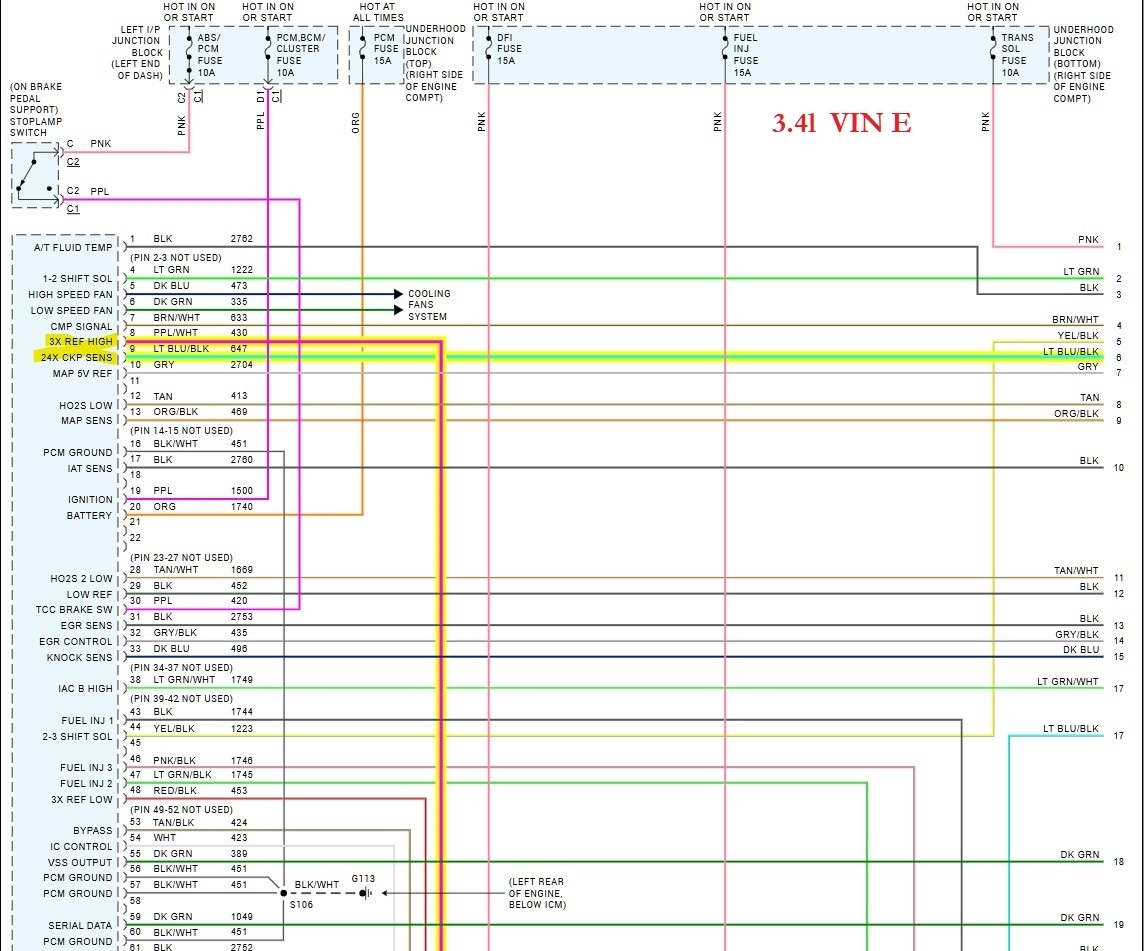
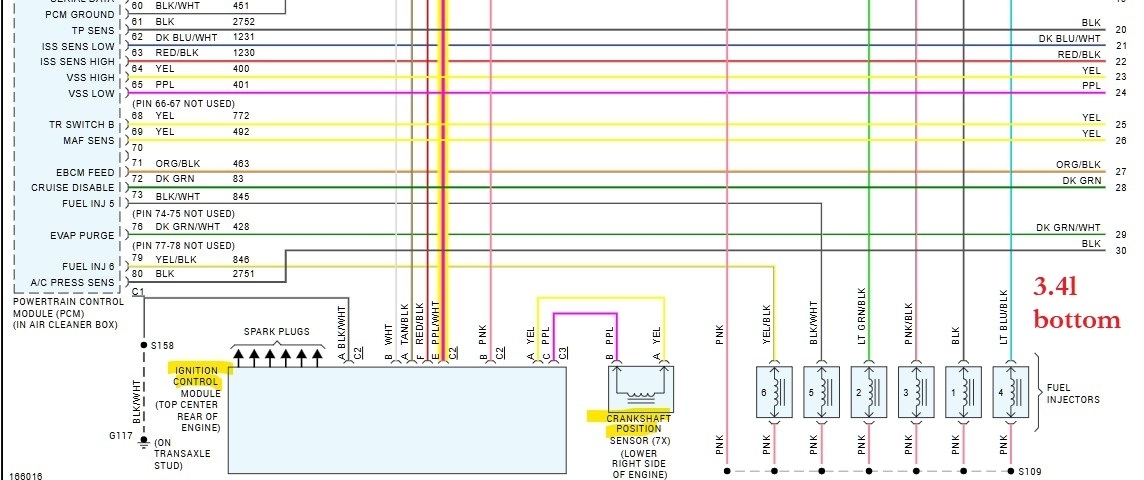
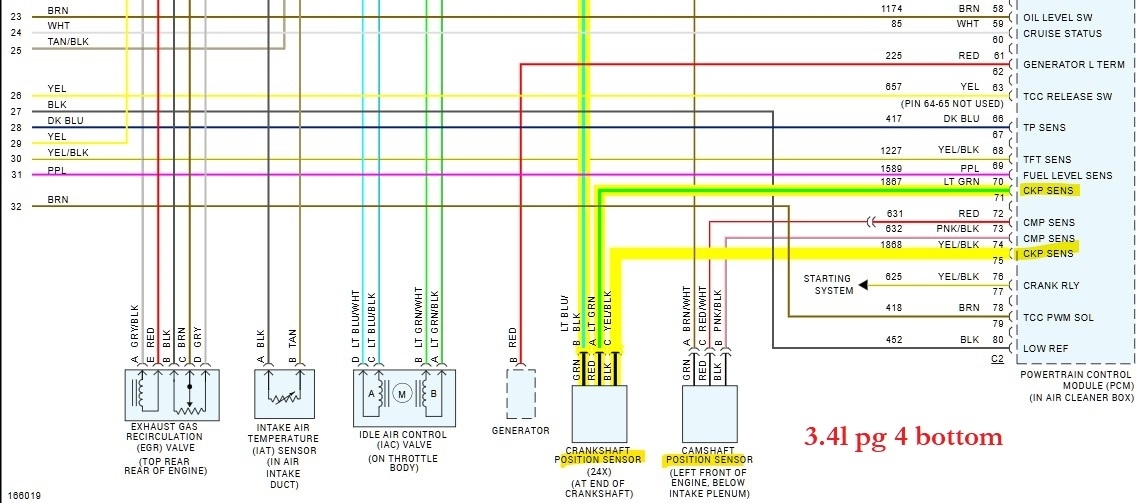
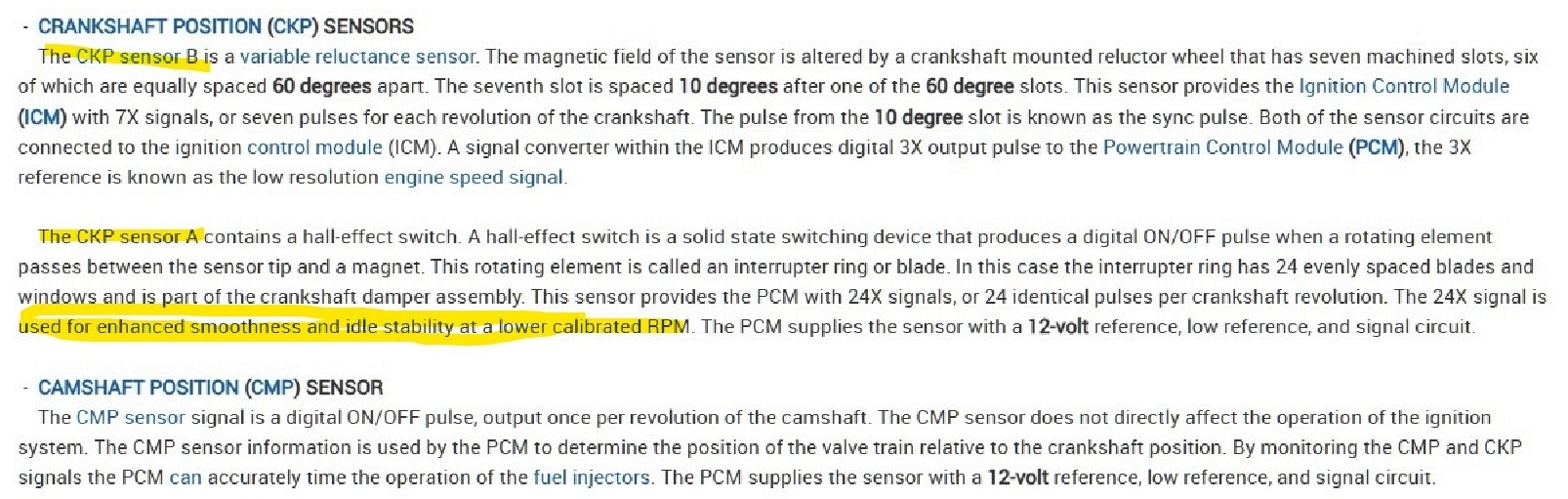
Okay, the differences I see in service info from All Data are the 3.4liter (VIN E) has a 2 wire crank sensor (7x) which is an inductive type crank sensor which would produce a lower voltage AC sinewave type of signal in which the voltage levels would be lower at idle but rise at higher rpms, but is also showing a 2nd crank sensor in the OEM wiring diagrams which is a 3 wire Hall effect sensor (24x) listed as "At end of crankshaft".

The 3.8liter (VIN K) has 4 wire hall effect type crank sensor. So, one of these service info sources is incorrect, the 3.4liter wiring diagrams are not showing any internal wiring of the ignition module circuits. It does show the same pink wire powering the module at Key On.
If it's a 3.4liter there is going to be another 3-wire crank sensor.

Both systems generate a 3x signal from the ICM to the PCM, you can check if the 8th VIN is a K or E, but it sounds like you have a 2 wire crank sensor, and the other crank sensor will be either near the front of the crankshaft near the harmonic balancer or at the rear near the flex plate.

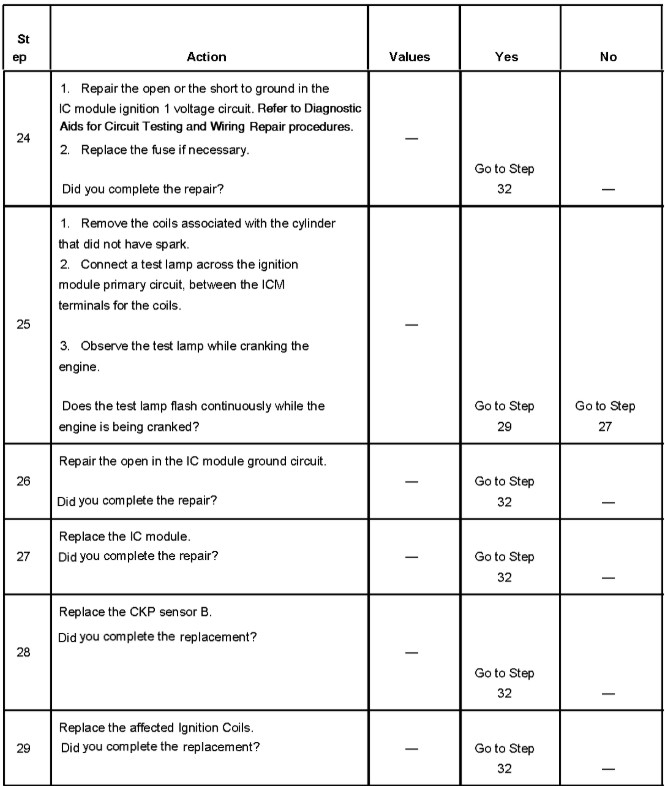
To answer your question about the voltage level with the coil removed, to shortcut this, the flow chart for the 3.4L says to remove the coil in question, and put a test light across the two terminals for the removed coil and observe the test light while cranking, it should flash indicating coil power and control, I know this doesn't answer your question on power at the coil with just the key On, but it will test the module. I'll post this flowchart section for you as well and you can go through it. These modules are known for failing, but having a correct crank sensor input is also needed.
The flow chart has you disconnect crank sensor A and B at different sections of testing, so I'll put up the wiring diagrams for the 3.4liter as well.
Was this
answer
helpful?
Yes
No
Sunday, March 23rd, 2025 AT 7:04 PM
Tiny
AL514
  • MECHANIC
  • 5,499 POSTS
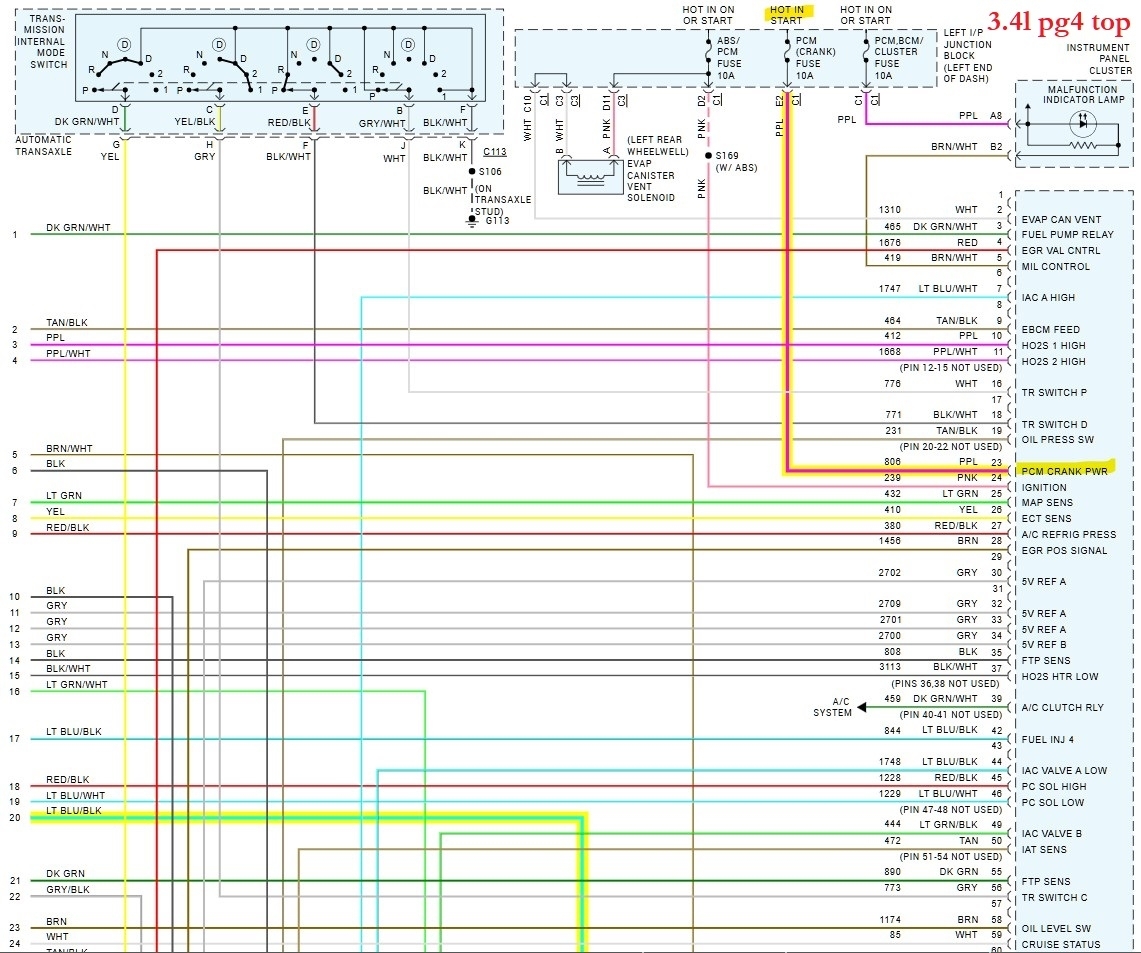
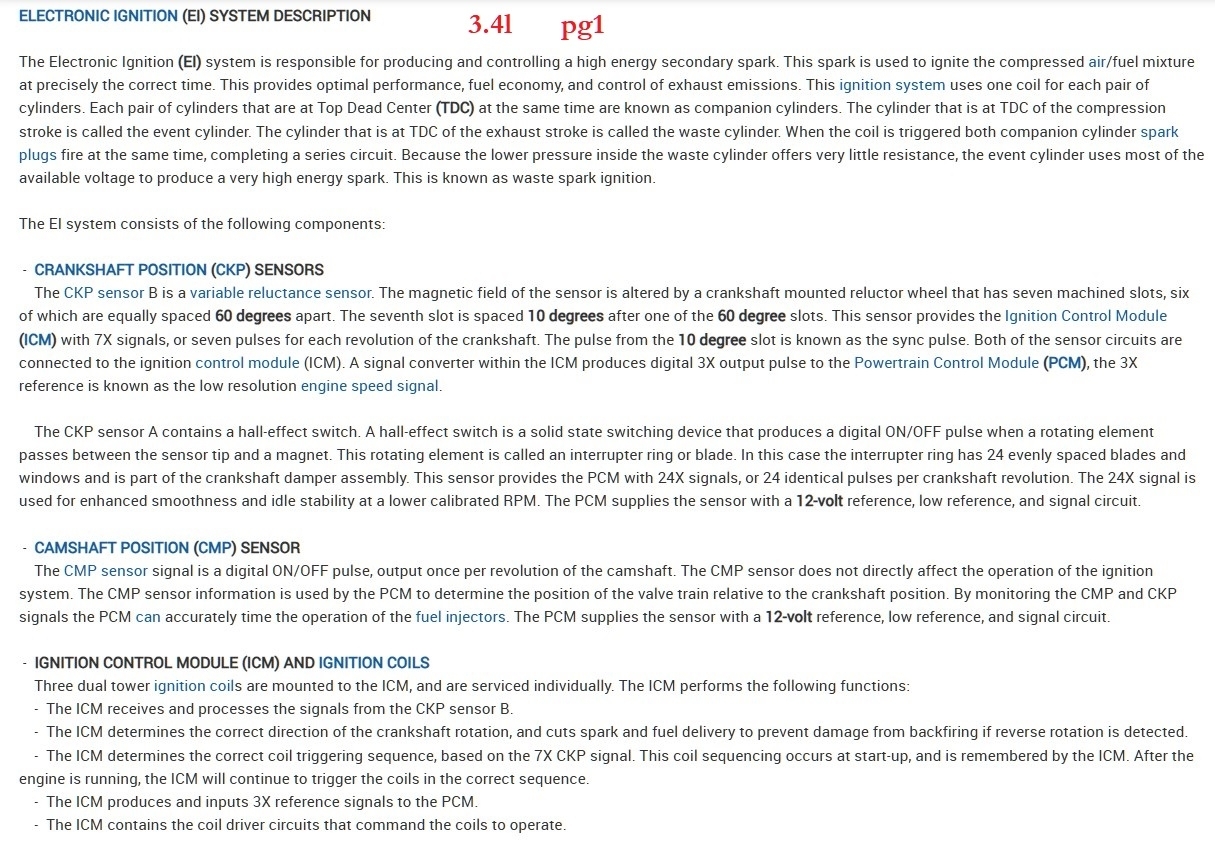
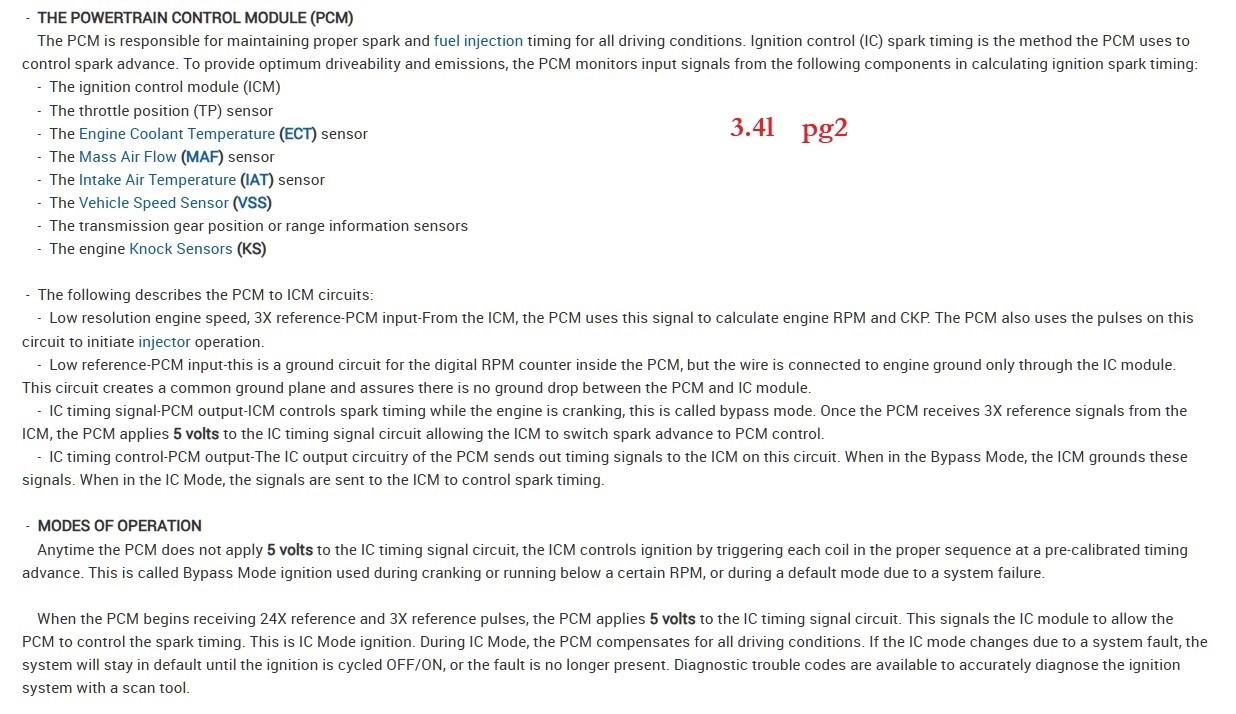
Heres the aftermarket and OEM wiring diagrams (1-5) for the 3.4liter, the Ignition system operations (6, 7) and the ICM flow chart testing.
Was this
answer
helpful?
Yes
No
Sunday, March 23rd, 2025 AT 7:51 PM
Tiny
AL514
  • MECHANIC
  • 5,499 POSTS
These are the wiring diagrams from the 3.8liter service info, they list the 18x signal, I have seen All Data info be incorrect before, these diagrams show a 4 wire crank sensor being a hall effect sensor, but reviewing your posts, the code that is setting (P1374) is the PCM detecting the incorrect number of 3x pulses, and that 3x pulse comes from the ICM. From your checks already, if you have a 2-wire crank sensor, then there is supposed to be a second 3 wire crank sensor as well.

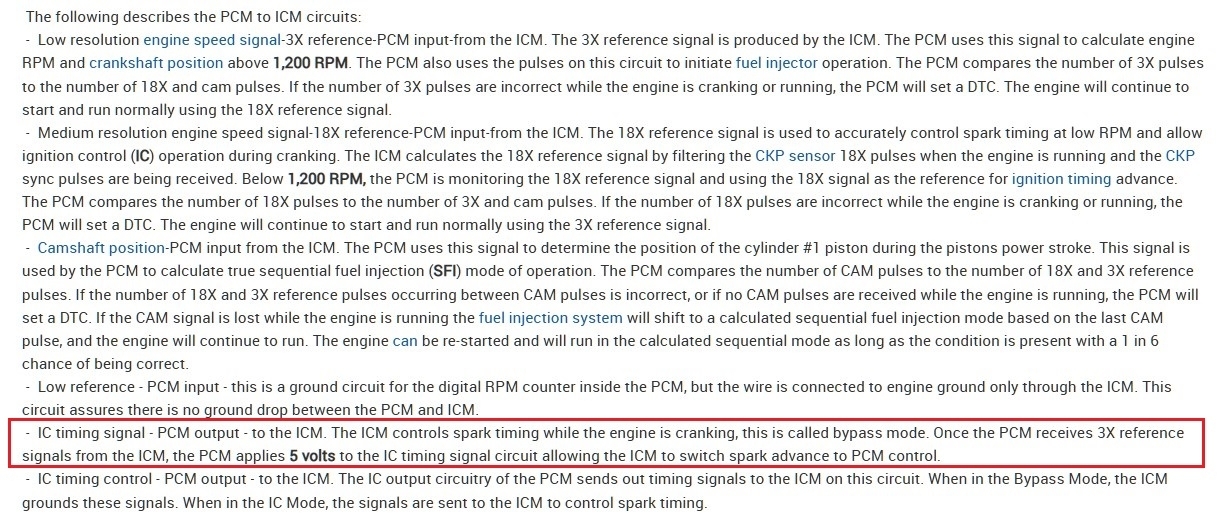
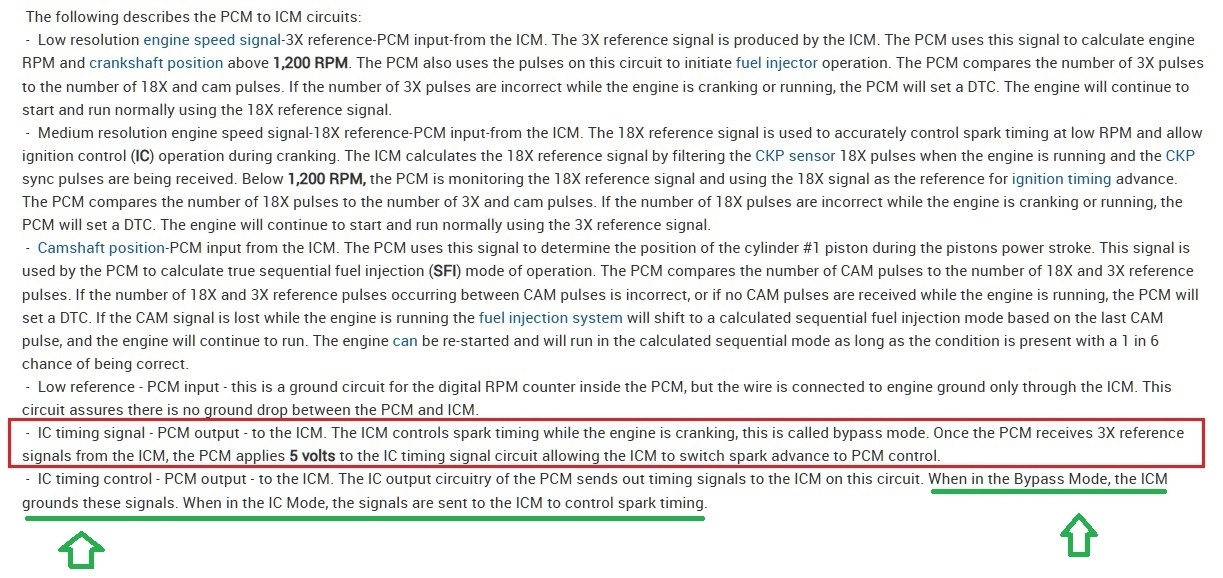
You mentioned there being a 3x RPM signal on the scan tool, once the 3x signal is detected by the PCM during cranking, it says the PCM should send out a 5volts switching IC control over to the PCM, with it outputting the timing control to the ICM instead of the ICM controlling timing.
The circuit description also states the engine will continue to start and run using the 18x reference and camshaft position PCM input signals alone. So, the fact that you're at a no spark condition but seem to have a 3x RPM signal sounds like the ICM is just not triggering the coils. I've posted the different operations for the two crank sensor setup (diagram 4) below. Each systems works on two "X" signals whether they are two crank sensors or just one, it seems like you have a 3.8 that doesn't have the 4 wire crank sensor if I'm understanding you correctly.
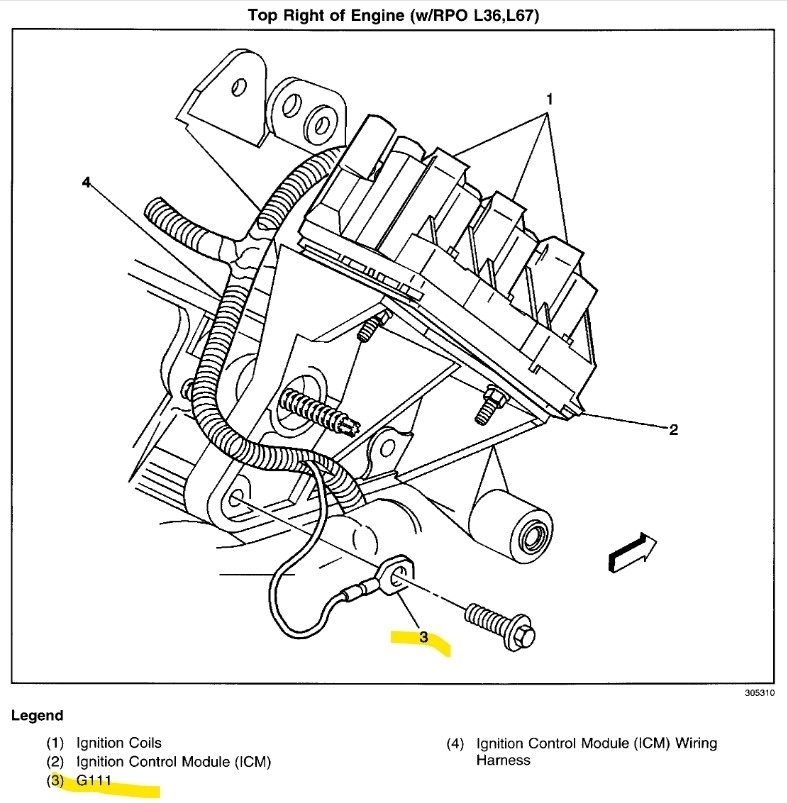
You could try getting a used ICM to see if that is the fault, I assume using a test light substituted in as a coil method during cranking will not produce a signal. Youve done a lot of testing already, but you're correct on checking the sensors wiring for a short to ground. I would check it with the meter set to ohms, you shouldn't have continuity to ground with everything unplugged. Check both the 3x and 18x circuits with the ICM and PCM unplugged so both are insolated from everything. I would also verify the ICM's ground wire as well if you haven't already. Read some of the info on the bottom of the 5th diagram about the IC timing signal.
Was this
answer
helpful?
Yes
No
Sunday, March 23rd, 2025 AT 10:30 PM
Tiny
BRUCEDUNCAN
  • MEMBER
  • 29 POSTS
I have a 3.8 ltr engine with a 4-wire crank sensor.
Was this
answer
helpful?
Yes
No
-1
Monday, March 24th, 2025 AT 9:34 AM
Tiny
BRUCEDUNCAN
  • MEMBER
  • 29 POSTS
Today is March 24, year 2003 monte carlo ss 3.8 ltr. Engine 4 wire crank sensor. I wasted 2 hours of typing today and the other day. Your site didn't record my last diagnostic information, and today my computer switched screens for no reason. I will try it again.
I disconnected the icm harness and have no shorts to ground on any cam or crank sensor wires. The red/black stripe 3x lo ground wire from icm to pcm ground has.1 ohms resistance. Good ground. The tan/black stripe bypass control wire has 5.5 to 6 volts while cranking measured at the icm harness. Www. Autocodes. Com said it shoud be 5 volts while cranking. This might prove the pcm should be getting power on the pink (ignition) wire from the fuse box. My diagram says fuse 12.
I wish you could have found out the icm coil primary spade + voltage key on engine off but it is what it is I have no triggering or spark.
I made a discovery yesterday while cranking I saw on my scan tool I have no cmp signal while cranking. I am assuming cmp is camshaft position sensor signal. No trouble codes were set while cranking. So now I have a whole new problem to diagnose. I will get back to you on this. Bruce, thanks.
Was this
answer
helpful?
Yes
No
Monday, March 24th, 2025 AT 2:33 PM

Tiny
AL514
  • MECHANIC
  • 5,499 POSTS
Sorry to hear about the PC/site glitch. But the 4-wire crank sensor is the hall effect sensor, it should output 2 square wave (on/off) signals, either 12 or 5 volts. The cam sensor is the same, it has a 12volt reference feed that comes from the ICM, so note that. It will also produce an on/off signal the same as the crank sensor. The Tan/Black wire is labelled as the IC timing Signal, and the White wire is labelled ID timing control. I agree the pink wire is most likely powered up, but you may want to verify it receiving a full 12volts. I would also check that the cam sensor is receiving 12volts on the White/Black wire, same wire that powers the crank sensor. Those are the first two checks to do.
And for checking the coil terminals, remove one coil and put a test light across it and crank the engine. Also check it using battery negative as ground. That will tell you if power is being applied to the coils. The ICM provides power to pretty much everything having to do with the ignition, the PCM uses the cam sensor mostly for injector timing, but I think a few power checks here will tell you if the ICM is bad or not. If power is missing right at the ICM connector for either the cam/crank sensors, unplug one of those sensors and retest, just to verify one of those sensors isn't pulling the 12v reference down. If the results are the same, plug the sensor back in and unplug the other one, retest for power.
You only need a back probing pin and test light at the ICM connector to do almost all these checks.
I'd run through the ICM power and ground checks, if they are ok, they make sure there is 12v going out to the cam/crank sensors. Don't over think the process, the cam sensor is included in this code setting criteria, even with a multimeter you should see an average voltage of the cam sensor's signal while cranking. If the code is still in memory, clear it out as well. The PCM might not set another code if the P1374 is still set.

If the ICM is not sending out power to those sensors, and you have tried unplugging one at a time, then you know the ICM is faulty.
Its the same as if the 5volt reference, that other sensors, use was being pulled to ground by a bad sensor, except here it's a 12volt reference. Same idea.
Here are the diagrams again for the 3.8 with the 4-wire crank sensor and cam sensor wiring.
Was this
answer
helpful?
Yes
No
Tuesday, March 25th, 2025 AT 12:20 PM
Tiny
BRUCEDUNCAN
  • MEMBER
  • 29 POSTS
Today is March 25. The cam and crank sensors get 10 volts from the ICM for a 3.8 ltr. Engine according to Haynes repair manual not 12. I have 10 volts cranking at my crank sensor. I already gave you my triggering test results they failed no triggering. I all ready gave you my ICM power and ground specs they passed.
As previously stated, I have no CMP signal while cranking on my scan tool. Here are my test results.
The camshaft sensor signal wire black, from ICM to PCM, was.1 to.2 ohms resistance I disconnected the PCM and probed the harness, so the wire isn't broken and has good continuity to the PCM. I turned the crank by hand three 360-degree rotations plus about 180 degrees more to see 1 on off signal from the cam sensor, 0 volts to 4.9 volts. I grounded to the battery post - and then to cam sensor ground at the ICM and got the same readings. The Haynes manual said I should see approximately 10 volts. I took a reading at the PCM (harness disconnected) and got o volts off, 5 volts on while turning 2 360-degree rotations I got one on off reading. What do you think about the 5 volt reading specs? The PCM is getting an on off signal from the ICM cam signal wire, but the scan tool says no signal.
I am going to check a few more wires, and I will get back to you. Bruce
Was this
answer
helpful?
Yes
No
Tuesday, March 25th, 2025 AT 3:43 PM
Tiny
BRUCEDUNCAN
  • MEMBER
  • 29 POSTS
I just contacted www. Autocodes. Com and he said I should have 5 volts on the cam sensor ICM output to the PCM, black wire. My question to you now is why does my scan tool show no CMP signal when cranking?
Was this
answer
helpful?
Yes
No
Tuesday, March 25th, 2025 AT 5:04 PM
Tiny
AL514
  • MECHANIC
  • 5,499 POSTS
I would think All Data is more accurate than Haynes repair manuals, that manual gave the incorrect voltage readings from the beginning. So, for your triggering test you put a test light in place of a coil? Many hall effect sensors use a 12v feed and can output 12v or 5v signal, so I'm okay with a 5volt signal, You may want to invest in a scope, even just a 2 channel little scope to monitor signals if you're going to be repairing your own vehicles, it would really help determine if these signals are good or not.
I don't know why your scan tool is not reading the cam signal. Is the code still set in the PCM? How many live data PIDs does that scan tool show for live engine data? And if the code is still set, I would clear it out while testing.
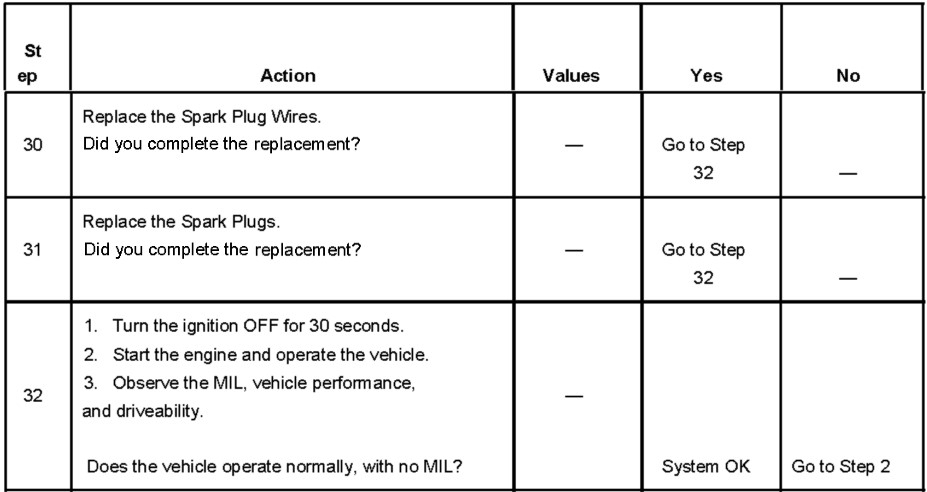
Did you go through the flow chart for this code, step 4 has you do a scratch test with a test light on the Low Resolution engine speed signal wire (circuit D, Purple/White wire) at the ICM, and watch for an rpm signal on the scan tool, if the wire is ok to the PCM, they have you replace the ICM. With the code cleared, it takes 2 consecutive ignition cycles to set the code again. Thats the direction service information wants you to take for this code. I can't tell you if the signals you're getting are good or not with a multimeter because we can't see them.
Was this
answer
helpful?
Yes
No
Wednesday, March 26th, 2025 AT 12:50 PM
Tiny
BRUCEDUNCAN
  • MEMBER
  • 29 POSTS
Today is march 26. The cam sensor should be getting power I got a 0 volts off 5 volts on at the pcm harness (disconnected) Black signal wire. I rotated the crank pulley by hand 2 complete 360 degree turns to get 1 on off reading.
I put a test light in place of all 3 coils and got no triggering while cranking. I put battery power to coil primary negative terminal on top of the icm where the coils plug in and got over a12 volt reading on all three coils so the grounds are good. I put a test light to battery + and coil primary - and the test light lit. I then cranked the engine and the light went out with no flickering hence no triggering. Autocodes. Com said the coil primary - terminal does the on off switching to control the spark. I tested all 3 coil primary ground with the same results. I asked autocodes. Com 10 times if the coil primary + terminal should have 12 volts key on engine off and was told yes every time, I have full power on the icm feed pink wire which powers up the coils. If I can believe autocodes. Com I should start with a new icm. Maybe you could check mitchell, alldata, or a dealer service site about the coil primary + voltage key on engine off situation. The icm is getting a signal from the crank and cam sensors the sensors are not open or dead.
There is no longer a code set in the pcm I unplugged the pcm harness.
I don't know what a live data PID is. I have various live data info. Crank sensor rpm, cmp signal yes or no, live sensor data and more. I all ready told you I don't understand flow charts. I am reading rpms from the 18x and 3x crank wires while cranking. I don't know what the scratch test will prove on the flow chart. My Haynes manual calls the low resolution engine speed signal on your diagram a 3x reference high, the purple/white stripe wire on both diagrams, terminal d at the icm harness. Fuel injection control outgoing from icm to pcm. I guess I should see rpm on my scan tool on the crank sensor 3x rpm guage.
The issue now is no cmp signal and no coil power or triggering.
Was this
answer
helpful?
Yes
No
Wednesday, March 26th, 2025 AT 3:09 PM
Tiny
AL514
  • MECHANIC
  • 5,499 POSTS
The flow chart tells you how to do the test, hook a test light to B+ and tap on and off the D wire of ICM, this should show an RPM signal on the scan tool, all you are doing is triggering and RPM signal to the PCM using a test light. Using a test light hooked to B+ protects from shorting anything out because the test light acts as a load in the circuit.
Regardless of if the coils have power on the ICM board with the key on, the ICM is not providing power when cranking anyway, Thats why you're putting the test light in place of a coil. The ICM should be providing power during cranking and also control the coil (test light) on the ground side. Coils are ground side switched. If the test light is not flashing during cranking no power is being applied. You said you have no ground side trigger either, back probe the D terminal of the ICM and tap the back probe with the test light to verify the PCM is seeing the RPM signal and reporting it on the scan tool. If you're reading the 18x and 3x already on your scan tool, I don't know what else you're trying to prove out, the ICM is obviously not controlling the coils. Check the resistance of each coil before replacing the ICM to make sure none of them are shorted out. They should all read the same resistance.
Was this
answer
helpful?
Yes
No
+1
Wednesday, March 26th, 2025 AT 3:44 PM
Tiny
BRUCEDUNCAN
  • MEMBER
  • 29 POSTS
Today is March 28. I will do the tap test. Today I checked the cam and crank sensor signal, power, and ground wires from the sensors to the icm (harness disconnected) for shorts to power, shorts to ground, shorts to adjacent wires. I have no shorts.
I did the same test from the icm to the pcm (pcm harness disconnected), (icm harness disconnected). I got the test procedures off of www. Autocodes. Com.
The pcm ground wire black/white stripe pin 60 I measured from the pcm harness to battery - post (harness disconnected) was.1 to.2 ohms. Good pcm ground. The cam sensor signal wire from the icm to the pcm black wire was.1 to.2 ohms resistance.
The 3x lo red/black stripe ground wire going from the icm to pcm was good.1 to.2 ohms. I need to check this wire from the icm harness to battery - post. It looks like the wire grounds through the pcm to battery - post. It might ground the cam sensor signal wire I am not sure can you check on that. I need to check for continuity Through the pcm. To eliminate why the scan tool has no cmp signal when cranking. The cam sensor black signal wire had an on off signal of 0 to 5 dc volts at the pcm but I grounded to pin 60, pcm ground not the 3x lo ground red/black stripe. Thanks Al. Bruce
Was this
answer
helpful?
Yes
No
+1
Friday, March 28th, 2025 AT 2:58 PM
Tiny
BRUCEDUNCAN
  • MEMBER
  • 29 POSTS
I just contacted www. Autocodes. Com and he said the black cam signal wire going into the PCM is grounded through the PCM ground pin 60 black/white stripe going to battery ground. Not the 3x lo ground wire red/black stripe.
Was this
answer
helpful?
Yes
No
Friday, March 28th, 2025 AT 4:16 PM
Tiny
AL514
  • MECHANIC
  • 5,499 POSTS
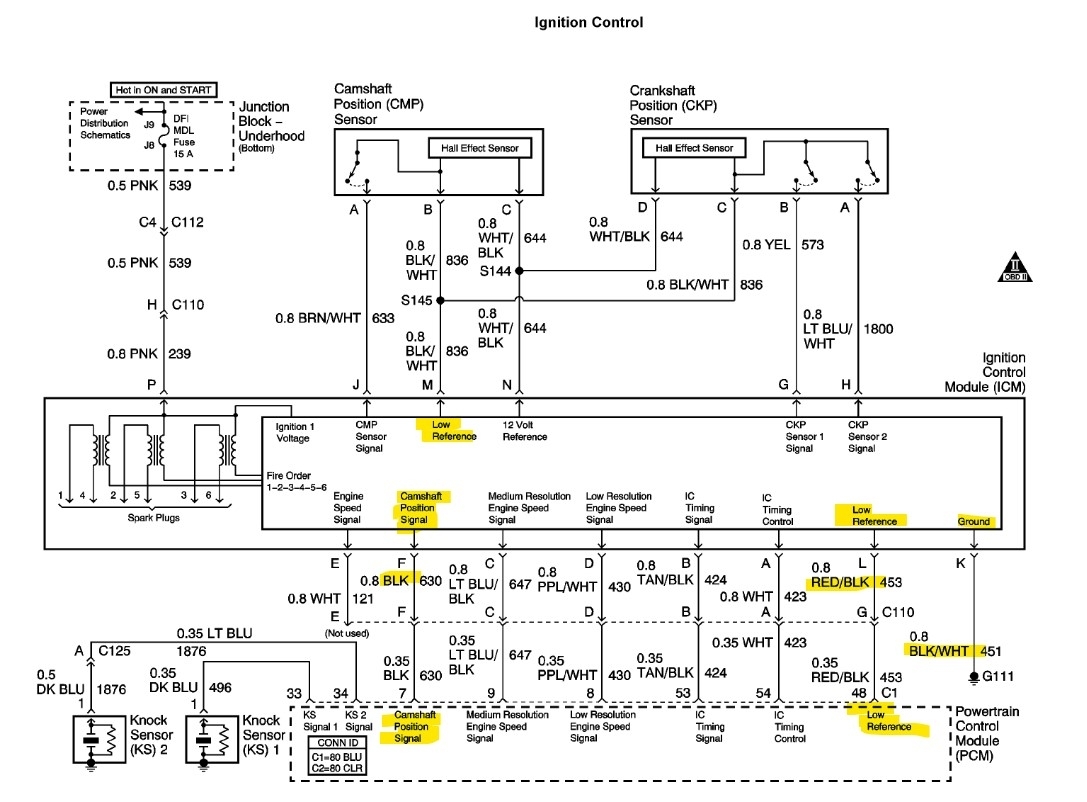
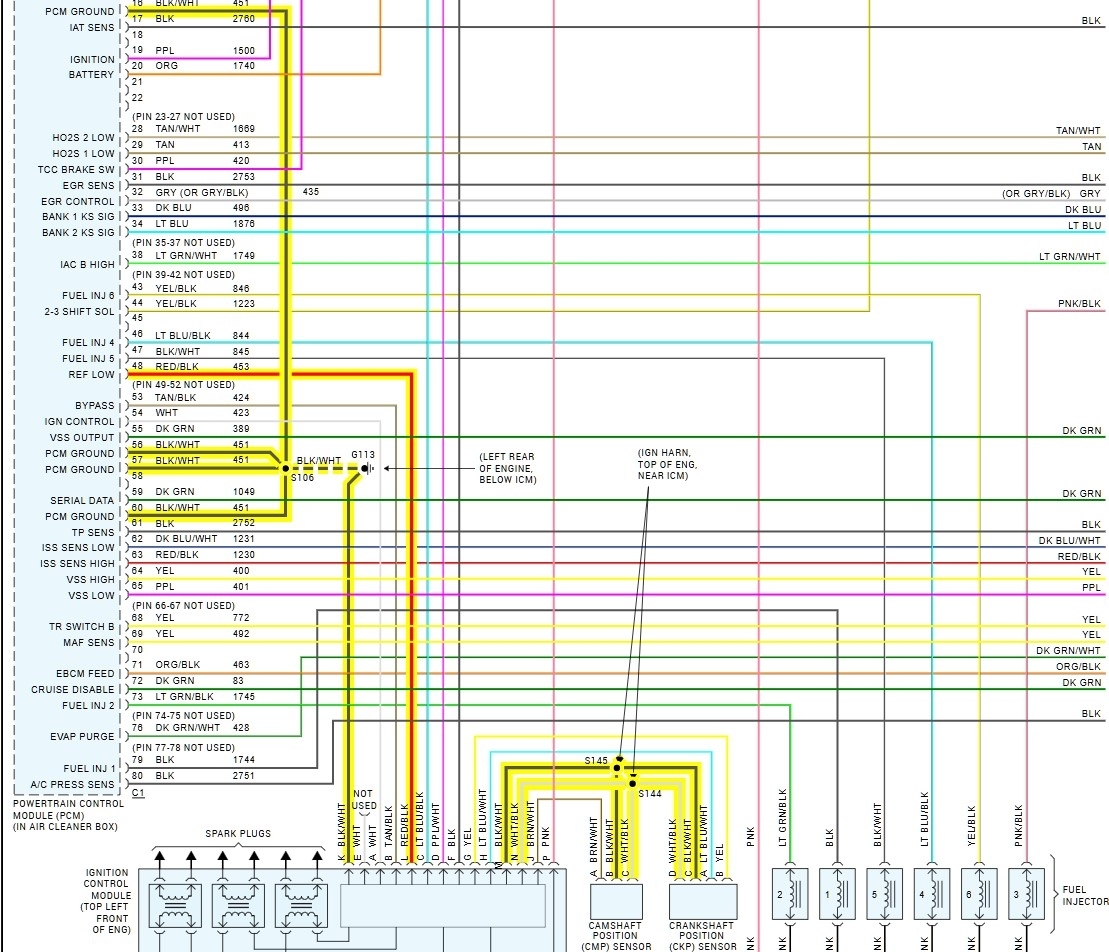
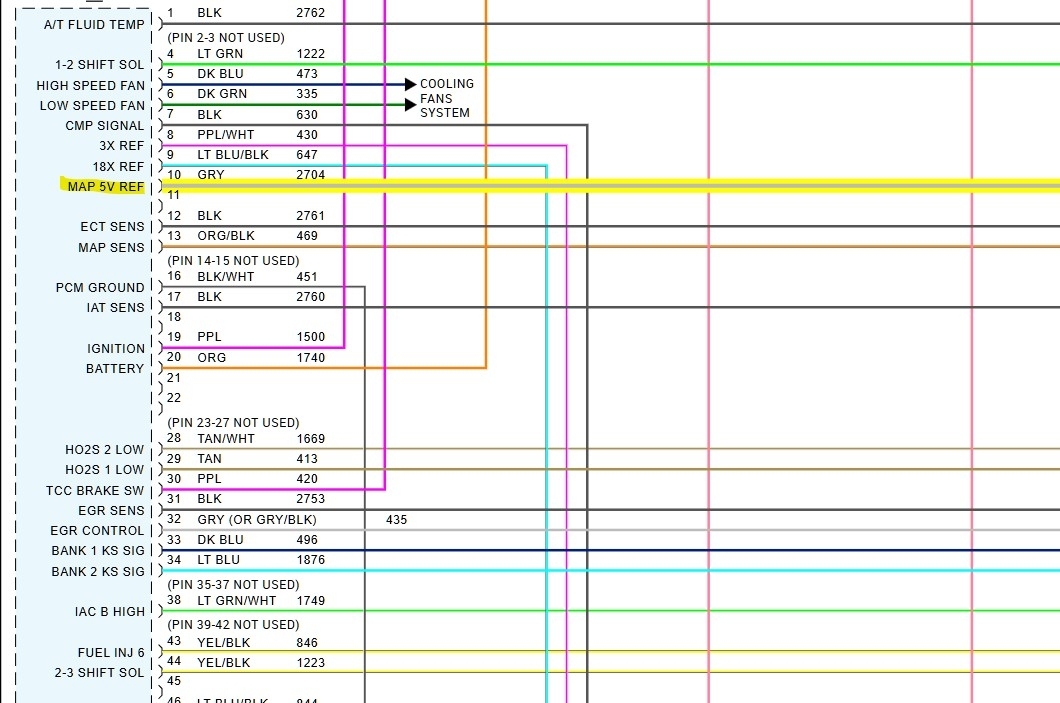
Here are the ICM Low Reference and cam signal, as well as the PCM grounds. The cam and crank sensors share a ground and reference voltage.
Was this
answer
helpful?
Yes
No
+1
Friday, March 28th, 2025 AT 5:25 PM
Tiny
BRUCEDUNCAN
  • MEMBER
  • 29 POSTS
Today is April 1, 2025. Hi Al I did the tap test on step 4 of the flow chart. Low resolution engine speed signal. I am glad I checked your diagram my haynes manual diagram doesn't even describe the circuit accurately. It says the purple/white wire is a 3x reference high. Your diagram calls it a low resolution engine speed signal. I accidentally went to the 3x reference low on red/black stripe wire and got no rpms. So I checked your diagram and redid the test. As I tapped the low resolution engine speed wire (Purple/white stripe) I got readings all over the place from 122 rpms up to 42,228 rpms and jumping around in between. The flow chart said to go to step 8 which is checking for a poor or intermittent connection at the icm. My icm harness is clean and shows no pin damage. I got output readings dc volts, at the pcm (harness disconnected) of my crank sensor 18x wire (light blue/black stripe) of 0 volts off 5 to 6 volts on. I saw a steady on off signal nothing intermittent. I hand cranked the engine for this test. I then switched to ac volts and got a funny reading of 0 volts to 2.5 volts ac switching so fast it didn't even look like an on off signal.
My 18x ac volts reading at the icm (sensor to icm) terminal g yellow wire which I checked in the past while turning over with the starter motor was 3.5 ac volts. You said previously my multimeter is too slow to read this signal.
I checked my crank sensor 3x wire at the pcm, pcm harness disconnected (purple/white stripe) my haynes book calls it a 3x reference high signal your diagram calls it a low resolution engine speed signal. I got a steady 5 volt reading no switching at all. What does this mean? I cranked the engine by hand probably 5 360 degree crank pulley revolutions.
I measured the 3x wire from the crank sensor to the icm, hand cranking blue/white wire terminal h. And got 0 volts off 6.5 volts on dc volts. I saw nothing intermittent. I checked in the past and got a reading with ac volts while cranking with the starter and got 1.7 to 2.8 ac volts at terminal h 3x (crank to icm). I may or may not check my 18x and 3x ac voltage outputs from the icm to the pcm.
My next concern is not getting a cam signal while cranking on my scan tool.
My cam signal black wire at the pcm (harness connected) cranking with the starter motor was dc volts off 2.5 to 3 volts on 5 volts. Should the cam sensor read 0 volts when off? Is my snap-on multimeter too slow to read proper off voltage or do you think there is something wrong with the icm. If I am correct the cam sensor has an on off signal every two 360 degree crank pulley revolutions. I would think my multimeter would pick it up but it might be too slow what do you think? My fuel pump relay is unplugged I wouldn't think that would affect anything but maybe I should plug it in and redo the test. I was told the cam sensor black wire feeds the pcm for fuel timing at the injectors.
What do you think we should do or test about not getting a cam sensor signal on the scan tool? As previously stated the pcm has good ground pin 60 black/white wire.1 to.2 ohms to the battery - post. Back when my car was running I had a cam sensor signal.
Thanks, Bruce
Was this
answer
helpful?
Yes
No
Tuesday, April 1st, 2025 AT 6:09 PM

Please login or register to post a reply.