I'm going to tell you more than I know. Moisture-proof heat-shrink tubing is designed to be used on cars, and it is expected to be in the vicinity of leaking gas, oil, and coolant, so it has to be compatible with those products. We know it's okay to solder splices inside the gas tank because wires are usually soldered to the sending unit. (Some are just crimped or riveted).
The same holds true for the tubes I mentioned with the ring of solder inside. A number of people have been very happy using them, but I like to see the solder flow smoothly into the joint, so I'm not that comfortable using them yet. Also, it is a sign of good soldering techniques to make a strong, solid mechanical connection between two or more wires, THEN you make the good electrical connection with the solder. We're not making that mechanical connection first with those tubes.
Here's something totally different you might consider. Once the splices are soldered, seal them with a small ball of Silicone Gasket Sealer. Many years ago, my mother hit a large chunk of scrap metal in the highway with her '88 Grand Caravan. It tore off the rear heater and AC lines, and punched a 3" x 4" hole in the front of the gas tank. Hours later, I was able to drive it a mile at a time to leap-frog it home, with time to cool down as I walked back to get my car. After a few miles of that, I sanded the tank around the hole, then completely enclosed it by building up layers of Chrysler's black gasket sealer. Never smelled gas from then on. Once at home, it was going to take many days to get a new tank, so for a temporary patch, I covered the vulnerable gasket sealer with a sheet of very thin tin, then, to keep that from corroding, I added another layer of gasket sealer. That patch became hard as a rock over time, and that "temporary" repair lasted over 30 years until the tank rusted out on top.
At that time Chrysler offered two types of gasket sealer. That black stuff that I used cures more rubbery, and it will not bond and seal through any film of gas or oil. It has to be applied to clean, dry surfaces. Once it's in place and the parts are assembled, it can come in contact with any liquids, even before it cures. It's commonly used for valve cover gaskets. They also have a gray sealer that cures harder. It will bond through a light film of oil in case you overlooked it. It's also harder to remove next time compared to the black stuff. They may have other versions of that now, and there are plenty of similar products from other suppliers. I mainly mention Chrysler's products because I'm very familiar with them.
By the way, I've used those sealers in my other career, in sealing arcing high voltage transformers in TVs. Even repaired the arcing high voltage transformer in one of my alignment computers.
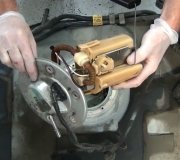
Inside your gas tank, you can use these sealers as a glue too. For example, if one of the wires has a chance of dragging along the float arm and preventing it from moving freely, use a rubber band, tape, or anything else to hold the wire out of the way, then add a spot of sealer to hold it there. In this case you'll want to wait for it to cure so it stays where you want it. Both of these begin to skin over within about 20 minutes, but give them a couple of hours to fully harden.
Wednesday, September 10th, 2025 AT 3:08 PM