Engine Stalls?

1996 CHEVROLET SILVERADO
260,000 MILES • 5.0L • V8 • 2WD • AUTOMATIC
Avatar
GC6345
  • MEMBER
  • 5 POSTS
When I first start up my truck in the morning I have to hit the gas a couple of times just to get it moving and when I do it jumps like I mashed the gas....the only codes I'm getting are mass air flow senser and random cylinder miss fire ....I've changed the air flow senser and plugs and wires and even the distributor cap plus the ignition coil...I'm at a loss for words as to what's going on...fuel pump is less than a year old and so is my fuel filter so...
Aug 1, 2014 at 4:33 PM
Advertisement
Avatar
JACOBANDNICKOLAS
  • CAR REPAIR CONTRIBUTOR
  • 110,190 POSTS
Have you checked for power to the MAF? Have you confirmed that fuel pump pressure is within the manufacturer's specs even though it is somewhat new?

These guides can help

https://www.2carpros.com/articles/engine-stalls

and

https://www.2carpros.com/articles/how-to-check-fuel-system-pressure-and-regulator

Please run down these guides and report back.
Aug 1, 2014 at 5:16 PM
Avatar
GC6345
  • MEMBER
  • 5 POSTS
No I haven't. ..how do I check both of them
Aug 1, 2014 at 5:18 PM
Avatar
JACOBANDNICKOLAS
  • CAR REPAIR CONTRIBUTOR
  • 110,190 POSTS
This is the closest I could find for your vehicle. It will be very similar.

https://www.2carpros.com/articles/testing-a-fuel-pump-and-pressure-regulator-video

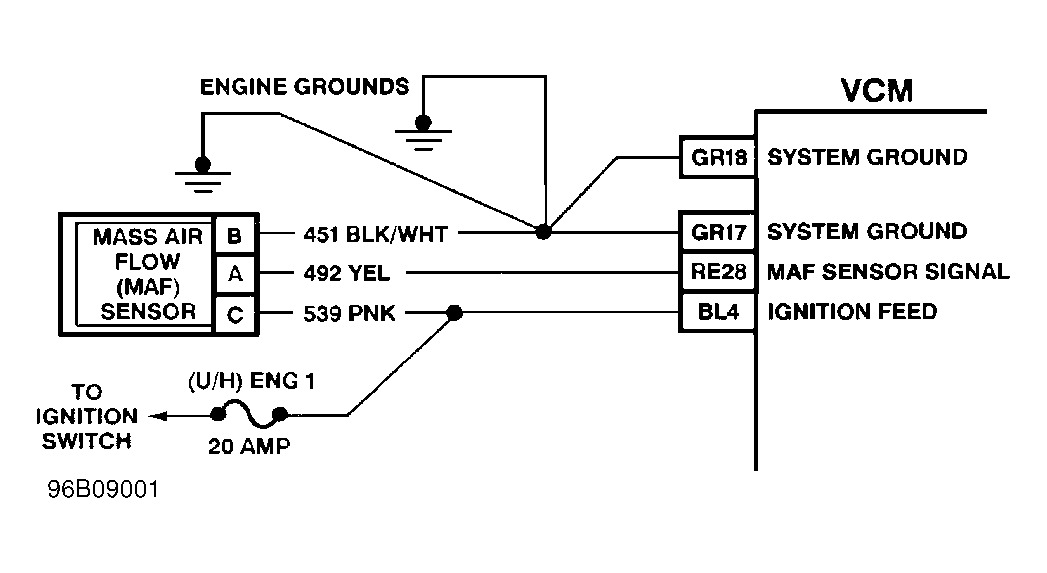
As far as the MAF, I need to know what code you found to give the proper directions. I have attached a schematic of the MAF wiring system. Take a look at check grounds and check for power as shown.
Aug 1, 2014 at 7:07 PM
Avatar
GC6345
  • MEMBER
  • 5 POSTS
I got 12 volts to my maf and idk about my fuel pressure lol
Aug 1, 2014 at 7:14 PM
Avatar
JACOBANDNICKOLAS
  • CAR REPAIR CONTRIBUTOR
  • 110,190 POSTS
Do you have the trouble code that was found?
Aug 1, 2014 at 7:20 PM
Avatar
GC6345
  • MEMBER
  • 5 POSTS
The trouble codes I always get are mass air flow sensor low voltage, multiple/random cylinder misfire, and O 2 sensor bank one sensor 2 low voltage. ...I've changed everything and they still show...
Aug 3, 2014 at 9:48 AM
Avatar
JACOBANDNICKOLAS
  • CAR REPAIR CONTRIBUTOR
  • 110,190 POSTS
Hi:

You know, I feel the MAF and O2 sensor issues are related. Do you have access to a scanner that can read real time data?

If you have the actual code numbers, for example, P0137, that would really be helpful. I have pages of tests to go through and can't do it without the codes. Since you haven't replaced the MAF, it may be the issue. First, check the following:

Air intake - objects blocking throttle body inlet screen
Intake Manifold leaks
Vacuum leaks at throttle body
Air leaks at EGR valve flange and pipe
Crankcase ventilation valve faulty, missing, or incorrectly installed.
Also, check the brake booster vacuum supply for leaks.

IF they all check okay, then this is where I need to know what codes you found. For example, does it have a P0121? That would indicate throttle position angle is not near 0 and certain things need checked. If it is near 0, then I have to go a different direction. Without the actual codes, we could spend weeks going through things.

Let me know.
Aug 3, 2014 at 10:53 AM
Avatar
GC6345
  • MEMBER
  • 5 POSTS
Sorry it took so long to get the codes but I don't drive my truck as much as I used to since I got a new vehicle. But here are the codes I have showing up right now and are the usual ones Po101 and po140. There is another one I usually get but it hasn't shown up yet so but I'll let u know when it does
Aug 17, 2014 at 2:38 PM
Avatar
JACOBANDNICKOLAS
  • CAR REPAIR CONTRIBUTOR
  • 110,190 POSTS
I will assume that you checked the items I listed. Also, that you have a real time scanner that you can look at how things are reacting.

The first thing I need you to check is for throttle position angle. It should be near 0. Let me know what you find.
Aug 17, 2014 at 7:12 PM
Avatar
RWALLACE33
  • MEMBER
  • 25 POSTS
Hi, I was driving down the highway, and my truck shut off as if I ran out of gas. But still had power steering and brakes and everything. Then wouldn't start.

I came back the next morning to try to figure it out. I looked at the cap and rotor. And they looked decent all the points intact, cleaned it up anyways. Checked the coil for spark. There was spark. I pulled one plug to check for spark there was spark. I can hear my fuel pump engage. So I tried to jump it with a buddies truck and it sputtered a couple times and I just fed it some gas with the accelerator pedal And the truck started, and I drove it home no problem.

Now every time I go to start the truck it sputters a few times and I just feed it gas with the pedal then it starts. But it's a rough start.

It's always had a long crank for it to start as long as I've owned it. And always hesitated to accelerate when it first starts up, But with this starting behavior, something definitely seems like it's going to need fixing.

Any ideas? Thanks, Rob
Sep 3, 2020 at 12:36 PM (Merged)
Avatar
JACOBANDNICKOLAS
  • CAR REPAIR CONTRIBUTOR
  • 110,190 POSTS
Welcome to 2CarPros.

Rob, the idea that you have to press the gas indicates to me there is more fuel than is needed to start the engine. When you press the throttle on a fuel injected vehicle, it shuts the supply off.

I have a few questions. First, have you checked fuel pump pressure?

https://www.2carpros.com/articles/how-to-check-fuel-system-pressure-and-regulator

Is the check engine light staying on when the engine is running? Do you have a live data scanner?

I'm questioning if the fuel pressure regulator is bad or if the engine coolant temperature sensor (ECT) is bad. The regulator is a vacuum operated component. Often times when they go bad, they draw fuel through the vacuum hose directly into the engine. A rich mixture is the result.

On the other hand, if the ECT is bad, it could be telling the computer the temps are extreme and the computer over compensates with a rich fuel mixture. If you have a live data scanner, you can check what the ECT is indicating. Also, if the check engine light is staying on, have the computer scanned. Most parts stores will do it for free.

If you could, let me know the answers to my questions.

Take care,
Joe
Sep 3, 2020 at 12:36 PM (Merged)
Avatar
RWALLACE33
  • MEMBER
  • 25 POSTS
No I haven't checked the fuel pump pressure. I've never checked fuel pressure before, I'm slightly new to mechanics. How might I do that?.

the check engine light is not on. And I don't have a live data scanner. Is that just an obd2 scanner?
Sep 3, 2020 at 12:36 PM (Merged)
Avatar
JACOBANDNICKOLAS
  • CAR REPAIR CONTRIBUTOR
  • 110,190 POSTS
Welcome back:

I will provide directions for testing fuel pressure. You will need a fuel pressure gauge, but most parts stores will lend/rent one to you.

As far as a live data scanner, yes, it is an OBD2 scanner. However, it has the option for you to view specific components while they are working. In this case, I wanted you to look at the temperature sensor's signal. If it was saying -40°F and the actual temp was 80°F, the fuel mixture would be extremely rich and cause a hard start and rough running.

Okay, as far as the fuel pressure, the original link I included above shows how it is done in general. Here are the manufacturer's specs for pressure:

FUEL PRESSURE SPECIFICATIONS
FUEL PRESSURE
1. Ignition "OFF" for 10 Seconds.
2. With ignition "ON," engine "OFF" and fuel pump running, pressure should be 385-430 kPa (56-62 psi).
For additional fuel pressure testing procedures,

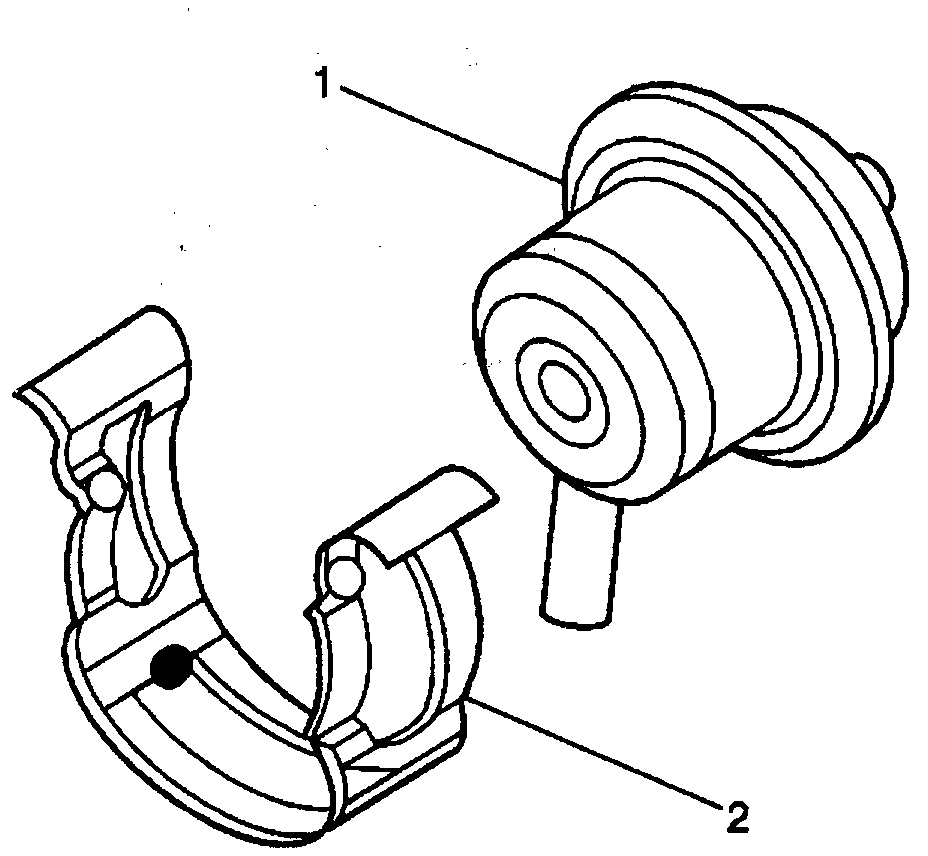
Now, I attached a picture of the fuel pressure regulator for you to see what it looks like. The problem is its location. It is under the intake manifold. Based on what you described, I am questioning if the regulator is bad and allowing fuel to be drawn into the engine via the vacuum hose. If you can see the regulator and are able to remove the vacuum hose, do so. Check to see if there is any evidence of raw fuel in the vacuum hose. If there is, it needs replaced.

Please feel free to ask questions if you need anything. I'm not here 24 hour's a day, but a minimum of once a day for a few hours, so I will get back to you.

Let me know if this helps or if you have other questions.

Take care,
Joe
Sep 3, 2020 at 12:36 PM (Merged)
Avatar
RWALLACE33
  • MEMBER
  • 25 POSTS
Okay, thanks. I think It might be the fuel pump. Because I usually drive around under half a tank.

Another question. I had one of the two catalytic converters rust apart and it was rattling around. I tried to weld it back to the pipe. And exhaust putty it. But it still leaks like crazy. It's really loud. Am I able to just cut one catalytic converter out of these vehicles and replace a pipe and clamps? Or will it fuck up the way the vehicle runs? I don't care if there's a check engine light as long as it sounds better.
Sep 3, 2020 at 12:36 PM (Merged)
Avatar
JACOBANDNICKOLAS
  • CAR REPAIR CONTRIBUTOR
  • 110,190 POSTS
Welcome back:

It will affect how it runs because the computer won't know what is happening without an accurate reading from the oxygen sensor. It will most likely cause a rich fuel mixture to that one side.

If you have easy access, see if you can get an inexpensive universal cat that will work. Then cut the old one out and clamp the new one in place.

Let me know what you find on the fuel pressure. Also, feel free to let me know if you need help.

Take care,
Joe
Sep 3, 2020 at 12:36 PM (Merged)
Avatar
HUNTER4255
  • MEMBER
  • 4 POSTS
When at an idle or driving, the engine wants to cut when I turn on the lights or brakes. Once when I even opened the drivers door at an idle. Battery at 12.86 volts DC and Alternator at 14.75 volts DC at an idle, at fire up, 15.25 volts DC. At one point the engine cut out and I had no power at all. No lights or dome light, nothing. Battery was good. After a few attemps, the power came up and the engine fired. Fuses all good. Ign. switch replace in 2004. Today, engine cut out and took a few cranks to fire it up. Any thoughts???
Sep 3, 2020 at 12:37 PM (Merged)
Avatar
CARADIODOC
  • CAR REPAIR CONTRIBUTOR
  • 34,309 POSTS
Can you clarify the voltages? When is the battery at 12.86 volts? Engine off? Engine running? If the generator and battery are not at the same voltage, suspect a problem with the heavy wire going back to the battery.

14.75 volts with the engine running is perfect. 15.25 volts is a little high and suggests, along with some of your other observations, loose or corroded battery cables.

A running problem and a confused voltage regulator can also be caused by voltage spikes from the generator. The generator will keep the battery charged, but the spikes will confuse some of the computers on the truck.

caradiodoc
Sep 3, 2020 at 12:37 PM (Merged)
Avatar
HUNTER4255
  • MEMBER
  • 4 POSTS
[quote:cf127a2189="caradiodoc"]Can you clarify the voltages? When is the battery at 12.86 volts? Engine off? Engine running? If the generator and battery are not at the same voltage, suspect a problem with the heavy wire going back to the battery.

14.75 volts with the engine running is perfect. 15.25 volts is a little high and suggests, along with some of your other observations, loose or corroded battery cables.

A running problem and a confused voltage regulator can also be caused by voltage spikes from the generator. The generator will keep the battery charged, but the spikes will confuse some of the computers on the truck.

caradiodoc[/quote:cf127a2189]Battery is side post and the connections are clean and tight. Cable from battery to alternator is in good shape, no breaks and is also tight. Battery is at 12.86 volts with out the engine running. The 15.25 volts was when then engine first started up in the morning and after if warmed up, the volts dropped to 14.75. At the alternator and battery. Belt is good and not slipping. Did see a change in the dash gauge at one point, was over center point of 14 amps then went under 14 amps then back to 14 amps. Seems to run pretty much below 14 amps, say 13 or so.
Sep 3, 2020 at 12:37 PM (Merged)
Avatar
CARADIODOC
  • CAR REPAIR CONTRIBUTOR
  • 34,309 POSTS
Don't rely too much on the dash gauge for diagnosis except that you are familiar with what is normal. The voltage readings at the battery and generator seem fine. Those are what really count.

At 240,000 miles, I would guess the generator has been replaced a couple of times already. If not, suspect worn brushes causing an intermittent no-charge condition. You will have to make some measurements when the problem is acting up.

12.8 volts at the battery suggests it's in dandy condition although an intermittently shorted cell, (not common), could cause the symptoms you listed. If you see your dash gauge drop to 13 volts or less, jump out, (stop the truck first :)), and measure the battery voltage. If it is indeed below 13.75 volts, measure at the back of the generator too. If both are low, suspect a defective generator, but first measure the voltage on the small plug-in red or brown wire, (I can't remember the color). It must have full battery voltage on it while the engine is running. It should have around 2 volts with the ignition switch on and the engine not running. That is the circuit that starts up the generator and turns the battery light on the dash on and off. A resistor is used if you don't have a battery light.

If you can catch it not cranking again, measure the voltages at the battery while a helper holds the ingition switch in the "crank" position.

caradiodoc
Sep 3, 2020 at 12:37 PM (Merged)
Avatar
HUNTER4255
  • MEMBER
  • 4 POSTS
[quote:660a0730b6="caradiodoc"]Don't rely too much on the dash gauge for diagnosis except that you are familiar with what is normal. The voltage readings at the battery and generator seem fine. Those are what really count.

At 240,000 miles, I would guess the generator has been replaced a couple of times already. If not, suspect worn brushes causing an intermittent no-charge condition. You will have to make some measurements when the problem is acting up.

12.8 volts at the battery suggests it's in dandy condition although an intermittently shorted cell, (not common), could cause the symptoms you listed. If you see your dash gauge drop to 13 volts or less, jump out, (stop the truck first :)), and measure the battery voltage. If it is indeed below 13.75 volts, measure at the back of the generator too. If both are low, suspect a defective generator, but first measure the voltage on the small plug-in red or brown wire, (I can't remember the color). It must have full battery voltage on it while the engine is running. It should have around 2 volts with the ignition switch on and the engine not running. That is the circuit that starts up the generator and turns the battery light on the dash on and off. A resistor is used if you don't have a battery light.

If you can catch it not cranking again, measure the voltages at the battery while a helper holds the ingition switch in the "crank" position.

caradiodoc[/quote:660a0730b6]Thanks, I will give this a try. I have never really had any troubles with this truck other than fuel pump issues. I do pull a camper, 24 footer with this truck. I do think myself, that this could be an alternator issue do to the fact that the truck also charges the trailer battery when hooked to the trailer. Do you recommend a heavy duty alternator and will the computer handle more amp output from the alternator?
Sep 3, 2020 at 12:37 PM (Merged)
Avatar
CARADIODOC
  • CAR REPAIR CONTRIBUTOR
  • 34,309 POSTS
Don't jump the gun until you're sure the alternator is the problem.

As for going to a heavy duty unit, you won't gain anything. The smallest unit you're going to find will still deliver well over 70 amps. A totally dead battery will only draw around 20 amps for a minute or two when it first starts to recharge. It only takes little more than that to maintain three fully charged batteries and run the rest of the electronics on the truck. The reason for the much higher capacity of your alternator is to prevent a drop in voltage when it is momentarily stressed to provide for power windows, power seats, wipers, radio, head lights, and heater fan on high all at the same time. A drop in system voltage can cause the many computer modules on the truck to become confused and do strange things. It is very unlikely you will ever need more current than the alternator can deliver.

Going to a larger alternator will only provide a larger maximum capacity. It will not charge batteries any faster or deliver more current then the truck demands. One potential unintended consequence has to do with the wire between the alternator's output terminal and the battery. In the late '70s - early '80s, for example, Chrysler products came with one of three different size alternators depending on the accessories on the car. A fuse link wire was part of the wire between the battery and alternator output terminal. All of the alternators mounted and plugged in the same so sometimes people installed one with the larger capacity. That would not cause a problem in itself, but if someone performed a ful-field load test to determine its maximum output, more current might be drawn through the fuse link than it could handle. To complete the modification properly, it was necessary to use a larger diameter wire with its larger fuse link.

If you haven't had a problem with the trailer attached before, there is no reason to need a higher capacity alternator now. It won't last any longer or run the electronics any better unless the trailer causes the current one to be near its maximum output all the time.

As for the Engine Computer, he has no idea what the charging sytem is doing or how much current it's delivering. The voltage regulator inside the alternator watches system voltage. An increase in current demand lowers sytem voltage. That tells the regulator to run the alternator harder to increase current flow. That results in voltage going back up.

Here's another way to visualize what you can't see. Think of a municipal water tower. As long as it's full, a pressure gauge at ground level says "100 psi". When a little water, (current) is drawn off, the water level, and its pressure, (voltage) goes down. The water pump has no idea what the water level is in the tank, but it sees the drop in pressure so it delivers more water volume to build the pressure back up. There is a limit to how much water can be drawn at any given time based on the number of homes connected to the system, so all that's needed is a pump that's big enough to meet the demand if every home turned the toilet, sink, shower, and garden hose on at the same time. Installing a pump with a higher capacity would fill the tank faster, . . . if the pipe diameter was also increased.

Hope that all made sense. Electrical was the hardest subject I taught because it can't be seen, touched, or manipulated. I had real good results by comparing anything electrical to water flow in a pipe or river.

caradiodoc
Sep 3, 2020 at 12:37 PM (Merged)
Avatar
HUNTER4255
  • MEMBER
  • 4 POSTS
[quote:8da52c3b14="caradiodoc"]Don't jump the gun until you're sure the alternator is the problem.

As for going to a heavy duty unit, you won't gain anything. The smallest unit you're going to find will still deliver well over 70 amps. A totally dead battery will only draw around 20 amps for a minute or two when it first starts to recharge. It only takes little more than that to maintain three fully charged batteries and run the rest of the electronics on the truck. The reason for the much higher capacity of your alternator is to prevent a drop in voltage when it is momentarily stressed to provide for power windows, power seats, wipers, radio, head lights, and heater fan on high all at the same time. A drop in system voltage can cause the many computer modules on the truck to become confused and do strange things. It is very unlikely you will ever need more current than the alternator can deliver.

Going to a larger alternator will only provide a larger maximum capacity. It will not charge batteries any faster or deliver more current then the truck demands. One potential unintended consequence has to do with the wire between the alternator's output terminal and the battery. In the late '70s - early '80s, for example, Chrysler products came with one of three different size alternators depending on the accessories on the car. A fuse link wire was part of the wire between the battery and alternator output terminal. All of the alternators mounted and plugged in the same so sometimes people installed one with the larger capacity. That would not cause a problem in itself, but if someone performed a ful-field load test to determine its maximum output, more current might be drawn through the fuse link than it could handle. To complete the modification properly, it was necessary to use a larger diameter wire with its larger fuse link.

If you haven't had a problem with the trailer attached before, there is no reason to need a higher capacity alternator now. It won't last any longer or run the electronics any better unless the trailer causes the current one to be near its maximum output all the time.

As for the Engine Computer, he has no idea what the charging sytem is doing or how much current it's delivering. The voltage regulator inside the alternator watches system voltage. An increase in current demand lowers sytem voltage. That tells the regulator to run the alternator harder to increase current flow. That results in voltage going back up.

Here's another way to visualize what you can't see. Think of a municipal water tower. As long as it's full, a pressure gauge at ground level says "100 psi". When a little water, (current) is drawn off, the water level, and its pressure, (voltage) goes down. The water pump has no idea what the water level is in the tank, but it sees the drop in pressure so it delivers more water volume to build the pressure back up. There is a limit to how much water can be drawn at any given time based on the number of homes connected to the system, so all that's needed is a pump that's big enough to meet the demand if every home turned the toilet, sink, shower, and garden hose on at the same time. Installing a pump with a higher capacity would fill the tank faster, . . . if the pipe diameter was also increased.

Hope that all made sense. Electrical was the hardest subject I taught because it can't be seen, touched, or manipulated. I had real good results by comparing anything electrical to water flow in a pipe or river.

caradiodoc[/quote:8da52c3b14]Thanks, with the help. I am a HVAC Service Tech., so I do the same with my customers, most customers can not understand the technical but using different ways to explain the seq. of events, helps.
Sep 3, 2020 at 12:37 PM (Merged)

Avatar
2 LINSEY
  • CAR REPAIR CONTRIBUTOR
  • 287 POSTS
Thank you for using 2CarPros.com. We appreciate your donation and look forward to helping you in the future.
Sep 3, 2020 at 12:37 PM (Merged)

Avatar
RAMIREZ
  • MEMBER
  • 2 POSTS
my truck feels like its going to turn off when its runnig when I give it some gas it sounds worse what could the problem be.
Sep 3, 2020 at 12:37 PM (Merged)

Avatar
BLACKOP555
  • CAR REPAIR CONTRIBUTOR
  • 10,386 POSTS
first i want you to do the simple things that usually should fix the problem.

first change the fuel filter and air filter and throttle body.

after those are cleaned replace the plugs and wires.

also is there a check engine light.
Sep 3, 2020 at 12:37 PM (Merged)
Avatar
RAMIREZ
  • MEMBER
  • 2 POSTS
[quote="Ramirez"]Other Category problem
1996 Chevy Silverado V8 Two Wheel Drive Automatic 149873 miles
----------------------------------------------------------------
I already did all those things about two months ago. I think it might be the fuel pump.
Sep 3, 2020 at 12:37 PM (Merged)
Avatar
BLACKOP555
  • CAR REPAIR CONTRIBUTOR
  • 10,386 POSTS
Also be sure to check and clean the EGR valve and check for vaccum leaks, to check for vaccum leaks fire up the truck and spray carb cleaner on all hoses around the gasket of the intake manifold, egr valve, if idle changes you have found a leak.
Sep 3, 2020 at 12:37 PM (Merged)
Avatar
JAYGS
  • MEMBER
  • 1 POST
Engine Mechanical problem
1996 Chevy Silverado V8 Two Wheel Drive Automatic unknow miles

the pump is working but can not get fuel to the butterfly. could it be the fuel perssere reg? also have fuel to inj. can spray start fuild an will start but wont stay running.
Sep 3, 2020 at 12:37 PM (Merged)
Avatar
RASMATAZ
  • CAR REPAIR CONTRIBUTOR
  • 75,992 POSTS
You need to confrim the fuel pressure if its within specification by using a fuel pressure tester.

The fuel pressure specification should be 60-66psi
Sep 3, 2020 at 12:37 PM (Merged)
Avatar
SMILEYMILLER1
  • MEMBER
  • 2 POSTS
I have a 96 chevy silverado with a 5.7 vortec engine. Runs decent at idle and low speeds, but as i apply more gas it acts like its choking out and looses hourse power on hills at any speed. Could this be the throtle position sensor? Ive recently changed the upstream o2 sensors and plugs and distributor cap.
Sep 3, 2020 at 12:37 PM (Merged)
Avatar
HMAC300
  • CAR REPAIR CONTRIBUTOR
  • 48,601 POSTS
scan for codes and check fuel pressure with a gauge 60-66 psi. auto parts rent it.
Sep 3, 2020 at 12:37 PM (Merged)
Avatar
SMILEYMILLER1
  • MEMBER
  • 2 POSTS
Yeah, shortly after posting the question, i read the article on back firing and it made a lot of sence. Thanks for the fuel psi range. :)
Sep 3, 2020 at 12:37 PM (Merged)
Avatar
HMAC300
  • CAR REPAIR CONTRIBUTOR
  • 48,601 POSTS
one other thing on these if the fp is ok then check rotor in dist it should not move or if it does very little the dist gear wears out and you'll need another distributor.
Sep 3, 2020 at 12:37 PM (Merged)
Avatar
ROY ALLEN
  • MEMBER
  • 1 POST
After I drive for a while it just dies and I have to let it sit for a while until it will start again.
Sep 3, 2020 at 12:37 PM (Merged)
Avatar
KASEKENNY
  • CAR REPAIR CONTRIBUTOR
  • 18,907 POSTS
Hi Roy,

Does it run fine then just cut off with no warning? Any check engine light on? If so, can you pull the codes?

Here is a guide that will help with the general principals of what we need to start eliminating.

If you have a fuel pressure gauge, let's hook that up and then tape it to the windshield so you can monitor rail pressure the next time this happens. If fuel pressure remains constant when it cuts off then we can eliminate a lot of items, such as fuel pump, regulator, or the most unlikely of all, injectors.

If it just cuts off then we need to look at the crank sensor as being the most likely cause. However, if the fuel pressure drops and it stalls out then we are loosing fuel pressure somewhere.

Let me know and we can go from there. Thanks

https://www.2carpros.com/articles/engine-stalls
Sep 3, 2020 at 12:37 PM (Merged)
Avatar
AUTOETRONICS
  • MEMBER
  • 1 POST
I gotta 95' Chevy C3500HD Dually and right now the temp on the guage is between 1/2 and 3/4's and it bounces between that. Once I slap on my 10,000lbs trailer it runs the same until I stop, then it runs alittle above the 3/4 mark. Any suggestions? The engine is a 7.4L 454, auto tranny with cooler ad an engine cooler.
Sep 3, 2020 at 12:37 PM (Merged)
Avatar
BUDDYCRAIGG
  • CAR REPAIR CONTRIBUTOR
  • 2,262 POSTS
first i would verify that it's running hot with an independent thermometer.

next, make sure there isn't any debris in the fins of the AC condenser, oil cooler, tranny cooler, and radiator.

if you have a fan clutch instead of an electric fan, make sure the clutch has more resistance the hotter the engine is.

what about replacing the thermostat?

and while you're doing that, get that nasty dexcool antifreeze out of there, and flush the radiator and put in some good old fashioned green stuff.
Sep 3, 2020 at 12:37 PM (Merged)
Repair Safety Notice: This information is for general instructional purposes only. Vehicle repair can be dangerous. Verify all information, follow manufacturer service procedures, use proper tools and safety equipment, and consult a qualified repair shop when needed.