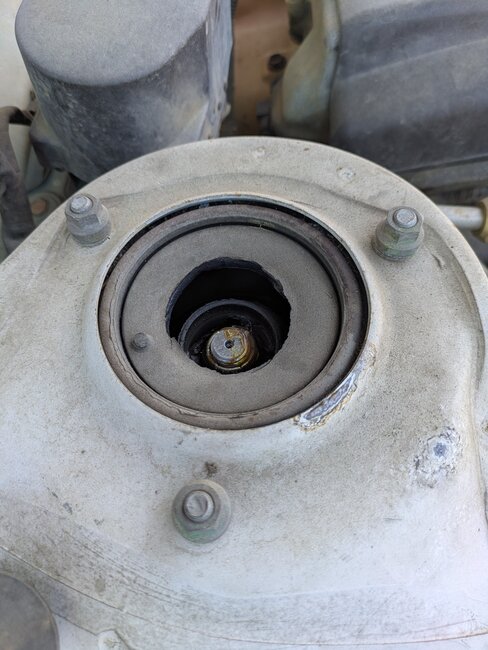
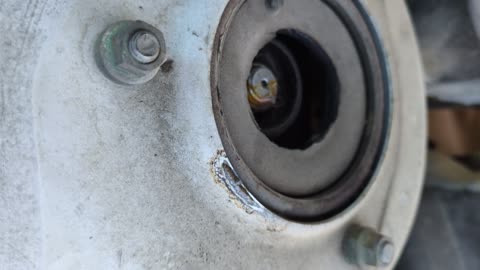
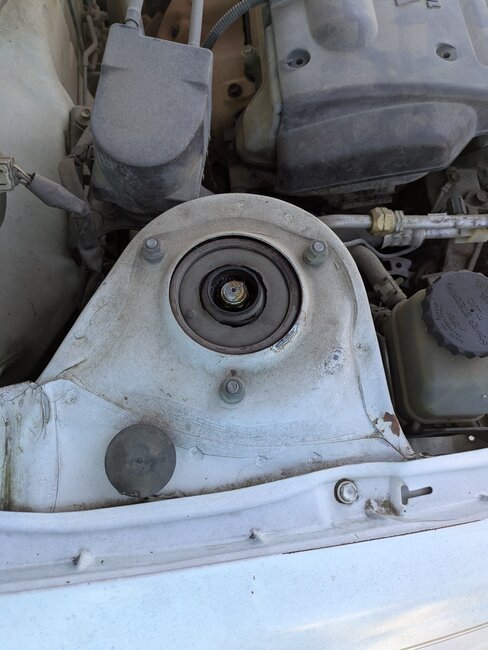
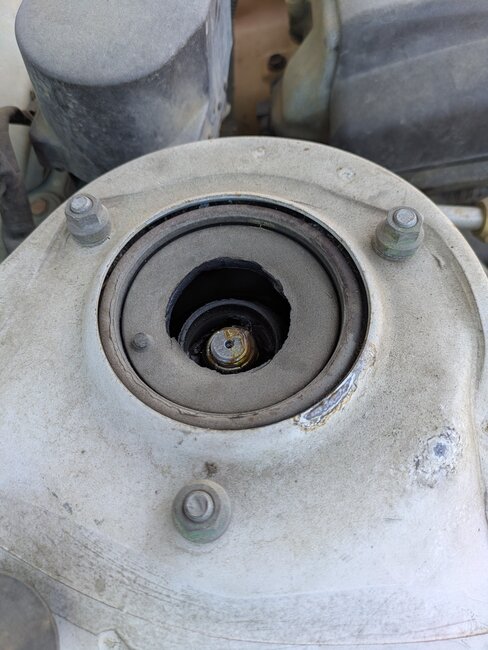
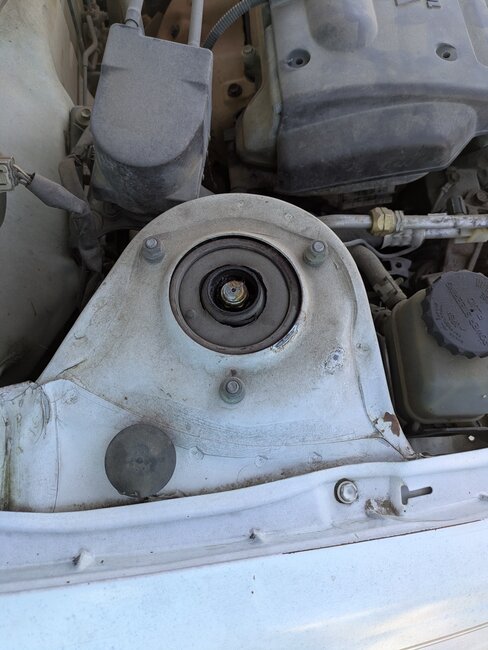
This isn't actually caused by the strut itself. The broken part is called, "the upper strut mount". The car is drivable as long as you're aware of what can happen and you pay attention as you drive. In the photo below, the upper mount is shown at the top. It is two pieces of metal with rubber sandwiched in between. It's that rubber that has torn loose.
Besides holding the top of the strut's shaft in position, the mount keeps the coil spring contained under pressure. This one is going to fall apart when it is removed, but the other one will require a strut compressor to take it apart. The spring only has to be compressed another half inch or so, but then, once the large center nut is removed, that compressed spring is very dangerous. I've seen two squirt out of the compressor. One shot up and took out an 8-foot light fixture. One I was working on flew out, through the shop, out the door into the parking lot, and made so much noise, an office worker behind two closed doors came out to see what the racket was all about. That said, if you watch some videos on replacing struts, the job can be done by a competent do-it-yourselfer. Spring compressors can be borrowed from an auto parts store that rents or borrows tools.
Next, given the mileage, and the fact the other side has the same amount of miles and age, the struts should be replaced too. On the broken side, you would need to compress that spring anywhere from six to as much as 12 inches. This is the most dangerous part of the job as there's a lot of opportunity for the strut to pop out under high pressure. Each spring has to be strong enough to hold up well over a thousand pounds of car.
The next thing to consider is due to age only, not mileage, the coil springs will be weak, or "sagged". That makes the front of the car sit too low to the ground. Due to the geometric relationship of the steering and suspension parts, those are designed to produce the best handling, ride quality, and tire wear. While the alignment, ("camber", in this case), can be adjusted to specs, tire wear will still be very poor if ride height isn't corrected first. That is done by installing new coil springs. Conscientious alignment specialists won't even align a vehicle with sagged or modified ride height.
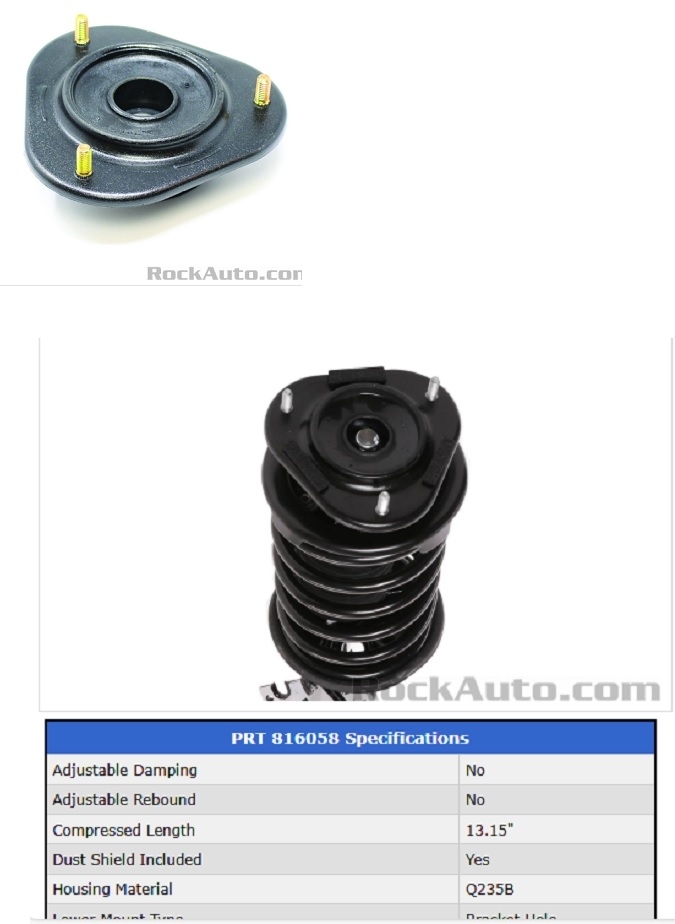
Also, we always replace struts and coil springs in pairs. All of these problems can be easily solved by installing a pair of "quick struts". The assembly looks exactly like the old one as it is removed from the car. It's a simple bolt-in procedure that gets you new coil springs, new upper mounts, and new struts, already assembled and ready to pop in.
As for driving the car this way, there's two things that will make the steering direction unpredictable. The first is when that large upper nut / strut shaft walks left and right. That affects the first of the three main alignment angles called "camber". Tires want to roll in the direction they're leaning. If you can visualize a wheel that's perfectly straight up and down, as viewed from in front of the car, that would be 0.00 degrees. If it was tipped out so far on top that it is laying flat on the ground, that would be 90.00 degrees. A typical camber setting might be in the area of 0.00 to 0.50 degrees, far too little to see by eye. When camber goes much higher than that, the tire starts to wear faster on the outer edge. With the amount of movement seen in your dandy video, I'd estimate that is a good five degree change. That by itself will cause the car to pull in a different direction depending on which way it shifts.
Next, due to the geometric relationship of the other parts, shifting left and right causes the steering linkage on that side to need to shift accordingly, but since that doesn't happen, that wheel will turn left or right as the strut shifts. You will have to counteract that by turning the steering wheel the other way. This change is one of the other three alignment angles called "toe". That's the direction the wheel is steering when the steering wheel is straight ahead. A typical specification for "total toe", the sum of toe on both wheels, might have a tolerance of as much as 1/8". With the shifting strut, I'd expect yours to be changing between a half inch to maybe as much as an inch. Regardless if one or both sides have this change in toe, toe wear by itself always affects both tires equally. They'll both wear on the inside edge or the outside edge, and the blocks of rubber tread will develop a choppy pattern.
Between the shifting camber and the shifting toe, this makes for a very tiring car to drive.
I must point out too that while I said the car can be driven, that is in reference to not leaving you sitting on the side of the road in a pile of tears. That isn't going to happen. What IS of concern is if the other guy runs a red light and causes a crash, you can be sure his lawyer or insurance investigator will see the broken upper mount, then will look closer for any other modifications or worn parts they can find. They will rightly convince a jury that you were partly at fault for the crash because you were less able to avoid it due to reduced handling performance. We especially worry about this all the time when doing brake work. Even that sagged ride height can be used in their arguments.
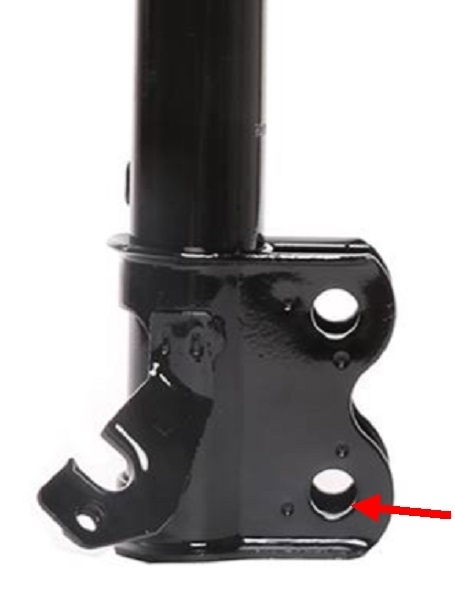
My recommendation, to avoid all these potential problems, is to install a pair of quick struts. I used the Rock Auto site for these photos, but most local auto parts stores and even farm and home stores have them. Given there's no need to pay someone to install them, these assemblies cost a lot less than when buying the individual parts. You may have to fight with the broken side to get the pieces out, but the other side is a simple bolt-in job. The car will need to be aligned afterward. GM cars come with the lower strut mounting bolt holes as shown in the second photo. On Most older Chrysler products, the lower hole, (red arrow), is oval-shaped to allow camber to be adjusted. Many aftermarket struts for GM cars come this way too, but if not, if camber needs to be adjusted during the alignment, the mechanic will grind one of the holes into an oval, then install a special bolt with an offset head that helps hold it in position so it doesn't shift when you hit pot holes. If the holes aren't slotted on your new struts, installing them that way will get camber close enough to allow you to drive to the alignment shop.
One hint with these lower bolts is they usually have splines just under the head that prevents them from spinning. You have to remove the nut, then pound the bolt out. I leave the nut on a few threads so those threads don't get damaged when doing the pounding. When they use those splines, the bolt heads will have only two flats, not six like on a normal hex bolt.
Here's links to related articles:
https://www.2carpros.com/articles/jack-up-and-lift-your-car-safely
https://www.2carpros.com/articles/basic-car-safety-inspection
https://www.2carpros.com/articles/how-car-steering-works
https://www.2carpros.com/articles/checking-shocks-and-struts
https://www.2carpros.com/articles/how-to-replace-a-suspension-strut-and-spring
https://www.2carpros.com/articles/how-car-tires-work
You won't need all of these. I included more articles for the benefit of others researching this topic.
Let me know if you have questions, or please keep me up to date on your progress.
Images (Click to enlarge)
Aug 29, 2025 at 2:49 PM