Power Steering Pump/Belt?

Tiny
PACKERS27
  • MEMBER
  • 2000 GMC SIERRA
  • 5.3L
  • V8
  • 2WD
  • AUTOMATIC
  • 350,000 MILES
I had been hearing a lot of whining from the power steering pump for a while previously. My power steering seemed to be fine and I checked the fluid and the fluid was good. I drove it like this for a long time and continuously kept an eye on the fluid and about 6 months ago it completely went out. The other day the entire belt broke and it's probably due to the pulley of the power steering pump being extremely loose. I want to go ahead and get this fixed so my question is, is this something I can do myself or does the pulley have to be pressed inside of the pump itself? Can I buy the pulley and pump together already pressed? Also what size is the nut on the back of the pump where the line goes in and how many bolts hold this pump on. Thank you so much
Friday, November 21st, 2025 AT 1:18 PM

22 Replies

Tiny
PACKERS27
  • MEMBER
  • 219 POSTS
I finally Tracked Down the exact pump that I need and it is very expensive and it would be even more expensive to have someone install it and this truck simply just isn't worth that type of repair. Now my new question is, since I don't mind driving this truck with no power steering how can I fix this pulley so I can put a new belt on it or what can I do about that
Was this
answer
helpful?
Yes
No
Friday, November 21st, 2025 AT 1:57 PM
Tiny
PACKERS27
  • MEMBER
  • 219 POSTS
Is there a way that I can bypass that pulley all together with a shorter Serpentine belt? The pulleys have five tines in it so I guess that's like seven grooves
Was this
answer
helpful?
Yes
No
Friday, November 21st, 2025 AT 2:18 PM
Tiny
CARADIODOC
  • MECHANIC
  • 34,330 POSTS
Based on your description that the pulley is loose and you have no power steering assist, it sounds like the shaft of the pump is broken. I ran into that once quite a while ago, but the broken shaft wasn't apparent until the belt was removed, then the shaft could be pulled out of the pump, with the pulley still attached. There was no tell-tale leakage around the front seal.

The loss of power assist can also be due to an internal leak in the steering gear. If your truck has rack and pinion steering, you most commonly lose power assist in just one direction first, then the other direction a few weeks later, and the assist typically comes back at first when the fluid gets warm. That type of failure gets progressively worse over a few weeks until the assist eventually never comes back. If you have the older common steering gearbox, I don't remember ever running into one that caused a loss of power assist. For those, the pump is the better suspect.

Some truck models also use a computer module to provide variable power assist depending on road speed. I think those are mostly used with rack and pinion steering gears. They can cause loss of power steering assist too.

Given the cost of parts, the need to switch the pulley, the special tools required, and the very low failure rate, the better solution would be to get a good used pump from a salvage yard. Everything I found is just the pump, some with the reservoir and some that you need to reuse yours, but they all come without the pulley. That's because the same pump can be used on many different models and years, but with different pulley diameters, number of grooves on the pulley, and varying depth the pulley is pressed on. They only have to inventory one pump that way to cover all the models.

The next issue is you will need a special pulley puller to get the pulley off the old pump. You can find a set of tools at Harbor Freight Tools, but most auto parts stores that rent or borrow tools will have that set. In my city, they make you buy the tools, then you get a full refund when you return it. If you decide to keep a tool, you still return it, then they order or give you a brand new one.

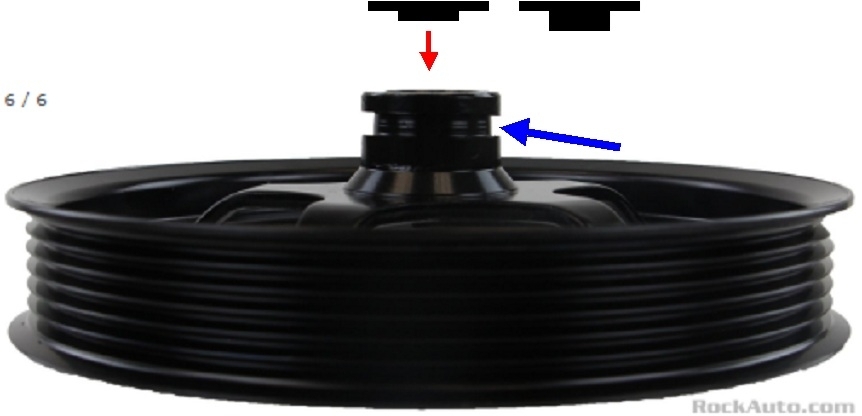
You'll notice there's a collar about an inch and a quarter in diameter around the front of the pulley. Depending on who made the tools, a one or three-piece tool goes around that lip, (blue arrow in my nifty photo), then a bolt is threaded through that tool to push the shaft out of the pulley.

The next issue is when you push the pulley onto the new pump, how far you push it on is critical. 1/16" too much or too little can set up a miserable belt squeal. Rebuilt pumps often come with a bolt that threads into the shaft's center hole, and a nut and washer to run the pulley on. While they do work once or twice, you still need that special tool set to remove the pulley and to pull it back out if you press it on too far.

One way to know the pulley is on the correct depth is to observe the ring of rust inside the pulley's center hole. After pushing the pulley on, remove the tool, then if you see any shiny area showing on the center hole, the pulley has to go on further. You can creep up to the proper depth that way, but you won't know it if you went on too far.

The better way is to use a special spacer to set the depth. I can't find a photo, so I drew two examples in the photo below, (top of photo). You chose the spacer with the depth that matches the old pulley's depth and place that on the pulley just before you attach the pulling tool. They have holes for the pulling bolt to go through. The narrow part of the spacer, (on the bottom in my drawings), hits the end of the shaft when the correct depth is reached. It won't let you push the pulley on too far. Those spacers normally do not come as part of the special tool kit. When I used these at a Chrysler dealership, the replacement pulleys and replacement pumps came with the correct spacer, then we were expected to just throw them away later. I kept them and found there were only two sizes at that time. If the pulley is pressed on flush with the end of the shaft on the old pump, you don't need or use either spacer with the new parts.

If you do go with a used pump, look at how far your pulley is pressed on, then find a pump from the same year and model and check that this pulley is on the same depth. That eliminates the need for the special tools.

I can't tell you the nut size for the pressure hose other than to suggest it's most likely metric. Use a flare-nut wrench, aka Line wrench because these nuts will be very soft. Flare nut wrenches grab the nut in four places instead of two with standard open-end wrenches. I'd expect that nut to be 15 or 17 millimeter, but GM is famous for often using the very uncommon 16 millimeter too.

Sorry about the photos not working. That should be solved after the site is finished being updated.
Was this
answer
helpful?
Yes
No
Friday, November 21st, 2025 AT 3:41 PM
Tiny
PACKERS27
  • MEMBER
  • 219 POSTS
That sounds like a liynif stuff for a ragged old truck. I've been saying that Im not gonna spend no more money on yhe truck. What Id like ti do is nit use that pulley and pump at all. Just have a belt that goes around the other pulleys. Can you assist with that
Was this
answer
helpful?
Yes
No
Friday, November 21st, 2025 AT 8:17 PM
Tiny
CARADIODOC
  • MECHANIC
  • 34,330 POSTS
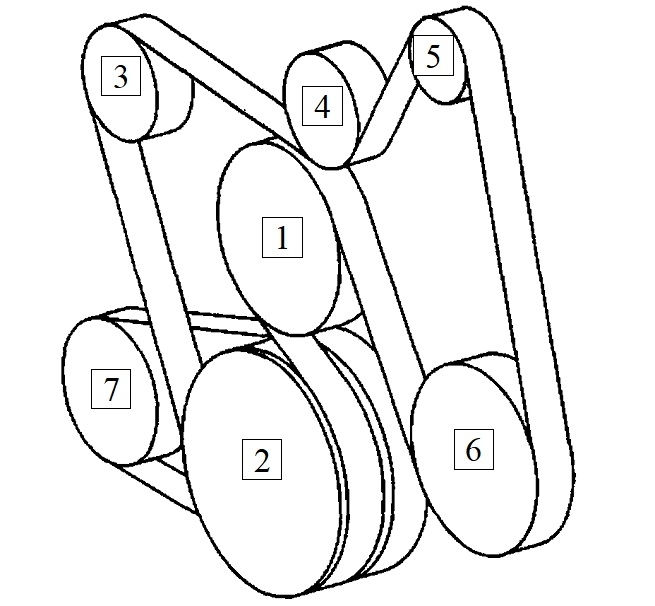
I looked at the belt routing diagram but they couldn't be bothered to label the pullies. My guess is, ... Looking from the front, the power steering belt is on the lower right. I labelled that # 6. If you remove just that, the belt will rub on the upper pulley, # 4. You'd have to bypass pulley number 5. If that is a spring-loaded tensioner pulley, you won't have a way to keep the belt tight. If you go around pulley # 4 in the opposite direction, the ribbed side of the belt will be running on a smooth pulley.

This would be a trial and error job. Unless you can find someone who has already done this, and knows the belt size needed, the best I can suggest is to use a piece of string to get a measurement, then see if the auto parts stores have something. They normally go by application, not size, but they might have listings in their books for which part number is what size.

There's a couple of other things to consider. The proper repair with a used pump should cost less than a tank of gas or an oil change. My bigger concern is power steering is part of a safety system. If you get in a crash because the other guy ran a red light, for sure a lawyer or insurance investigator will find the modification, and convince a jury that you were partly at fault because you were less able to avoid that crash. Also, once they find anything related like that, they will pick your vehicle apart even more to find anything they can to shift the blame away from their client.

Even you aren't involved in a crash, when I worked at a very nice family-owned new-car dealership, I had the owner's blessings to refuse to align a vehicle or do any work on it if I thought there could develop a safety or liability issue. We have to keep that in the back our minds with every vehicle we touch. Once I do an alignment on something with altered ride height, wide wheels, missing battery hold-down hardware, burned out lights or anything altered related to safety systems, I and the dealership become part of anything that lands that driver in court. The people at most shops won't work on your truck if they see the power steering pump missing. Based on your user name, I'm wondering if you're in Wisconsin? If you are, I am too, so I know how the laws can affect us.

I don't count a vehicle out based on mileage or age. I have an '88 Grand Caravan with 440,000 miles. I'd still be driving it if the body hadn't rusted so badly that the carpet is the only thing holding the front and rear together! That too was a safety issue as uni-body vehicles are stronger than those with full frames, as long as they aren't rusty.

I strongly recommend going with a used pump as it will be faster and easier, but if you do find a way to bypass it, please post how you did it and the belt size that worked.

I should mention too, for the benefit of others researching this topic, a lot of GM trucks use a hydro-boost system for power brakes. The brakes get their power assist from pressurized power steering fluid. Without power steering, you won't have power brakes either on those models.

One last thing to consider is steering effort. You won't miss the power steering at highway speeds, but you'll need strong arms in parking lots. I didn't see any reference related to the belt routing diagrams that there were some trucks built without power steering, but if there were, consider replacing your steering gear with one of those manual units. Manual steering gears have a different gear ratio to make them easier to turn. It will take more steering wheel revolutions to go from full-left to full-right, then the "clock spring" becomes another factor. That's a wound-up ribbon cable in a plastic housing under the steering wheel. It makes a solid electrical connection to the air bag. Those are designed to wind up and unwind just a tiny bit more than what's needed, and little extra. One extra turn on the steering wheel will destroy that cable. If the truck was available with manual steering, there will be a different clock spring to work with that.

One more last thing, I've had Chrysler cars that I raced on oval tracks, but in a class that required them to be street legal. Due to some of the modifications, some cars didn't have power steering but they did still have the power steering gear boxes. Without pressurized power steering fluid, those gear boxes had a horrendous amount of free play. It wasn't unrealistic to see the steering wheel turned an eighth turn either way before the wheels started to turn. That makes for a really miserable car to drive at any speed, and you can never be sure which way it's going to go on bumpy roads. I don't think GM gear boxes are that bad, but it's still something to keep in mind
Was this
answer
helpful?
Yes
No
Saturday, November 22nd, 2025 AT 7:27 PM
Tiny
PACKERS27
  • MEMBER
  • 219 POSTS
2 is fan. 3 is tension pulley. 4 is idle pulley I guess. Its a free pulley it seems. 5 is alternator. 6 is power steering pump. My concern of replacing it with a used one is that it seems to be more to it than just bolt the old one iff and slapping a new one on. The gear ratio stuff and all that confuses me. All I saw was one metal metal going to it for fluid. When shopping for part, it asked me if it was a gear box or rack I have no idea what that means. I did get the GM part number but a new one is $450. The truck isnt worth alot. I also have to get it pressed in I believe. I dint know what to do
Was this
answer
helpful?
Yes
No
Saturday, November 22nd, 2025 AT 8:07 PM
Tiny
STEVE W.
  • MECHANIC
  • 15,233 POSTS
Go to a you pull it yard or a normal salvage yard, Give them the year make and model and they will point you to one of the tens of thousands of these trucks in the yard. That pump will come fully assembled and at my local pull a part will cost you about $25.00. To replace it you use a turkey baster to remove as much fluid as you can, then remove the belt, break the pressure line fitting loose and remove the return line. Then unbolt the pump, bolt the replacement on and reverse the rest of the process. Now fill the pump with fluid and rotate the pulley by hand a few times. Now install the belt. Start the engine and let it run a few seconds, shut it off, check the fluid level, make sure it is full to the cold mark. Now start the engine and turn the wheel fully to the lock, now to the other lock. Repeat that a couple times. Top up if needed. As for a bypass, cannot be done without modification because of the belt routing and by the time you buy the different parts you have paid for the used pump.
Was this
answer
helpful?
Yes
No
Saturday, November 22nd, 2025 AT 9:51 PM
Tiny
PACKERS27
  • MEMBER
  • 219 POSTS
I understand that but there is a brace between the pulley and pump
Was this
answer
helpful?
Yes
No
Saturday, November 22nd, 2025 AT 11:56 PM
Tiny
CARADIODOC
  • MECHANIC
  • 34,330 POSTS
I've never done this on a GM truck, so hopefully Steve can be of help, but I do know on many Ford models, the pump's shaft goes through an aluminum mounting bracket, then the pulley is pressed on. Dandy design, which Ford is known for, that makes replacing the pump very difficult and requires the special tools, even if you want to get one from a salvage yard.

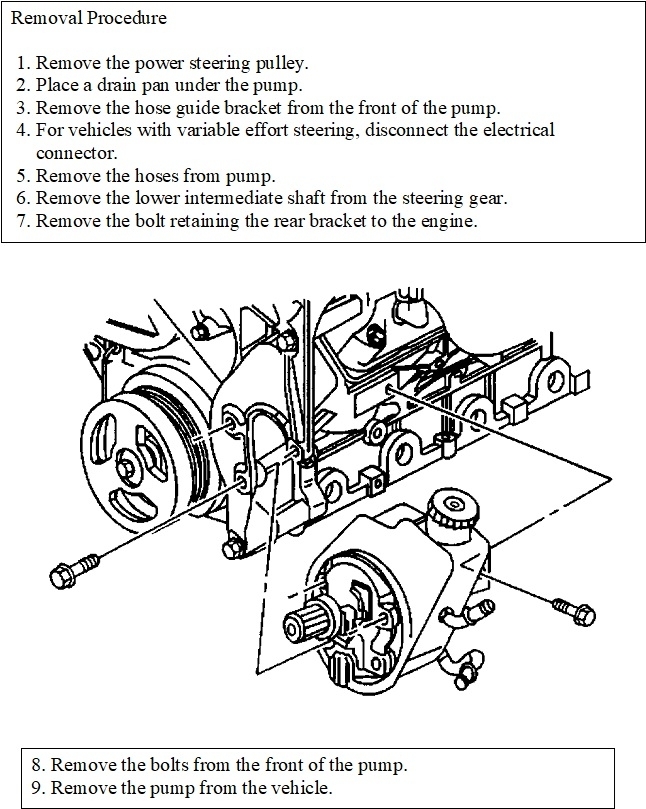
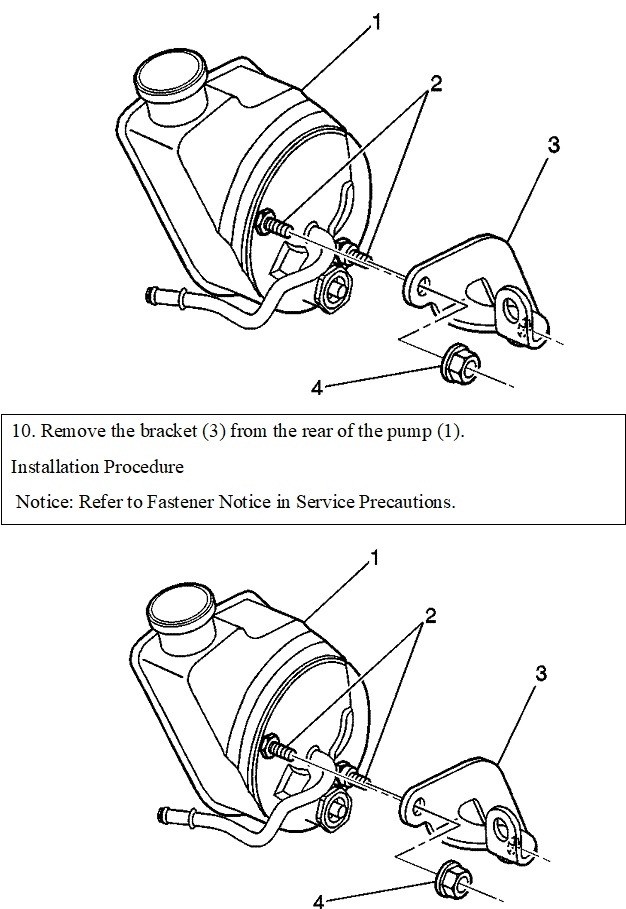
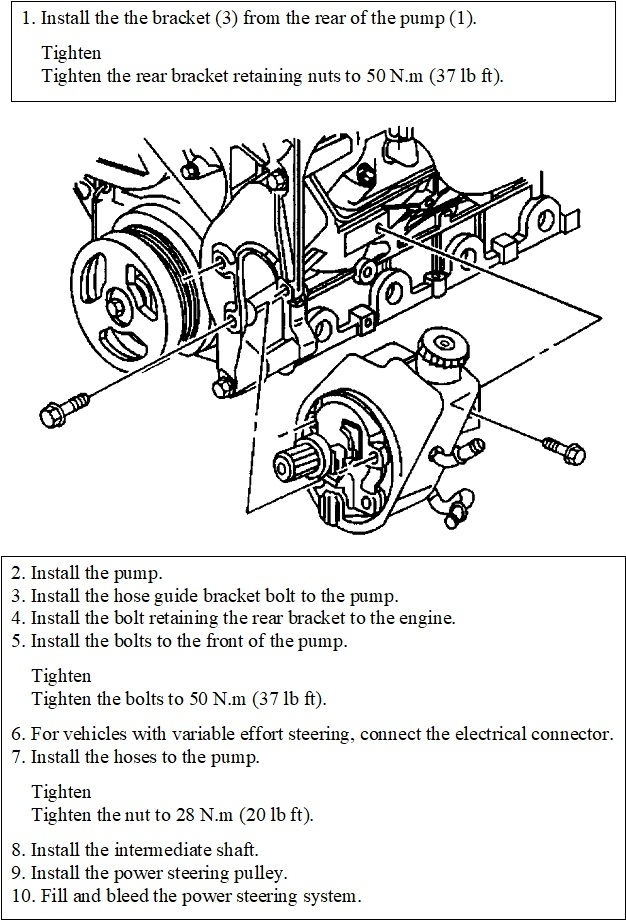
Steve, can you explain to me, step # 6 in the instructions I posted earlier says to remove the intermediate shaft to the steering gear. Why is that necessary? Next, they say to remove the pulley, like I described has to be done on Fords. From the drawings, that doesn't appear to be necessary either. Have you ever done one of these?

As for the type of steering on this truck, both are listed in the parts list on Rock Auto, so both were available, possibly different between 2wd and 4wd. For many years trucks only had the "recirculating ball", or common steering gear box. I posted photos below. That gear box is on top, looking down on the top of it as you'd see it under the hood. A picture of the rack and pinion steering gear is at the bottom. The two parts are not in scale. The top gear box is much smaller and very much heavier.

You can also post a photo of your steering system and we can tell you which type you have.

I thought of one more thing. We have a yard near me where they will install the parts they sell you. I don't know what they charge for that, but it might be worth looking into. They will have all the tools and know exactly what to do the most efficient way.
Was this
answer
helpful?
Yes
No
Sunday, November 23rd, 2025 AT 12:39 PM
Tiny
STEVE W.
  • MECHANIC
  • 15,233 POSTS
Being a 2WD it may have a rack in it, really depends on the option package but the description of still steering OK without power assist would make me bet it's a rack, RB boxes without power generally steer like you are trying to unscrew a tree out of the ground. GM started doing the same as Ford about when they came out with the new front accessory drive plates on the new LS design. GM tells you to remove the intermediate shaft because the rear brace on the pump bolts to the block behind it, it can usually be removed without taking the shaft out but it's tight. The pulley removal is a piece of cake with a removal tool. Takes longer to type that out than it takes to remove the pulley. The tool is available as a rental at most part stores. This is the same pulley and process, https://www.youtube.com/watch?v=MtHG4y_rdMI

If you have never touched a wrench before it will take roughly 3 hours to change it, if you know what you are doing you can easily take an hour off that time. The worst part is usually bleeding out the air.

From your description I agree with Doc, the pump shaft broke when the pump locked up internally. The jolt snapped the belt. Replace the pump and you should be good to go.
Was this
answer
helpful?
Yes
No
Sunday, November 23rd, 2025 AT 2:19 PM
Tiny
PACKERS27
  • MEMBER
  • 219 POSTS
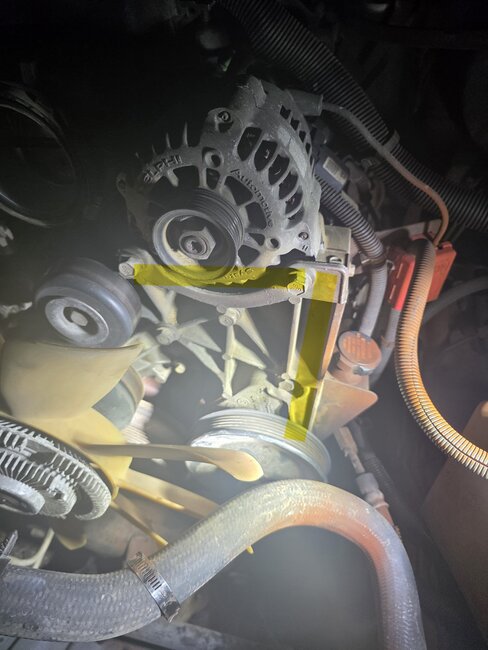
Yall are amazing when it comes to this stuff. I've been using yall for years. Im very familiar with a wrench but only a mechanic to small stuff. I know nothing about a power steering pump. I do have the part number on the pump I have. The brace that is between the pulley and pump is an L shape bracket sort of and it has the pulley attached to it. Not the tensioner but the other one. The entire bracket can come off with the parts attached and I've seen people have them for sale on Facebook marketplace but not the one I need. The part number on my pump is 15766354. Heres a highlighted picture
Was this
answer
helpful?
Yes
No
Sunday, November 23rd, 2025 AT 4:15 PM
Tiny
PACKERS27
  • MEMBER
  • 219 POSTS
On the diagram of yesterday's post I meant to say that #1 pulley is thr fan and #2 is the water pump. I believe that's right
Was this
answer
helpful?
Yes
No
Sunday, November 23rd, 2025 AT 5:21 PM
Tiny
STEVE W.
  • MECHANIC
  • 15,233 POSTS
While you can remove it with the mount you will need to remove a lot more parts than just removing the pulley and dropping the pump out.
Was this
answer
helpful?
Yes
No
Sunday, November 23rd, 2025 AT 7:28 PM
Tiny
PACKERS27
  • MEMBER
  • 219 POSTS
How many bolts hold the power steering pump on
Was this
answer
helpful?
Yes
No
Sunday, November 23rd, 2025 AT 7:50 PM
Tiny
PACKERS27
  • MEMBER
  • 219 POSTS
After watching a video on this, it looks really simple. I already have the fan shroud, and upper radiator hose and air intake out if the way. I may need to remove the fan too, maybe not. I noticed that I have a star pattern bolt (I guess) in the center of the pump shaft. I didnt see that in the dudes video. I assume I will need a puller with that size? Do u happen to know the size and how to go about this
Was this
answer
helpful?
Yes
No
Sunday, November 23rd, 2025 AT 8:46 PM
Tiny
STEVE W.
  • MECHANIC
  • 15,233 POSTS
There are 3 bolts in the front and the one in the rear bracket. Then you swap the rear bracket to the new pump. The torx is machined in the center of the shaft, doesn't get removed. The puller nose sets on it. Then when you install the pulley the stud screws into the threads inside the torx area.
https://www.youtube.com/watch?v=EXDysSOs07g
Was this
answer
helpful?
Yes
No
Monday, November 24th, 2025 AT 8:01 PM
Tiny
PACKERS27
  • MEMBER
  • 219 POSTS
Ok great I believe I can do this fairly easily. Ill report back when I finally get to it. Thank you guys so much
Was this
answer
helpful?
Yes
No
Monday, November 24th, 2025 AT 9:08 PM
Tiny
PACKERS27
  • MEMBER
  • 219 POSTS
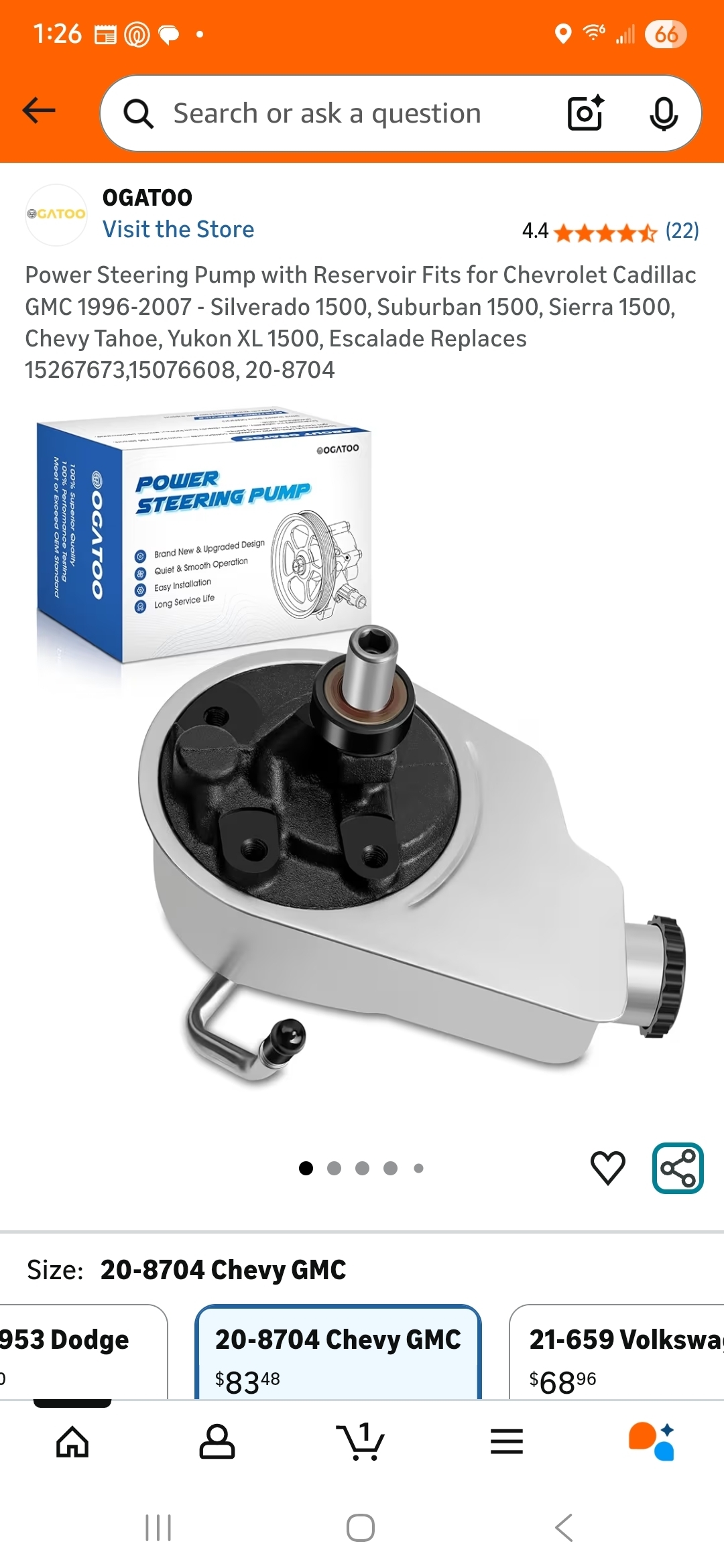
This part off of Amazon shows that it will fit my vehicle because it has the same part number as mine and it's a lot more cheaper than the $385 one. I just wanted to make sure that it would get the job done.
Was this
answer
helpful?
Yes
No
Tuesday, November 25th, 2025 AT 11:25 AM
Tiny
STEVE W.
  • MECHANIC
  • 15,233 POSTS
I generally do not use parts that are online only, and far cheaper than all the other parts stores. Far too many people have discovered that they got junk parts. However it's your choice. Did you look on Rock Auto? They show the OE for 300 but a lot of other options for half that price.
Was this
answer
helpful?
Yes
No
Tuesday, November 25th, 2025 AT 11:40 AM
Tiny
PACKERS27
  • MEMBER
  • 219 POSTS
No I did not I will take a look at that
Was this
answer
helpful?
Yes
No
Tuesday, November 25th, 2025 AT 11:49 AM

Please login or register to post a reply.