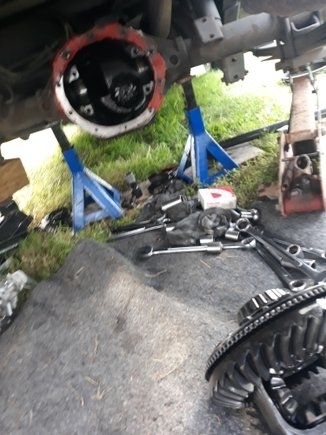
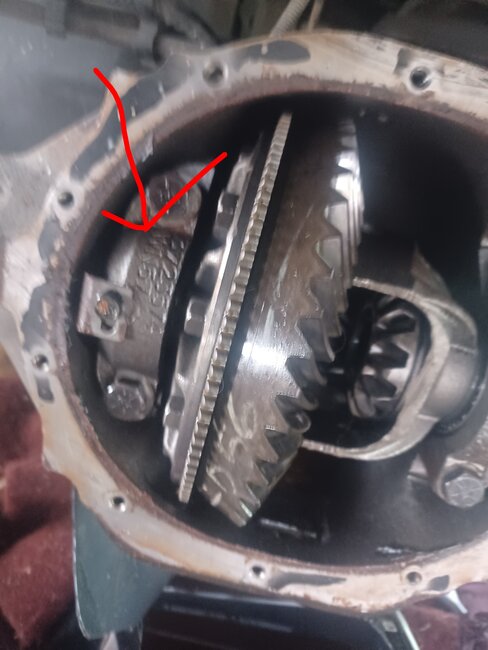
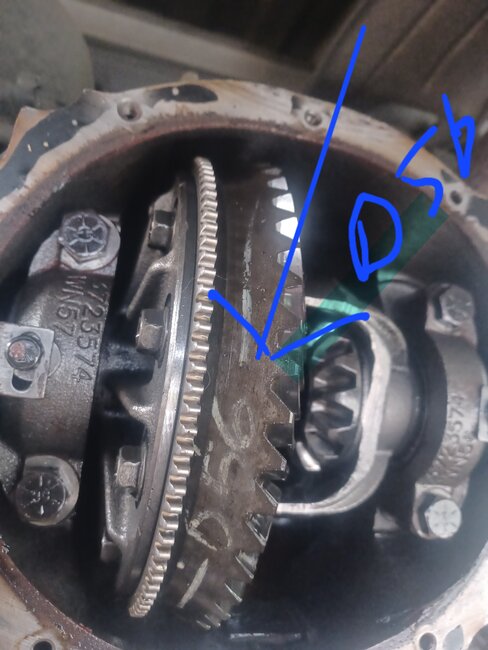
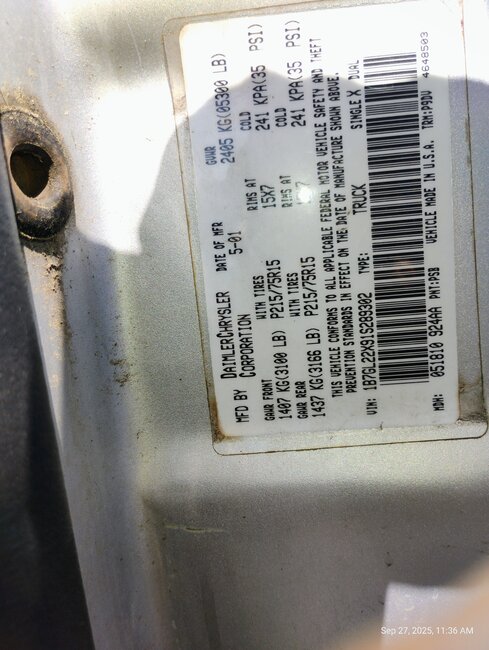
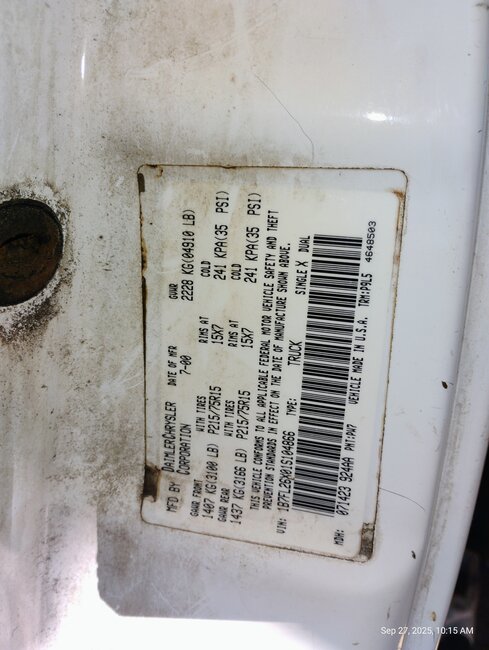
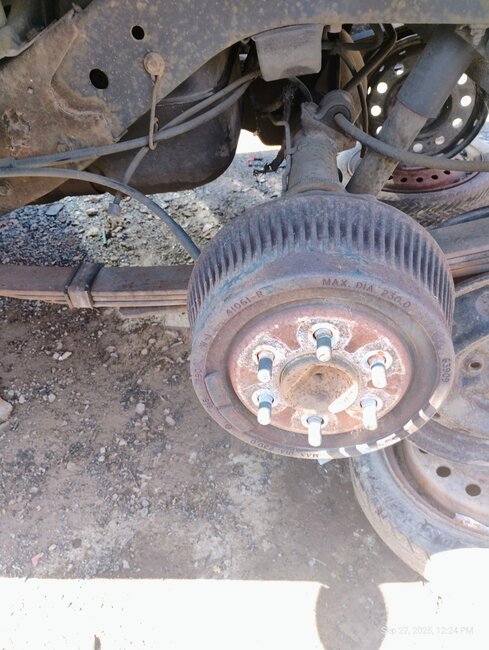
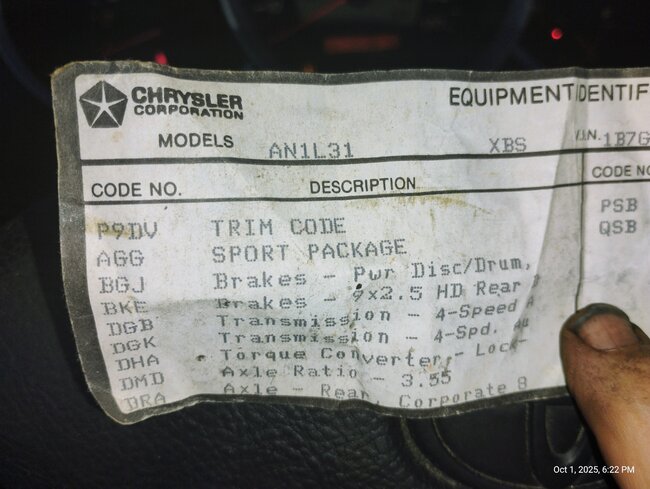
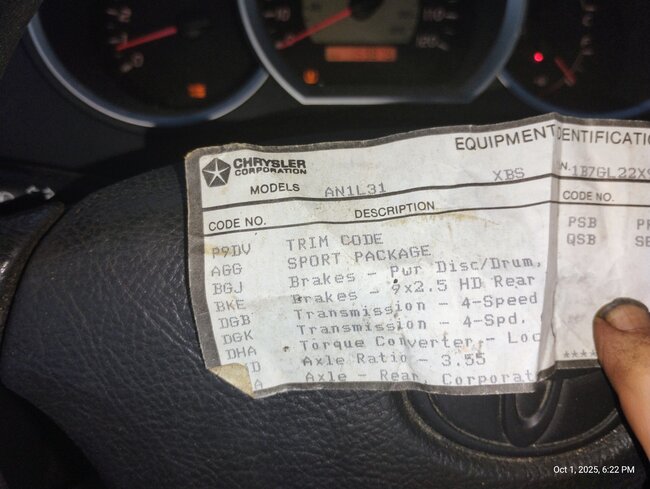
For an axle in the vehicle, fastest is to raise both rear tires off the ground and support the vehicle on jack stands. Leave the transmission in "park" so the driveshaft can't turn. Now, grab one rear tire and rotate it by hand. If you can, it is not a locking differential. When rotating one tire forward, the other one will rotate rearward, (the other way).
When you have a locking differential, both wheels will insist on rotating the same way. To rotate them together, you WILL have to take the transmission out of "park" and allow the driveshaft to rotate. When doing that, there is an over-running clutch in the transmission that you will be forcing to rotate too. Those only like to rotate one way, so don't be surprised if you can rotate the pair of wheels rather easily one way, but it takes more effort to turn them the other way. As I recall, the wheels will rotate easily in the forward direction. You would see the same thing if you were to rotate the drive shaft by hand. One way it will turn somewhat easily with just one hand. The other way, you're turning additional rotating parts in the back of the transmission, so you'll definitely need both hands and it will be noticeably harder to turn.
With these designs, there is a set of spring-loaded clutch plates inside the differential assembly that tries to lock the two small axle gears together. That's what makes both rear wheels rotate under power when either one of the tires slips on snow or mud. Think of this as a rather wimpy hand shake. It gets the job done, but the parts can slip if enough force is applied. In the case of the axle, the two wheels / axle shafts need to rotate at different speeds when you go around a corner. Slippage in the clutch plates allows that to happen, while the pressure ensures both tires get some power when one is slipping. Since there's some play in the springs, during turning, the clutch plates like to grab too aggressively until enough force builds up to tear them apart, then they rotate a little, then grab too hard again. That's what makes the assembly chatter on tight turns. The whale oil additive quiets that chattering.
Now that I've shared this wondrous information, allow me to add a few comments of value, for the benefit of others researching this topic, to ward off potential confusion. There are two other locking differential designs that do basically the same thing, but without those clutch packs. One was an old design we called the "Detroit locker", and I'm pretty sure was only used by GM in the 1970s. That one acted exactly like a standard, or common "open" axle; "open" simply meaning non-locking. Once one spinning wheel was rotating a certain amount faster than the other one, centrifugal force would throw out a weighted lever that activated a mechanical catch that suddenly locked both axles together. That was a result strictly of the difference in rotational speed of the two wheels. I don't know what it took to make it unlock, but it had to do that, otherwise any car, including race cars, are very miserable to drive on dry pavement with the two sides locked together.
Regardless of how or when the unit unlocked, there was also a second weighted lever, also run by centrifugal force, that forced the assembly to unlock at and above 35 mph. At that speed you don't need a locking axle, and to be locked solid like this one did makes for a somewhat dangerous, or unpredictable vehicle to drive at higher speeds. So, this design only kicked in when needed, with no drag at other times, and it never interfered with stability or handling at highway speed.
I know even less about this second design, other than what I've learned from other mechanics. This is a differential used on Dodge trucks that has what looks like an engine oil pump between the ends of the two axle shafts. One shaft holds the body of the pump. The other axle shaft drives the pump's rotor. During normal operation, both parts rotate at the same speed, so no pumping action takes place. It's when there's a significant difference in speed due to one wheel spinning, that the assembly pumps gear lube under pressure. That oil puts pressure on a set of clutch plates that tries to lock the two axle shafts together. It takes a little time for that pressurized fluid to bleed off. The slipping should be done by that time, then the assembly unlocks to improve fuel mileage. I think that design showed up around 2005, give or take a couple of years.
Locking differentials are going by the wayside now. Just about every car and truck model today is available with optional anti-lock brakes, which are an add-on system to the standard brake system. When you have anti-lock brakes, you next have the option to add traction control, and if you have that, you have another option to add stability control. Each new advancement requires the vehicle to have the previous option first. They can't be a stand-alone option. The more advanced 4-wheel anti-lock brake systems control a skidding tire by reducing brake fluid pressure to that one brake, but then it reapplies that fluid pressure once the wheel gets back up to speed and the skidding stops. That, "block, bleed, reapply" sequence can occur up to 30 times per second, but 15 is more common. (That's the buzzing you hear, and feel in the brake pedal, during a skid). Since the ABS system can reapply braking power to any one wheel, the add-on traction control system can do the same thing. Rather than relying on a mechanical locking differential, traction control lightly applies the brake to the spinning wheel, causing the tire with more traction to get more power. My 2014 Ram has traction control, and it's very effective. The first car I drove with it was the first Intrepids at the dealership I worked at, and it too was a lot of fun. Tried, but couldn't get it stuck in snow, going uphill.
By the way, to the best of my knowledge, only one truck, an International from the 1960s, was ever available with a locking front axle. That was back in the days when few people were driving 65 mph. If you can find anything with a locking front axle today, I'm pretty sure it is designed for use on dirt where the tires are free to slip. Driving on pavement with a locking front axle would be extremely miserable and tiring.
There's nothing to gain by going to a synthetic gear lube. Any product specified for this purpose will have the necessary additives, except for the friction modifier. Add that only when necessary. The gear lube will get hot during long highway runs. That causes it to thin, and it gets much stiffer in cold weather. One of the selling points of synthetic oils is they're less susceptible to changes in viscosity with changes in temperature, but if there was a real benefit in those products, the manufacturer would have used them on the assembly line, and they would specify that in the specifications. Standard gear lube meets all the requirements for the bearings to get lubricated, the rubber seals to stay pliable, and it stands up to the pressure between the gear teeth. There's also the consideration that the whole idea of a ring and pinion gear set is the gear teeth are sliding across each other. The gear lube has to stick a film of oil that doesn't squish out, to prevent early tooth wear. The synthetic oils will do the same things, but there's usually different additives in them. To be safe, I would only use synthetic if the entire axle has been drained of the old oil first. Don't use synthetic to top off an axle already filled with petroleum-based gear lube. One product might have a detergent, (more so in engine oil), that attacks the seal conditioner in a different product, for example. Mixing some products can destroy the qualities of both of them. A perfect example is mixing GM's Dex-Cool antifreeze with anything else. It turns it into "Dex-Mud" that can clog radiators and heater cores.
I hope I've covered everything. Let me know if I missed anything.
Oct 2, 2025 at 9:27 PM