"When we unplug the netural safety switch and use the test light and turn the key over there is not illumination on either prong of wires"
You silly guy. Have you not heard that the laws of physics have been rewritten and standard neutral safety switches do not work anymore? The engineers were not satisfied until they added another unnecessary level of complexity to a simple circuit. Instead of the neutral safety switch providing the ground for the starter relay, it now grounds a signal voltage, (most likely a 5.0 volt signal). That tells the computer to electrically provide the ground for the relay's coil. If you have ever heard of Rube Goldberg, you will know how stupid this is, but that is what the insane engineers have forced us to buy.
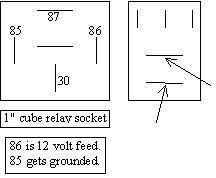
I have been all over the Chrysler web site and find it to be even worse than their paper diagrams. Their test procedure does not agree with the diagrams either, and I cannot even find a drawing of the fuse box, so we will have to figure this out as we go. From their description, it sounds like you have relays under the hood that are 1" square as shown on the left side of this drawing.
It sounds like you already used a jumper wire to jump between terminals 30 and 87 and it cranked. If that is correct, we know the constant twelve volts to the relay is okay, the circuit to the starter solenoid is okay, the battery cables, and the starter are okay. That leaves the coil half of the relay which you were already looking at.
Terminal 85 is listed as getting twelve volts from the ignition switch. You can check that with a test light. In this situation, that is often more accurate than a digital voltmeter. It takes a lot more current to light up a test light. If the contacts inside the ignition switch are arced or burned, or the connector terminals have been overheated, you may not get enough current through to light up the test light or to run the relay, but that could easily show up as twelve volts on a digital voltmeter. That would give an erroneous reading.
In case you have the relay like on the right side of my drawing, or if there is any confusion with the terminal numbers, we can do the same tests another way. Disregard the fifth middle terminal in the relay socket. It is not used in this circuit. With your test light's clip lead grounded to the body or battery negative post, probe the remaining four terminals. One will have twelve volts all the time. That should be terminal thirty. Of the two parallel side terminals, you should find twelve volts on one of them when a helper turns the ignition switch to "crank".
If both of those are okay, we have the two ground circuits to test. Move the test light's clip lead to the battery positive post, then probe the last two terminals in the relay socket. The test light should light up on terminal 87. It will be finding ground through the very low resistance of the starter solenoid. We know that circuit is okay because the starter worked when you jumped 30 to 87.
On older cars, you could easily test the neutral safety switch circuit the same way. It also provided a ground circuit when the transmission was in park or neutral. Since the insane engineers added the engine computer to complicate the circuit, you will have to use an ohm meter to test the switch. Unplugging the switch, then trying to measure voltage at the connector was the standard test when the circuit was designed with common sense. All that was required was the relay be installed and someone had to turn the ignition switch.
What I would suggest with your car, if you have not found a problem in any of the first three circuits, is to stick a thin piece of wire in terminal 86 so you can measure the voltage there with the relay installed. If you see twelve volts when the ignition switch is turned to "crank", it is not getting grounded by the engine computer. The possibilities are a broken wire to the computer, (not likely), a problem inside the computer, a problem with the neutral safety switch or wire to it, or the vehicle's anti-theft system may be involved in disabling the starter. That would correlate with the engine not running when you bypassed the starter relay and it cranked, assuming the ignition switch was turned on.
If you have to test the neutral safety switch, the easiest way is probably to go to the engine computer and measure right from the connector. Sorry I cannot find a drawing of the connectors and pins. You will have to go according to wire colors, and often Chrysler molds the pin numbers on the plugs or sockets.
Connector 3, pin 38, a 20 gauge tan wire comes from the relay socket and must get grounded by the computer. Connector 4, pin 27, a 20 gauge black/white wire goes to ground through part of the neutral safety switch. You should be able to test that with a digital voltmeter or an ohm meter. You should read close to 0 ohms in park or neutral, or you will read 5.0 volts, (I am thinking), or twelve volts in reverse or drive. I would shy away from testing that circuit with a test light unless you unplug the connector from the computer. If it does send out 5.0 volts to be grounded by the switch, applying twelve volts through the test light could potentially damage the circuitry.
If you find all four parts of the circuit are working, I can offer three suggestions. There are five switches built into the "transmission range switch". One is for the backup lights, one is for the starter relay, but two of the other switches are also grounded in park and one in neutral. Perhaps they are related to the problem. The third thing is the computer itself.
After searching further, I cannot find any reference to an anti-theft system even offered or being involved with the engine or starter. You might instead consider the no-crank and failure to start problems could be related. A missing voltage to the engine computer could prevent it from turning on the automatic shutdown (ASD) relay and the starter relay. We will have to pursue that further if necessary.
Dec 27, 2017 at 11:35 AM
(Merged)