After a rebuild, it is a normal part of the procedure to adjust the mixture screws. The plastic caps were intended to prevent tampering with what was already adjusted properly at the factory. Conditions are different after the rebuild, so those caps are discarded.
Idle speed is not related to the mixture screws. If you hold the throttle blade open a little, you'll see if you work the choke blade by hand, a linkage pulls up on the idle speed cam. An idle speed adjusting screw rests on that cam and is used to set idle speed. The choke needs to be wide open, then, that cam needs to drop down to the low idle position. It can't do that while the throttle is released because the idle speed screw is putting pressure on it. That's why you must tap the accelerator pedal momentarily to let that cam drop down.
Sometimes those cams get gummed up with grease and oil residue, and need to be cleaned with Carburetor Cleaner from a spray can, but that shouldn't be a concern now, right after a rebuild.
I should back up a moment and start from the beginning. When the engine is cold, a thermostatic spring is trying to pull the choke blade closed, in preparation for starting. The idle speed screw is holding the cam from moving. That makes it impossible for the choke blade to close. You must press the accelerator pedal just an inch or two to let the choke blade close. Normal procedure is to press the accelerator further, one time. That "sets" the choke, and fuel sprays from the "accelerator pump" into the intake manifold for priming. That spray is needed because liquid gas does not burn. Only vaporized gas can burn. The goal of that sprayed-in gas is for a high enough percentage to turn to vapor by the time it gets into the cylinders for the engine to run. Most of that gas goes out the tail pipe, wasted, as a liquid, until the engine warms up.
As soon as the engine starts running, a vacuum-operated "choke pull-off" pulls the choke blade partway open through a short linkage. How much it pulls the blade open is critical and is adjustable. Opened too much when the engine is still cold will cause a lean stumble when trying to drive, or the engine may stall. Open too little, you'll have black smoke from the exhaust, or the engine may stall from being flooded. When you have a choke pull-off on the side of the carburetor, the linkage is in the form of an "S" bend. The adjustment is made by squeezing together or pulling apart that bend to make the linkage shorter or longer.
Many GM carburetors used a black plastic disc on the side of the carburetor for the choke pull-off. They have the thermostatic spring and the choke pull-off built into that one assembly, and on newer models, there could also be an electric heater built in to get the choke opened faster. Those will have one wire attached to the side of that disc. The disc is held on with three screws. Loosen those screws just enough to allow the disc to be rotated. That is how that style is adjusted. There's usually writing molded on the side with arrows that tell you which way to rotate it to make the choke open more or less / sooner or later.
When you don't have that black plastic disc, the thermostatic spring sits in a well in the intake manifold. A "heat riser" valve in the passenger-side exhaust manifold closes to force all the exhaust gas from that side to flow through a passage through the two cylinder heads and the intake manifold, then out the left side. That hot exhaust gas passes right under the thermostatic spring to warm it and cause it to open, and it warms the base of the carburetor to prevent icing in cold weather. It used to be quite common for that passage to become blocked with carbon. The symptom was after running okay for a few minutes, the choke wouldn't open all the way. A lot of black smoke came from the exhaust, and the engine ran very poorly. The electric assist on newer models helped solve the choke opening, but it didn't help with warming the base of the carburetor.
Related to that, the snorkel on the air filter housing has a vacuum-operated "motor" that opens a valve in cold weather so warmed air is drawn from around the left exhaust manifold, through a tube, into the air intake to help with getting the liquid gas to vaporize.
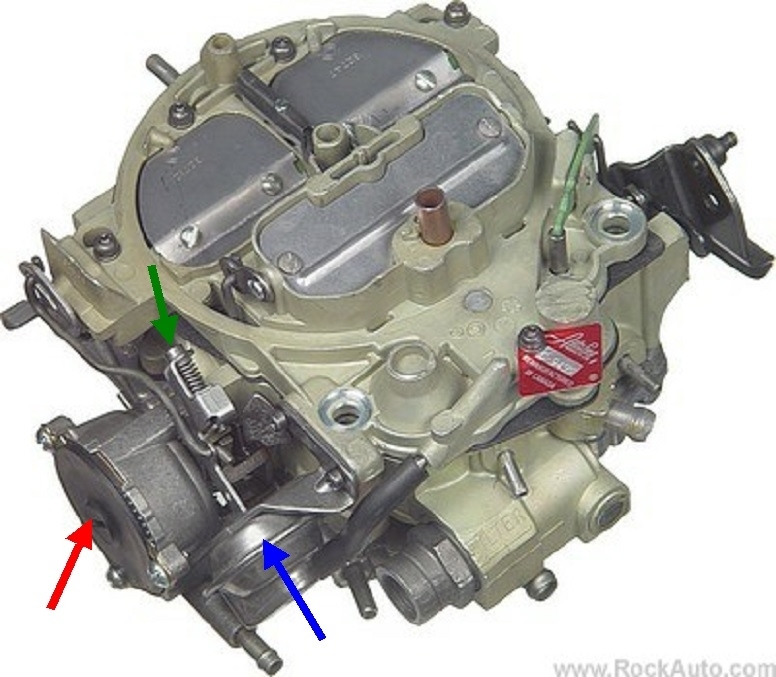
The first photo below shows the Quadrajet carburetor uses a combination of the things I described. The blue arrow is pointing to the vacuum-operated choke pull-off. Instead of the "S"-bend linkage, a screw, (green arrow), is used to set how far the choke blade opens. The red arrow is pointing to the cover over the thermostatic spring. The three screws are loosened just enough to allow that disc to be rotated. Just to the right of the red arrow, you can see a group of little notches in the housing. Those are to indicate where the disc is set. Adjustments are very small to make a big difference. When an adjustment is needed, usually one or two notches is enough. There's no terminal on this one for the electric choke assist. If there had been one, it would have been just above or to the right of the red arrow.
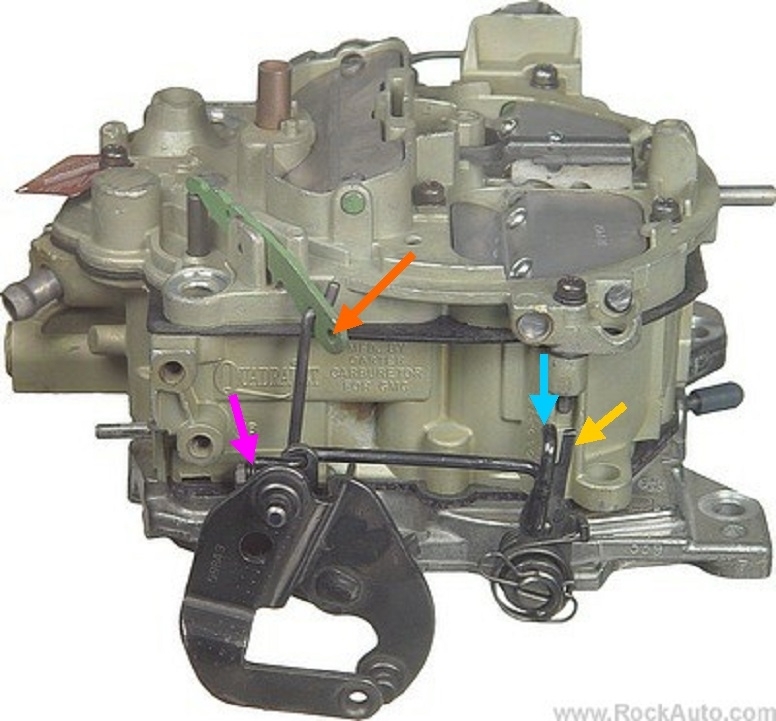
In the second photo, the purple arrow is pointing to the idle speed screw. On this carburetor, the accelerator pump is adjusted by putting the linkage in a different hole in the pump's lever, (orange arrow). There were normally three holes, but there's only two in this photo. If the pump was set to take a stroke that was too short, you'd have a miserable stumble and hesitation when trying to accelerate, even very gradually. If the stroke was adjusted too long, engine performance would be okay, but it wasted gas every time the accelerator pedal was pushed down. This is the lever for the pump that sprays the priming squirts in when you press the gas pedal to start the engine.
Another adjustment has to do with when the secondaries open. Opening too soon wastes gas. Opening too late causes a lag in power when more is needed for passing or going up hills. This adjustment is easy to do, but hard to describe. It involves bending the linkage at the light blue arrow. You bend the top of it forward or rearward. The top of it pushes on the spring-loaded lever, (yellow arrow). The more the link is bent forward, the further you must press the accelerator pedal before the secondaries start to open. Adjusting them to open later can increase fuel mileage at mid-throttle where the extra power isn't needed.
To address your question about having to press the accelerator pedal twice when the engine is warm, most likely too much gas was going into the engine when it was stopped, and that created a too-rich condition for the next start-up of a warm engine. Pumping in more gas next to the base of the carburetor gives it a chance to vaporize by the time it gets to the cylinders. The engine needs that gas to be in vapor form to burn. A potential clue here is the engine starts rather easily when cold, without having to set the choke.
It is also possible the engine was running too lean when stopped last time. Little fuel is left in the intake manifold. Since cranking takes place at a very low speed, fuel is not easily drawn into the cylinders. You need a lot more liquid gas to ensure a high enough percentage vaporizes to get the engine to run.
Images (Click to enlarge)
Feb 19, 2025 at 10:20 AM
(Merged)