Logo Automobile Information Add Site to Favorites  
Auto Repair
Auto Repair Home
Auto Repair Ask a Car Repair Question
Auto Repair Car Question Forum
Auto Repair Questions by Manufacturer
Auto Repair Questions by Topic
Auto Repair First Things to Check
Auto Repair How to Repair or Service
Auto Repair Car Repair Manuals
Auto Repair How Does it Work
Auto Repair Car Repair Video Series
Auto Repair Auto Maintenance
Auto Repair Car Sound Problems
Auto Repair Auto Term Abbreviations


Popular Site Links


Auto Repair Automobile Safety Inspection
Auto Repair Brake Replacement Guides
Auto Repair Service Engine Soon Light
Auto Repair Belt Routing Diagrams
Auto Repair Avoid Car Repair Rip Offs
Auto Repair Trouble Code Table
Auto Repair How to use Diagnostic Tools
Auto Repair Smog Test Preparation
Auto Repair Hybrid Car Information
Auto Repair Test Equipment Store
Auto Repair Auto Parts
 
Search Website
 
 
Recent Repair Topics


Auto Repair1992 Cadillac Deville T...
Auto Repair1979 Dodge Van Engine R...
Auto Repair1998 Jeep Wrangler Heat...
Auto Repair2005 Chevy Aveo
Auto Repair1999 Infiniti I30 Car I...
Auto Repair2007 Ford Focus How Do ...
Auto Repair1965 Other Ford Models B...
Auto Repair More Repair Topics...


Car Repair Advice by Professional Automotive Experts


Car Noises / Clicking Noise

Why is My Car Make a Clicking Sound?

Introduction - READ COMPLETELY BEFORE BEGINNING

When a clicking noise is detected first locate the area of the car it is being generated from. If the noise is being generated while you drive and you are having a hard time detecting the location of the clicking, have a helper ride along in the rear seat to give a new perspective on the origin of the clicking noise. A clicking noise can be generated by many things, from low engine oil level to loose lug nuts. Once a clicking sound has been detected action must be prompt. Clicking in most cases is telling you something has failed or is failing. There are some systems that make a clicking noise that is natural and nothing to worry about, for example: fuel injectors, relays, emergency flashers, turn signals and the air conditioner when you first turn it on. These components make a natural click noise when operating. We have listed the most common causes for a clicking noise below:

Clicking Sounds
Clicking Noise

Car Clicking Repair Guide:

  • Fan Blade Contacting the Shroud or the Fan Motor Has Failed:  To inspect an electric cooling fan start with ignition key off, next spin the fan blade by hand, it should "freewheel" if the fan motor does not spin freely it has failed and needs to be replaced. Next, check to make sure the fan blade is not contacting the fan shroud, if so reposition the fan motor to allow for more clearance and recheck operation. Use this procedure to check a belt driven fan driven assembly as well.
    Radiator Cooling Fan
    Radiator Cooling Fan
     

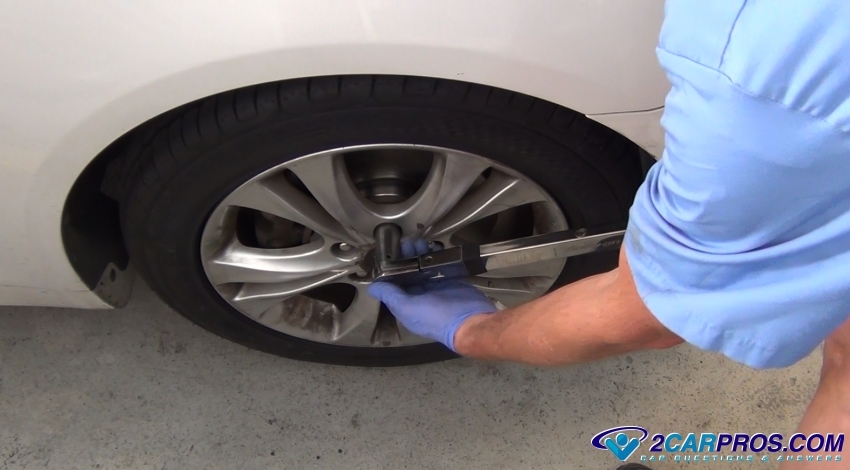
  • Loose Wheel Lug Nuts: The lug nuts on your car are used to fasten the rim and tire to the axle. It is recommended that the lug nuts are tightened to a specific manufacturer torque specification. If these lug nuts become or are left loose they can make a clicking noise while the car is in motion. To check for this condition use a lug wrench equipped with the correct size for your particular lug nut. If the lug nuts are loose re-tighten as needed. (Note: if the lug nuts have been loose for an extended amount of time it can damage the wheel stud and/or rim. Check for damage and replace or repair as needed).
     
  • Engine Making a Clicking Noise - Check the engine oil level, your engine depends on clean engine oil to lubricate the internal moving parts, if the engine oil level is low or the oil is dirty it can cause internal engine parts to malfunction. For example: a valve lifter is responsible for holding valve train clearance to a minimum, if the oil level is low or dirty it can cause the lifter to malfunction which will allow excess valve train clearance creating engine tapping or clicking noise. In extreme cases or when your engine has run out or close to out it can cause one of the many bearing surfaces to fail causing permanent engine damage and noise until repairs have been made. If this condition is left unattended the engine will suffer permanent damage and fail. If your engine is making a noise change the engine oil and filter with the manufacturers recommended weight (viscosity) oil first, if that does not make a difference engine repair work is needed. Click for additional engine noises.
     

    Change Motor Oil and Oil Filter
     

  • Loose Brake Caliper or Brake Pads: The brake pads and calipers are designed to slow the vehicle when applied. The brake caliper holds these brake pads that are applied to the brake rotor. If the caliper is loose or if the brake pads are not fitted properly they will make a clicking noise. To check for this condition inspect the brake caliper mounting bolts and brake pad mounting. The brake pads should not move vertically. If so the brake pad shims could have fallen out or the wrong brake pads are installed.
     

    How to Change Front Brake Pads and Rotors
     

  • Checking Broken Accessory Brackets: The engine accessories mounts are held in place on the engine using sheet metal mounts. These mounts can crack causing a ticking noise. To check for this condition remove the serpentine belt and start the engine if the noise is not present inspect the accessory brackets. Look for any rust colored powder usually located at the bolt holes or bends. This rust colored powder is indication of a crack in the mount. The ticking noise is generated as the metal is stressed. Repair or replace any broken mounts as needed.
     
  • Checking Heater Vent Control Actuators: The heater and air conditioning systems in your car use a electronic controller that moves an air blend door/mode door inside the heater plenum. These doors are used to control the airflow to various positions such as defrost, mi-level and floor positions. Blend doors also control the air temperature as it changes from heater to air conditioner mode. When blend door actuators fail they will make a clicking noise that is like a small machine gun. Depending on the condition of the malfunction the actuator can produce clicking noise for the duration that the ignition key is in the "on" position, while other malfunctions will be produced for a short time, say 20 seconds. If this condition occurs the blend door actuator needs to be replaced.
     
  • Check for Compressor Clutch Engagement - Turn the air conditioner to the "on" position and set controls to the coldest setting. Start the engine and allow to idle. Then open the hood and inspect the clutch at the front of the compressor, is it turning? "Engaged" if so, the system has enough refrigerant to activate. If the system is low on refrigerant it will not work properly. In this case an air conditioner recharge kit is needed to recharge the system. If the system is low on refrigerant it could cycle on and off, making a ticking noise. If the compressor clutch is not turning proceed to next step.

    Air Conditioner Compressor
    Air Conditioner Compressor
     

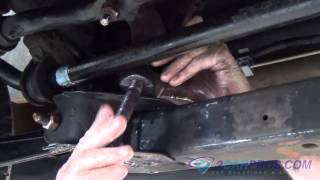
  • Check Sway Bar Links/Connectors/Bushings. The sway bar on your car is designed to stop the car from rolling (leaning) when driven into a corner. This bar is attached to the frame on each side and connected to each suspension control arm on both sides. To inspect sway bar bushings for wear look for cracked bushings or missing link insulators. If damage is observed replace the sway bar links with new and recheck system replace as needed.

    Sway Bar Link and Mount
    Sway Bar Link and Mount
     

  • Checking Front or Rear Strut Failure: Struts are created with hydraulic dampening valves that can fail causing a clicking or popping noise. If strut oil is leaking the shaft seal has failed and will cause a rattle or clicking noise. To test for this condition disassemble strut assembly and check for excessive strut movement, if strut is easily moved (low resistance) replacement is needed. A spring compressor is required for disassembly.


    Front Strut Leakage
     

  • Checking Front or Rear Shock Failure: Shocks are created with hydraulic dampening valves much like struts and can fail causing a clicking or popping noise. If shock oil is leaking the shaft seal has failed and will cause a rattle or clicking noise. To test for this condition inspect shock assembly and check for leakage, if shock is easily moved (low resistance) replacement is needed.

    Rear Shock Leaking
    Rear Shock Leaking

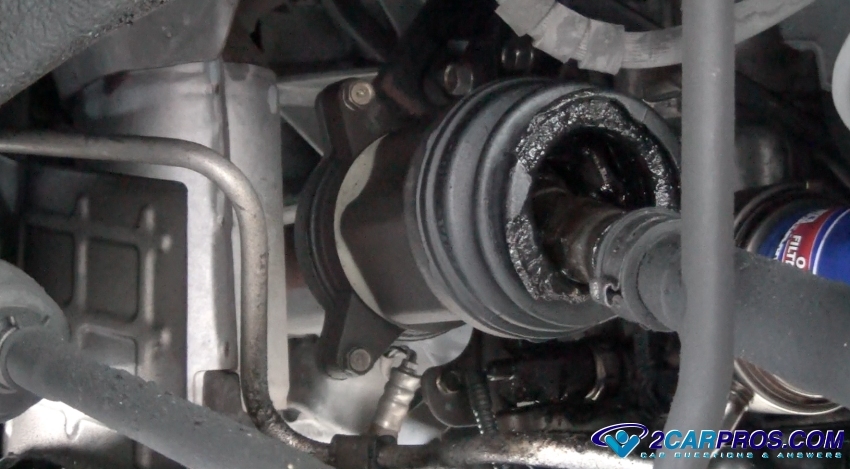
  • Testing Check Front Drive Axle CV Joints: When CV joints start to wear they will bind up on acceleration and in tight turns. This causes a vibration in the front suspension that transfers to the vehicle. Remove drive axles and inspect flexibility of each CV joint. If a bind or hard spot is observed the CV Joint/Axle needs to be replaced.

    Front Wheel Drive Axle
    Front Wheel Drive Axle

  • Drive Shaft U Joints: A driveshaft U joint is designed to act as a rotating junction that can be flexible while still transferring energy from the engine to the rear differential. A universal joint or U joint is constructed of 4 bearing caps that house multiple needle bearings. The universal joint is lubricated by adding grease through a zirk fitting on the joint. Some u joints are manufactured with a proper amount of grease and do not need service and therefore do not have a service fitting. If a universal joint fails it can make a clicking noise that contours the motion of the car. This condition is most noticeable at very slow speeds, and fades at higher speeds. To check for this condition inspect the U joint and look for a light rust powder around the bearing cups. This rust colored powder is caused by metal disintegrating and is a sign of universal joint failure. When a universal joint has failed it must be replaced and cannot be repaired.

    Universal or "U" Joint
    Universal or "U" Joint

  • Checking the Serpentine Belt Tensioner: If the belt is loose it can cause the belt to produce a clicking noise due to the lack of pressure needed for the belt to operate properly. The belt tensioner is responsible for hold pressure on the belt using an idler pulley with a coil spring. Replacing your car's multi rib belt or belt tensioner is relatively simple repair that can be done in a few minutes with minor tools in most cases. Always wear protective gloves and eyewear before you begin. To replace the belt or the belt tensioner reference the "how to replace a drive belt" video below:

    Drive Belt Tensioner
    Drive Belt Tensioner (appearance will vary)

    Get the Free Flash Player to see this video.

    Change Multi Rib Belt Video

  • Checking Axle Bearing Failure: An axle bearing is designed to support the weight of the vehicle by allowing the wheels to rotate. These bearings are manufactured with high grade steel that resists wear under extreme conditions. When an axle bearing fails it allows metal to contact metal under pressure with a linear motion creating a clicking noise. Remove axle bearing and replace with new and recheck. Some vehicles are equipped with a bearing hub assembly. This style of bearing is replaced by un-bolting the bearing hub assembly and replacing it with new.


    Axle Bearing Hub
  • Checking Clutch Noise: When your car is stopped or coming to a stop the engine needs to be disconnected from the transmission or the engine will stall. With automatic transmission vehicles a torque converter is used to separate the two units, but with manual transmission vehicles a clutch assembly is used to do the job. This clutch kit or unit is composed of a clutch disc, pressure plate, throw out and pilot bearings. (Some front wheel drive vehicles do not use a pilot bearing). Both types of vehicles use a flywheel but are designed a little differently. An automatic transmission has a lighter weight unit that the torque converter bolts directly to and is sometimes referred to as a flex plate. A manual transmission flywheel assembly is made heavier to help engine inertia and to make shifting smoother. The clutch pressure place bolts to the flywheel trapping the clutch disc in-between. The throw out bearing presses against the pressure plate to engage and release the disc. The pilot bearing is mounted in the flywheel and holds the input shaft for the transmission steady. When a throw out, pilot, or input shaft bearing starts to fail it can make a clicking noise that is audible when the clutch pedal is pressed or released. If the clicking noise stops or starts suspect these bearings.

    Clutch and Flywheel Assembly
    Clutch and Flywheel Assembly (Cut Away)

  • Check Exhaust System for Leaks: The exhaust system in your car is designed to move exhaust gases the engine creates to the rear of the car. If this system has small leaks it can cause to clicking noise, especially if the leaks are near the front of the engine at the exhaust manifold. Inspect the exhaust system for leak be looking for any flat black soot, this is a sign the system is leaking. Repair as needed to recheck system.

    Exhaust Manifold
    Exhaust Manifold
  • Rapid Ticking Noise When Engine is Cranked Over: A common problem with a car battery is low voltage. As a battery ages it loses the ability to store electricity resulting in an insufficient flow of electrical energy to the starter. The starter is designed to operate on a high amperage 12 volt system. When a starter is subjected to low voltage or amperage (flow) it will cause the starter to engage and disengage rapidly producing the machine gun like sound. To fix this problem a battery inspection or replacement is needed. There are two reasons that a battery will not perform as it should, either the alternator has failed allowing the battery's state of charge to become weak or the battery has failed and replacement is required. More: Rapid ticking noise when engine is cranked over
     
  • Checking Ignition System: The ignition system in your car ignites the fuel inside the engine's combustion chamber at the optimal time in the piston stroke to produce the most power while emitting the least amount of emissions as possible. There are many configurations of ignition systems but all operate on the same principle, create a low energy field and collapse it onto a high energy coil and that transfers the electrical energy into the secondary ignition system, i.e. coil wire, distributor cap and rotor (if equipped) plug wires and finally the spark plug. If the ignition system is failing it can cause an electrical charge to jump from the system to ground producing a clicking noise. Inspect system and repair as needed. Also a loose spark plug can cause a click noise while the engine is running. Locate the spark plug in question and tighten as needed.

For manufacturer specific procedures for any of the steps above please visit our car repair manual page.


Popular Service Repairs
Test Fuses
Replace Front Brake Pads
Check Engine Light
Rear Brake Shoes
Rear Brake Pads
Test Alternator
Replace Air Filter
Test Battery
Tune Up
More Service Repairs...
Advertisement
Car Questions
Acura
Alfa Romeo
American Motors
Audi
BMW
Buick
Cadillac
Chevy
Chrysler
Citron
Daewoo
Daihatsu
Dodge
Eagle
Ferrari
Fiat
Ford
Geo
GMC
Honda
Holden
Hummer
Hyundai
Infiniti
International
Isuzu
Jaguar
Jeep
Kia
Land Rover
Lexus
Lincoln
Mazda
Mercedes Benz
MG
Mercury
Mini
Mitsubishi
Nissan
Oldsmobile
Opel
Peugeot
Plymouth
Pontiac
Porsche
Renault
Rolls Royce
Rover
Saab
Saturn
Scion
Seat
Skoda
Subaru
Suzuki
Toyota
Vauxhall
Volkswagen
Volvo

Home l Help l Privacy Policy l User Agreement l About Us l Computer Repair Question l Contact Us l Link to Us l We're Hiring l Affiliate Program
  Copyright © 1999 - 2009 2CarPros.com - Professional Mechanics Online