I performed the following steps: I observed all of the markings for both cams and the crankshaft sprockets. I followed the book by placing the crankshaft at 11:00, and located the marked links on both timing chains. Before closing up the front cover, I performed two "dry runs", where I would time both sprockets, rotate the engine several times with a tourque wrench, and tear it back apart until I was satisfied that all marks were properly aligned. I verified that I was on the compression stroke, because all valves for the #1 cylinder were closed, which means it is in the compression stroke.
I followed the book to the letter, so I hope the book was right.
I measured 40psi fuel pressure, which stayed at 40 psi after shutting off the engine for at least 5 minutes, indicating that there was no appreciable leak-down.
To determine the spark, I used a spark tester. All cylinders had a good, consistent spark.
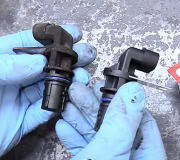
As far as the crankshaft position sensor is concerned, I took apart the harness, and ohmed out the wires to it. There were no shorts or opens, and the CKP itself read 345 ohms. The book said it should be between 290 and 390. However, I don't have an oscilloscope, so I can't actually measure the waveform. I may consider replacing it, since it costs less than $20.00. I don't mind spending that much to eliminate that as a suspect.
I don't know how to measure the signals to the fuel injectors, but I agree, that should be next. I will say, though, that during the starting process, some of the spark plugs had gas on them, so the fuel injectors are at least doing something.
Do you think it would be worth it to get a used oscilloscope? Alternatively, what would happen if I manually turned the engine a few degrees at a time, and looked at the CKP with a flukemeter - would that tell me anything?
Thanks.
Monday, September 24th, 2007 AT 8:23 PM