Sorry, you're grandpa's information is seriously out of date. You must never, ever disconnect a battery cable while the engine is running. Doing so can instantly destroy multiple computers. This was a test done back in the 1960s and '70s by mechanics who didn't understand how these simple circuits work.
It is very easy to have an engine that keeps running with a failed generator, and on some models, the engine will stall when a battery cable is disconnected, even though the generator and the voltage regulator are fine, so that "test" has no value.
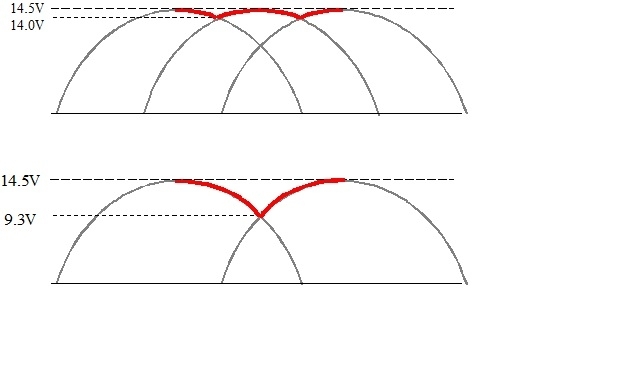
All AC generators, (aka "alternator), develop three-phase output, as shown in the top waveform below. Three-phase is very efficient, but it has some "ripple" voltage. In the top waveform, ripple voltage is only half a volt, the difference between 14.0 volts and 14.5 volts. It's the battery's job to smooth that out to a steady, roughly, 14.3 volts. The voltage regulator is the other half of the team. It holds system voltage to a safe level, and the battery is needed to help it do that.
When you disconnect the battery, the voltage regulator is going to "see" and respond to the 14.0 volts or the 14.5 volts, depending on the design of the circuitry. If it responds to the 14.5 volts, the regulator will reduce generator output in an attempt to lower its output voltage. It often can't lower the voltage enough because it keeps on seeing the highest point in the waveform. It reduces generator output so much that system voltage drops too low, then computers begin to shut down. This is where the engine would stall even though the entire charging system is working perfectly fine.
In some other designs, the voltage regulator responds to the low points in the waveform, 14.0 volts in this case. It tries to boost generator output, and while the high points, the 14.5 volts goes up, the regulator still responds to the low points. It keeps on raising output voltage until it can go as high as more than 30 volts. I've reached 35 volts on a test bench. That will destroy computers and burn out any bulbs that are turned on. One thing that can save you is generators are very inefficient at low speeds. Normal generator testing includes the need to raise engine speed to 2,000 rpm. That's where the generator's efficiency picks up and system voltage WILL go too high when the battery is disconnected.
Charging systems can fail in a number of ways. One way is the failure of one of its six "diodes". Those are one-way valves for electrical current flow. When one fails, you lose exactly two thirds of the generator's current-producing capacity. Your generator is rated at 110 amps. With one failed diode, the most it can develop is less than 40 amps. That may not be enough to meet the demands of the entire electrical system under all conditions. The battery has to make up the difference as it slowly runs down over days or weeks. With the misguided test of removing a battery cable on an older car, the engine would keep on running, even though the generator is defective.
The proper way to test the charging system is with a professional load tester. You can start the testing yourself if you want to with a simple digital voltmeter. Start by measuring the battery's voltage with the engine off. It should be very close to 12.6 volts if it's good and fully-charged. If it reads closer to 12.2 volts, it is good, but fully discharged. Charge it at a slow rate for a few hours with a small portable charger. If it measures around 11.0 volts or less, it has a shorted cell and must be replaced.
Next, measure the battery voltage again with the engine running. Now it must be between 13.75 and 14.75 volts. If it is, the voltage regulator is working properly, but this test only means it is okay to perform the rest of the tests. Those require the professional load tester. The series of tests takes less than a minute once the machine is connected. It measures the charging voltage, which you just did, and full-load output current and ripple voltage.
Full-load output current should be within a few amps of your generator's rated current, 110 amps. Ripple voltage is usually just shown as "low" or "high" with a series of flashing lights. We want that to be "low". When it is "high", it points to the failed diode. That's also when full-load output current will be way too low, as in less than 40 amps.
Here's links to some dandy articles that can explain this better than I did:
https://www.2carpros.com/articles/understanding-the-function-and-mechanics-of-an-alternator
https://www.2carpros.com/articles/how-to-check-a-car-alternator
https://www.2carpros.com/articles/how-to-use-a-voltmeter
The last one shows how to use a typical voltmeter, but they're using one with the "auto-ranging" function. That's an expensive feature you don't need. You can find a perfectly fine meter for around $7.00 at Harbor Freight Tools. Walmart and any hardware store have them too. I can help you set it up if needed.
Let me know what you find, then we'll figure out if there really is a problem.
Sep 9, 2025 at 3:36 PM