Yes. The proper way to test the charging system is to measure the battery voltage with an inexpensive digital voltmeter. Do that first with the engine not running. A good, fully charged battery will read very close to 12.6 volts. It will read higher right after charging due to "surface charge". That's an accumulation of electrons in the electrolyte that haven't been absorbed into the plates yet. To dissipate that surface charge to get a more accurate reading, just turn on the headlights for a few seconds.
A good battery that is run down will read around 12.2 volts. If you find it's closer to 11.0 volts or less, it has a shorted cell and must be replaced.
Next, measure the battery voltage again with the engine running. Now it must be between 13.75 and 14.75 volts. It might be a little higher if the battery is considerably discharged and the charging system is being run harder to charge it up. Don't get excited if you find it's around 15.0 to 15.3 volts. It should come down gradually over the next few minutes.
If these voltage tests are okay, that only means it is okay to do the rest of the tests, but those require a professional load tester. It will also measure full-load output current and "ripple" voltage. Here's a link to an article that explains it better:
https://www.2carpros.com/articles/how-to-check-a-car-alternator
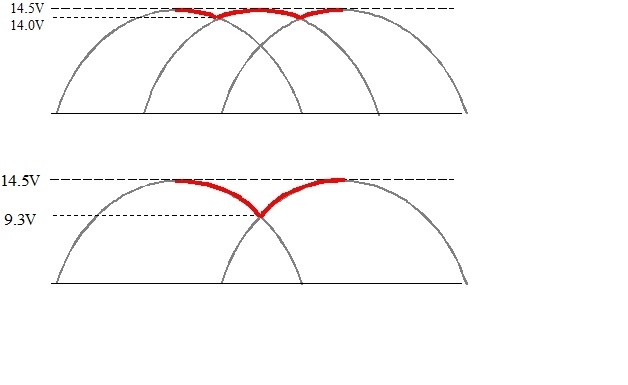
I put this drawing together to show what ripple voltage is. That's the red line in the top drawing. Every AC generator, (technically, "alternator" is a Chrysler term), has at least six "diodes". Those are one-way valves for electrical current flow. If all six are good, you'll get the top waveform, and under test, this is the only time the alternator will develop the maximum current it is designed for. You can find the listings on the Rock Auto web site, but I'd be pretty sure yours is rated for at least 120 amps.
When one diode has failed, you'll get the lower waveform in my sad drawing. Ripple voltage here is "high" and will be shown as such with a series of flashing lights on most testers. The other symptom is the alternator will only be able to develop exactly one third of its rated current. That can be enough to keep the engine running, but it's usually not enough to meet the demands of the entire electrical system and charge the battery. The battery will have to make up the difference as it slowly runs down over days or weeks. High ripple voltage also commonly shows up as an irritating whine on AM radio, that changes pitch with changes in engine speed.
Most vehicles today have voltmeters on the instrument cluster. They are notoriously inaccurate as far as voltage readings go, but are very good at showing when you see something out of the ordinary. Once you see where it normally sits, watch what happens when you turn on more and more high loads such as head lights and heater fan. If your alternator has a defective diode, it won't be able to keep up with demand and you'll see the voltmeter drop as system voltage approaches normal battery voltage of 12.6 volts. If the reading holds steady, the diodes are most likely okay and the charging system is working properly. I talk about failed diodes a lot because that is what we commonly see when alternators fail, but in fact, those failures are not especially common.
Be aware too, all generators are very inefficient at low speeds. You may see the voltage drop when you turn on those multiple loads, but it should come back up right away when you raise engine speed. You may also the voltage changes by watching the brightness of the head lights.
Apr 3, 2026 at 2:01 PM