The left brake rotor is warped and could be the cause of the steering wheel shake. There's two ways a rotor can warp. Thickness variation pushes the piston back into the caliper when the thicker section comes around. You feel that in the brake pedal. It pulses up and down once per wheel revolution. If it's bad enough, you might feel that in the steering wheel too. Your rotor most likely has lateral runout. That means the two sides of the braking surface are perfectly parallel like they should be, but they are not parallel to the center where the wheel bolts to. That means the pair of braking surfaces move left and right once per wheel revolution. If you had a GM or Chrysler product your symptom might be a lower than normal brake pedal because the piston got pushed into the caliper while driving, and you have to push the pedal further than normal to get the piston to come out enough to put pressure on the pads. Ford pistons push back into the caliper much harder than other cars so instead, the entire caliper moves left and right once for each wheel revolution. That can tug on the steering knuckle and linkage.
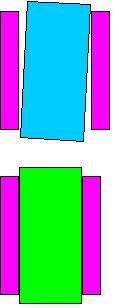
If the lateral runout was bad enough you would feel it in the brake pedal too. In my fancy drawing, the bottom one shows the rotor perfectly centered between the two pads. In the top drawing, the area of the worst lateral runout is between the pads and you can see how much further apart the pads are. Your lateral runout isn't that bad yet and may very likely never get any worse than it is now, but that's what you're feeling when you spin the rotor by hand and feel that tight spot. It's actually so common on any car that we don't even pay attention to it during a brake check.
The humming sound during braking could be tire wear. The blocks of tread squirm against the road surface differently when the force is trying to push them ahead during stopping vs. Allowing them to spin freely when cruising. Noise is almost always caused by a "toe" problem. That is the direction each tire is steering when you're driving straight ahead. On the alignment computer, most manufacturers specify 1/16" or 1/8" toe-in. That means the front of the wheels will be that much closer together than the rear edge. Road forces tug the tires back during driving and makes them, (ideally), perfectly parallel. When total toe is off by as little as 1/8", the tires are traveling in two different directions, either toward the center of the car or away from it. The sidewalls can only flex so much, then the tread has to scrub across the road surface. You can identify toe wear by rubbing your hand across or around the tread. It should feel smooth both ways. If you feel a sharp edge on one side of each block of rubber when you rub your hand one way but not the other way, you have toe wear and noise can result. A better way to visualize toe wear is to take a pencil, hold it straight up and down with the eraser on the table. Push down a little, then drag it sideways. You'll see the "leading edge" scrub off making eraser crumbs, but the "trailing edge" lifts up off the table. That part of the tire tread lifts up off the road and doesn't wear away. That's why it has a higher side that you can feel when you run your hand over it one way.
The good news is toe wear usually wears away after an alignment but it can take a few thousand miles. Once in a while the wear pattern keeps on wearing the same way and the noise actually gets worse over time. That depends on the tire design and manufacturer.
Image (Click to make bigger)
Sunday, July 3rd, 2011 AT 7:33 AM