shutters and turns off?

2002 CHEVROLET SUBURBAN
180,000 MILES • 5.3L • V8 • RWD • AUTOMATIC
Avatar
DANIEL47
  • MEMBER
  • 6 POSTS
Just replaced my intake manifold gasket now it will not stay on. started fine before I changed gasket now it starts and shutters and turns off feels like not enough fuel or air in the line or engine combustion problem not sure. Any information would be appreciated.
Oct 10, 2017 at 1:17 PM
Advertisement
Avatar
MHPAUTOS
  • CAR REPAIR CONTRIBUTOR
  • 31,937 POSTS
Check that you do not have a vacuum leak at the manifold, any old gasket remaining can cause a problem, and re check all connections, it will probably be something simple that you have over looked.re post if you cannot find anything. also, run a scan as this may point you in the right direction as well.
Oct 10, 2017 at 3:49 PM
Avatar
DANIEL47
  • MEMBER
  • 6 POSTS
Will do.checked all connections will check again...
Oct 10, 2017 at 4:45 PM
Avatar
MHPAUTOS
  • CAR REPAIR CONTRIBUTOR
  • 31,937 POSTS
okay, please keep me informed so i can be of assistance if required.
Oct 10, 2017 at 5:41 PM
Avatar
DANIEL47
  • MEMBER
  • 6 POSTS
Thinking spark plugs. This is what truck is doing
Oct 21, 2017 at 5:49 PM
Avatar
DANIEL47
  • MEMBER
  • 6 POSTS
Checked all connections. Re installed gasket.still won't stay on..at a loss
Oct 21, 2017 at 5:54 PM
Avatar
MHPAUTOS
  • CAR REPAIR CONTRIBUTOR
  • 31,937 POSTS
The video even sounds like a vacuum leak, the gasket is correct? all traces of the old gasket removed? manifold not warped? have you sprayed brake clean around the manifold to see if it changes revs? this must be something that you have disturbed if all was good before you removed the manifold.
Oct 22, 2017 at 1:09 AM
Avatar
DANIEL47
  • MEMBER
  • 6 POSTS
Yes no sign of old gasket cleaned very well.manifold doesn't look warped.if I turn key truck will start and then turn off but when I turn on and rev it 3 times will stay on but rough idle until I turn off..
Oct 22, 2017 at 9:45 AM
Avatar
MHPAUTOS
  • CAR REPAIR CONTRIBUTOR
  • 31,937 POSTS
Remove and clean idle air control, it may have some muck from cleaning blocking passage, try this next.
Oct 22, 2017 at 6:17 PM
Avatar
BIG BLUE 2
  • MEMBER
  • 2 POSTS
When starting from a stop sign at a very slow speed (5-10 mph} the transmission seems to stutter or shake when going to the next gear! This doesn't happen when accelerating at a faster speed. Any suggestions and possible cost?
Jan 6, 2020 at 9:54 AM (Merged)
Avatar
HMAC300
  • CAR REPAIR CONTRIBUTOR
  • 48,601 POSTS
have a trans guy look at this it may be a torque converter going bad.
Jan 6, 2020 at 9:54 AM (Merged)
Avatar
BIG BLUE 2
  • MEMBER
  • 2 POSTS
Thanks for your response. Any idea on the cost to repair or replace?
Jan 6, 2020 at 9:54 AM (Merged)
Avatar
HMAC300
  • CAR REPAIR CONTRIBUTOR
  • 48,601 POSTS
no because it could be something else
Jan 6, 2020 at 9:54 AM (Merged)
Avatar
MOKJWK11
  • MEMBER
  • 2 POSTS
I have a 2000 Chevy Suburban with 130000 miles. At speeds over 30 or so @ 2000-2200 rpm it shudders like we are driving over a washboard road. We get no error codes and it only occurs during slight aceleration, as soon as the throttle is let off or pushed harder it stops immediately. I was told it may be the torque converter lock up so I serviced the tranny and added 2 doses of lucas additive to no avail. I have pulled the relay for the tc lock up & saw no change. Recently the exhaust started rattling so I checked it for loose hangers etc., moved the exhaust pipe back & forth as much as possible, rattle stopped & no vibration for a day then back to same vibration & rattle. I have read there is a service bulletin for an exhaust vibration but can't believe the exhaust could make the car shudder so violently, anyone have any ideas?
Jan 6, 2020 at 9:54 AM (Merged)
Avatar
CARADIODOC
  • CAR REPAIR CONTRIBUTOR
  • 34,309 POSTS
Tight universal joints.
Jan 6, 2020 at 9:54 AM (Merged)
Avatar
XZH445
  • MEMBER
  • 1 POST
mokjwk11, did you get any resolution? I have a '98 Suburban 1500 4WD and it is acting exactly like your symptoms
Jan 6, 2020 at 9:54 AM (Merged)
Avatar
MOKJWK11
  • MEMBER
  • 2 POSTS
Havent had a chance to check u joints yet but I can't imagine that's the issue. Am on vacation & working on it this week will update when the issue is resolved.
Jan 6, 2020 at 9:54 AM (Merged)
Avatar
JIMMY25
  • MEMBER
  • 6 POSTS
The owner has said the problem is intermitant but becoming more frequent.
The engine seems to stutter while accelerating from a stop light. Once the rpms come up it seems ok. It does it more frequent with fuel level below 1/3. The fuel pump seems pretty loud. The pressure reads 52 at idle. When you accelerate either standing still or driving, it moves up to 60 psi momentarily and drops back to 52. If you let off the throttle it drops to 52 right away. The book says it should be 60 to 66. Is there a fudge factor? or absolutely not, 60 to 66 is where it has to be. I have used two different gages and both read the same. I changed the fuel filter and rechecked pressure. No difference.
At one point I was able to get it to stumble while in neutral. The gage was at a fairly steady 52 psi.
I also removed the EGR valve to check for obstacles. It looked ok.
It is a 5.7L CSFI.
The intake manifold was very recently resealed due to a coolant leak at the drivers side front coolant cross-over. It has not changed the stutter issue
Any suggestions?
No check engine light.
Jan 6, 2020 at 9:54 AM (Merged)
Avatar
BMRFIXIT
  • CAR REPAIR CONTRIBUTOR
  • 19,053 POSTS
Fuel pressure should be CSI 60-66 or for SFI 56-62
In both system fuel pressure a bit low and if not know but soon fuel pump need to be replaced
Check spark plugs
Spray distributor cap and coil with water and soap mix check for spark leak
Ground a test light and run it at and around the cap, coil, and wires
If have the flat distributor cap almost certain it’s at fault
Hook scanner and check distributor and CAM for adjustment
Good luck
Jan 6, 2020 at 9:54 AM (Merged)
Avatar
CARADIODOC
  • CAR REPAIR CONTRIBUTOR
  • 34,309 POSTS
Also look at the rear transmission mount. If it has sagged, the driveshaft will have less of an angle and a greater tendency to vibrate.

If you have a two-piece driveshaft, check the rubber mount for the center bearing. You may have to run it in gear jacked up on a hoist to see what is moving around or vibrating.
Jan 6, 2020 at 9:54 AM (Merged)
Avatar
JIMMY25
  • MEMBER
  • 6 POSTS
How often is the fuel regulator the problem? The pressure only seems low, not irratic.
Also it does have the flat cap. If that were it, why would it only do it occasionaly? It goes for long periods where it is just fine. It does act up more after it is been running for a while. I was also going to say that when I changed the fuel filter, I got about 30 1/16" beads of water. Is that about normal?
Jan 6, 2020 at 9:54 AM (Merged)
Avatar
BMRFIXIT
  • CAR REPAIR CONTRIBUTOR
  • 19,053 POSTS
We find it very common for the flat cap to fail more often and under load spark will leak and jump around (flat cap is where the wires on the side) use water and soap and spray it use a test light and check coil also using the same method
Shouldn’t have any water in the fuel filter check new fuel filter again if have water have to drain and clean tank or do something about it
Fuel regulator is not a common failure that I am aware of
Jan 6, 2020 at 9:54 AM (Merged)
Avatar
WABECKER
  • MEMBER
  • 1 POST
My Suburban shudders when the tach is above 2,000 rpm and my speed is anywhere between 50 & 65 mph. If I drive slowly (keeping the tach at 2,000 or lower) it performs fine, I can accelerate through the 50 to 65 mph window without any shuddering...Help?
Jan 6, 2020 at 9:54 AM (Merged)
Avatar
DOCFIXIT
  • CAR REPAIR CONTRIBUTOR
  • 18,828 POSTS
Maybe the lock-up torque convertor try driving with OD off. If it stops shruddering then possible TCC solenoid failure.
Jan 6, 2020 at 9:54 AM (Merged)
Avatar
JIMMY25
  • MEMBER
  • 6 POSTS
I broke down and put the new pump in. The pressure still only reads 52 to 60. What I did notice though, is that prior to replacing the pump, when I would accelerate the engine and turn the key off, most of the time the pressure would drop to 0. After installing the new pump, besides being quiter, it stopped dropping to 0 psi after accelerating and turning the key off. The cap and rotor was ok. I used an otc diag tool and adjusted the distrbutor to 0 on the cam. Seems to run good. Again I appreciate your help. Have a great weekend!!
Jan 6, 2020 at 9:54 AM (Merged)
Avatar
BMRFIXIT
  • CAR REPAIR CONTRIBUTOR
  • 19,053 POSTS
Thank you for the update


Happy driving
Jan 6, 2020 at 9:54 AM (Merged)
Avatar
TRISHA632004
  • MEMBER
  • 1 POST
I had my transmissiion flushed and a oil change done in the same day. The car was great! iIt was quieter, smoother and I drove it that night and next morning with no problems. After I returned home that morning I had the spark plugs changed. When I went to drive it a hour or so later it was sputtering, had no power at a stop and was kind of chugging along. I had the guy come back over that did all the repairs and he insisted it was my transmission acting up and to put some more conditioner, TRANS EX, in it and give it time. I told him there was no problem until after the spark plugs were changed, what should I do? I originally had sparklugs in there that said "Denso" on them but the mechanic guy said buy AC Delco regular and I think they are copper tops.
Signed,
"Help, I miss my truck"
Jan 6, 2020 at 9:54 AM (Merged)
Avatar
JACOBANDNICKOLAS
  • CAR REPAIR CONTRIBUTOR
  • 110,190 POSTS
The plugs he used are fine. In fact, they are used from the manufacturer. However, if I had to guess, I would say he mixed up some of the plug wires. Has he rechecked them?
Jan 6, 2020 at 9:54 AM (Merged)
Avatar
MRBILL57
  • MEMBER
  • 2 POSTS
Hi there,
I have this 'burbie - actually my wife's, and it is our tow vehicle for a 25' travel trailer.

For a couple years it has been shuddering at highway speeds. Started out in a narrow speed range, which has widened. Give more throttle or less and it stops. Most prominent in OD. Not much in Drive.

Have been told it is the Torque Converter. Have read that it might be the TCC solenoid. The TCC is supposed to be disengaged by the brake switch and when I press the pedal if it is doing the shudder, it DOES NOT STOP shuddering (foot still on gas to keep up speed). So either the brake switch is not canceling it or the TCC is not the problem?

The tail bearing has just a little side-play at the front of the driveshaft, and the rear end was replaced last year.

I have thought about replacing the TCC solenoid and mabe the TC. But the not cenceling thing makes me think it is not that.

Am going to check the TPS - hear that can cause it. I swear it seems like a mechanical thing not an ignition or fuel-system thing, because of the speed range and the sensitivity to throttle.

It is very annoying and I know it is not good on the drive train.

We are going to Florida on a 350 mile trip next week, towing our 25' trailer. It will be in drive for that. Last Spring we made the same trip, and it was not too bad. I planned to fix her before this trip, but just got the funds to do that this week. Arrgh!

I want to make a proper diagnosis.

If it is the TC, then what brand do you suggest? O.. has a Pro-King for $200 but I have not looked at other suppliers, brands or prices.

I think it is a 4L80E, but not sure yet.

I might change the TCC solenoid and filter, and refill with new fluid, but have heard that that can make one quit, and as we are going on a trip I might want to wait till we return. Of course, I don
Jan 6, 2020 at 9:54 AM (Merged)

Avatar
MERLIN2021
  • CAR REPAIR CONTRIBUTOR
  • 17,250 POSTS
Automatic Transmission/Transaxle Torque Converter Replacement TECHNICAL SERVICE BULLETIN Reference Number(s): 01-07-30-010C, Date of Issue:  May 12, 2008 Affected Model(s): 2009 and Prior GM Passenger Cars and Trucks; 2009 and Prior HUMMER H2, H3; 2009 and Prior Saturn Cars and Light Duty Trucks (Except VTi Equipped Vehicles (RPO M16 and M75); 2009 and Prior Saab 9-7X; with ALL Automatic Transmissions and Transaxles Supercedes: This bulletin is being revised to add the 2007-2009 model years. Please discard Corporate Bulletin Number 01-07-30-010B (Section 07 - Transmission/Transaxle). Related Ref Number(s): 01-07-30-010, 01-07-30-010A, 01-07-30-010B, 01-07-30-010C ARTICLE BEGINNING SERVICE INFORMATION The purpose of this bulletin is to help technicians determine when a torque converter should be replaced. Below is a list of general guidelines to follow. The converter should NOT be replaced if the following apply: DTC P0742 - TCC stuck on is set. This code is almost always the result of a controls condition (i.e. stuck TCC solenoid/valve). Experience has shown that this code rarely indicates a mechanical concern within the torque converter. • The fluid has an odor or is discolored but no evidence of metal contamination. • Fine metal particles (traces of metal flakes/gray color to fluid ) are found in the converter. This is not harmful to the torque converter. • The vehicle has been exposed to high mileage. • A small amount of wear appears on the hub where the oil pump drive gear mates to the converter (RWD only). A certain amount of such wear is normal for both the hub and oil pump gear. Neither the converter nor the front pump assembly should be replaced. • The torque converter should be replaced under any of the following conditions: The vehicle has TCC shudder and/or no TCC apply. First complete all electrical and hydraulic diagnosis and check for proper engine operation. The converter clutch may be damaged. Also, the converter bushing and/or internal O-ring may be damaged. • Evidence of damage to the oil pump assembly, pump shaft, turbine shaft, drive sprocket support and bearing, or metal chips/debris in the converter. • Metal chips/debris are found in the converter or when flushing the cooler and the cooler lines. • External leaks in the hub weld area, lug weld or closure weld. • Converter pilot is broken, damaged, or fits poorly into the crankshaft. • The converter hub is scored or damaged. • The transmission oil is contaminated with engine coolant, engine oil or water. • If excessive end play is found after measuring the converter for proper end play (refer to Service Manual). • Page 1 of 2 Automatic Transmission/Transaxle Torque Converter Replacement -1994 Chevrolet Subu...If metal chips/debris are found in the fluid filter, or on the magnet, and no internal parts in the unit are worn or damaged. This indicates that the material came from the converter. • The converter has an unbalanced condition that results in a vibration that cannot be corrected by following Converter Vibration Procedures. • Blue converter or dark circular ring between lugs. This condition will also require a complete cleaning of the cooler and a check for adequate flow through the cooler. • Converter bearing noise determined by noise from the bell housing area in Drive or Reverse at idle. The noise is gone in Neutral and Park. • If silicon from the viscous clutch is found in the lower pan (4T80-E ONLY). •

TESTING.........

TCC TESTING Converter Clutch Solenoid Disconnect harness connector to Torque Converter Clutch (TCC) solenoid. Measure resistance between TCC solenoid terminals. Solenoid resistance should be greater than 20 ohms. See Fig. 114 . Converter Lock-Up Signal At Transmission 1. Warm engine to operating temperature. Raise vehicle and support suspension where necessary to prevent damage to drive axles. 2. Disconnect converter clutch connector at transmission. Connect a test light across converter clutch harness terminals. Start engine and place transmission in Drive. Accelerate vehicle to 45 MPH and note test light. 3. If test light is not on, check solenoid power supply wire of harness for open or short to ground. Check ground circuit for open between harness connector and PCM. If harness is okay, see CONVERTER LOCK-UP SIGNAL FROM PCM. Converter Lock-Up Signal From PCM 1. Warm engine to operating temperature. Raise vehicle and support suspension where necessary to prevent damage to drive axles. 2. Connect a test light to battery voltage. Touch TCC control driver terminal with test light. See Fig. 114 . Accelerate vehicle to 45 MPH and note test light. If test light does not illuminate, problem is a faulty PCM connector or PCM. NOTE: When diagnosing converter clutch problems, ensure engine and vacuum systems are operating properly. For torque converter clutch electrical circuit information, see WIRING DIAGRAMS. NOTE: Some solenoids have an internal pressure switch in series with the solenoid winding and will not show continuity until that pressure switch is applied by transmission hydraulic pressure.
Jan 6, 2020 at 9:54 AM (Merged)

Avatar
MRBILL57
  • MEMBER
  • 2 POSTS
Thanks. No, it does not.

Like I said, the shuddering does not seem to be that the TCC is on/off/on... because when shuddering, stepping on the brake with throttle applied does not do anything to change it - still shudders.

Do you think it is a tranny issue, prop shaft bushing in the tailpiece, or maybe something else like the TPS?

How much side-to-side is typical on the tail connection at the driveshaft?

Is a valve maybe not switching properly? Would you recemmend filter and new fluid?
Jan 6, 2020 at 9:54 AM (Merged)
Avatar
MERLIN2021
  • CAR REPAIR CONTRIBUTOR
  • 17,250 POSTS
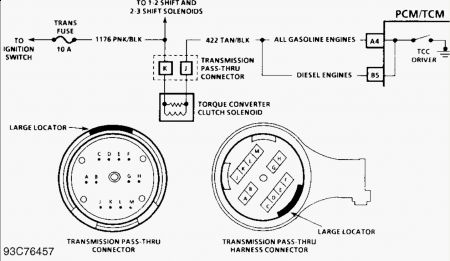
TCC TESTING Converter Clutch Solenoid Disconnect harness connector to Torque Converter Clutch (TCC) solenoid. Measure resistance between TCC solenoid terminals. Solenoid resistance should be greater than 20 ohms. See Fig. 114 . Converter Lock-Up Signal At Transmission 1. Warm engine to operating temperature. Raise vehicle and support suspension where necessary to prevent damage to drive axles. 2. Disconnect converter clutch connector at transmission. Connect a test light across converter clutch harness terminals. Start engine and place transmission in Drive. Accelerate vehicle to 45 MPH and note test light. 3. If test light is not on, check solenoid power supply wire of harness for open or short to ground. Check ground circuit for open between harness connector and PCM. If harness is okay, see CONVERTER LOCK-UP SIGNAL FROM PCM. Converter Lock-Up Signal From PCM 1. Warm engine to operating temperature. Raise vehicle and support suspension where necessary to prevent damage to drive axles. 2. Connect a test light to battery voltage. Touch TCC control driver terminal with test light. See Fig. 114 . Accelerate vehicle to 45 MPH and note test light. If test light does not illuminate, problem is a faulty PCM connector or PCM. NOTE: When diagnosing converter clutch problems, ensure engine and vacuum systems are operating properly. For torque converter clutch electrical circuit information, see WIRING DIAGRAMS. NOTE: Some solenoids have an internal pressure switch in series with the solenoid winding and will not show continuity until that pressure switch is applied by transmission hydraulic pressure.


https://images.2carpros.com/forum/automotive_pictures/62217_TCCsub_1.jpg

Any codes? Service engine light on? Check tailshaft mount! Get under it and push up on the mount, if tail goes up, mount is No good.
Jan 6, 2020 at 9:54 AM (Merged)
Repair Safety Notice: This information is for general instructional purposes only. Vehicle repair can be dangerous. Verify all information, follow manufacturer service procedures, use proper tools and safety equipment, and consult a qualified repair shop when needed.