2CarPros - Car Questions & Answers

1999 Subaru WRX Repair Question


Topics covered: Sensor, Wheel, Crankshaft.
Mileage: No information provided.

Asked on January 21, 2010

Cam shaft and crankshaft sensors

Electrical problem
1999 Subaru WRX 4 cyl All Wheel Drive Manual 15000 miles

what's the purpose of the cam shaft sensor and its relation with the crank shaft sensor ??


Thanks in Advance,
Nick Maple
Avatar Asked by Nick Maple

Answer

Replied on January 21, 2010

Hello and thanks for the donation!

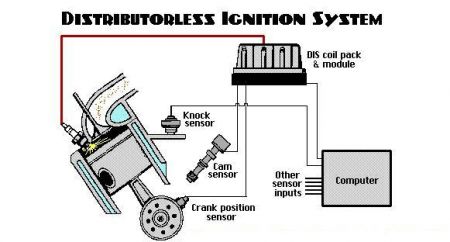
Distributorless ignition systems require a crankshaft position sensor (CKP), and sometimes also a camshaft position sensor (CMP). These sensors serve essentially the same purpose as the ignition pickup and trigger wheel in an electronic distributor, the only difference being that the basic timing signal is read off the crankshaft or harmonic balancer instead of the distributor shaft. This eliminates ignition timing variations that can result from wear and backlash in the timing chain and distributor gear. It also does away timing adjustments (or misadjustments as the case may be).

On 1996 vehicles with Onboard Diagnostics II (OBD II), the crankshaft position sensor is also used to detect variations in crank speed caused by ignition misfire. If the computer senses enough of these, it will illuminate or flash the Check Engine or Service Engine Soon light to signal the driver he has a problem


http://www.2carpros.com/forum/automotive_pictures/261618_Noname_1470.jpg


Hope this helps you understand the functions of the crankshaft position and camshaft position sensors a little better!

Tiny Answered by bluelightnin6 (expert)
17,236 answers provided
Replied on January 21, 2010

ok........a little helpful........what the job of the reluctor wheel or I'm not sure if its called a trigger wheel?? and how does the crank sensor read it??

Thanks in Advance,
Nick Maple

Tiny Response from Nick Maple
10 questions asked
Replied on January 21, 2010

The crankshaft reluctor wheel is mounted on the rear of the crankshaft. The wheel is comprised of four 90 degree segments. Each segment represents a pair of cylinders at TDC , and is further divided into six 15 degree segments. Within each 15 degree segment is a notch of 1 of 2 different sizes. Each 90 degree segment has a unique pattern of notches. This is known as pulse width encoding. This pulse width encoded pattern allows the PCM to quickly recognize which pair of cylinders are at top dead center (TDC). The reluctor wheel is also a dual track-or mirror image-design. This means there is an additional wheel pressed against the first, with a gap of equal size to each notch of the mating wheel. When one sensing element of the CKP sensor is reading a notch, the other is reading a set of teeth. The resulting signals are then converted into a digital square wave output by the circuitry within the CKP sensor.

The camshaft reluctor wheel is either pressed onto the camshaft or part of the timing gear depending on the application. The feature-or target- is read in a radial or axial fashion respectively. The wheel is a smooth track, half of which is of a lower profile than the other half. This feature allows the CMP sensor to supply a signal as soon as the key is turned ON, since the CMP sensor reads the track profile, instead of a notch.

Tiny Answered by bluelightnin6 (expert)
17,236 answers provided

Replied on January 22, 2010

The cam position sensor tells the ECU which stroke "intake or exhaust" the number one piston is on so it knows which cylinder to fire or inject fuel into.....From what i can understand. Hope this is correct??

Thanks in Advance,
Nick Maple

Tiny Response from Nick Maple
10 questions asked
Replied on January 22, 2010

Exactly. In simplest form, the camshaft sensor is used to control the timing of the injectors.

Tiny Answered by bluelightnin6 (expert)
17,236 answers provided
Replied on January 23, 2010

Is the ignition module and engine computer the same unit on DIS systems??

How often does the ecm reads the input from the CKP sensor and (CMP) sensor?

Another question, Once the ECM knows what stroke and (TDC) cylinder #1 is on from the 2 sensors,the ECM automatically does a sequence?? Theres no sensors monitoring any of the cylinders to know what there (TDC) and to know there stroke. Is the ECM already programed to fire automatically in a certain order, once it knows the number 1 cylinders position??

Thanks in Advance,
Nick Maple

Tiny Response from Nick Maple
10 questions asked

Replied on January 25, 2010

HI there,

The ECU (computer) gathers information from all the sensors and it is just a processor, it does this thousands of times a second, depending on the sensor, constant input signals such as the cam & crank angle are read constantly ever revolution, there are given parameters embedded in the system that the ECU will conform to, it will make timing, fuel injection and ignition adjustments as required to maintain optimum performance, most systems use a cam angle sensor to fire ignition & injection and the crank angle to identify cylinder position sequence. It often will only identify No 1 Cyl so that the ECU will be in faze with the engine and use the cam sensor for triggering the ignition & injection pulse, with variations as deemed by other input sensors. The firing order is programmed into they ECU so when it gets the input from the crank that its at No 1 TDC, the firing order is followed.

Mark (mhpautos)

Tiny Answered by mhpautos (expert)
27,079 answers provided