REMOVAL & INSTALLATION
POWER STEERING PUMP R & I
Removal
Disconnect fluid return hose at reservoir and drain fluid into suitable container. Remove high pressure hose and power steering pressure switch (if equipped) from pump and drain fluid into container. Depending on vehicle, loosen belt tensioner, alternator or power steering pump adjustment bracket bolts to remove drive belt. Remove steering pump adjustment bracket bolts (if equipped ).
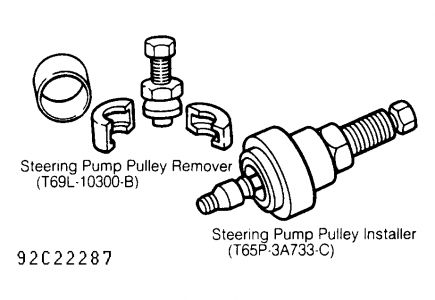
On most models, pump pulley must be removed before pump can be removed from support bracket on engine. Remove pulley from pump using Pulley Remover (T69L-10300-B). See Fig. 4 . DO NOT use conventional type puller to remove pulley, as pulley damage will result.
Remove pump and adjustment bracket (if equipped) from support bracket. On some models, air conditioning compressor must be removed from support bracket to access power steering pump mounting bolts.
Fig. 4: Identifying Power Steering Pump Pulley Remover & Installer
Courtesy of FORD MOTOR CO.
Installation
Install pump assembly to support bracket. Tighten bolts to specification. See TORQUE SPECIFICATIONS . If equipped, install adjustment bracket to support bracket, and tighten bolts to specification.
Install pulley to pump shaft using Pulley Installer (T65P-3A733-C). See Fig. 4 . Ensure pulley is flush with end of pump shaft for alignment with other pulleys for proper belt operation.
Apply lifting pressure to tensioner pulley, and install belt on pump pulley. Ensure proper belt routing. See SPECIFICATIONS article in the ENGINE PERFORMANCE section. If equipped with adjustment bracket, adjust belt and tighten pump adjustment bracket bolts to specification. See TORQUE SPECIFICATIONS .
Install hoses to pump. Tighten pressure hose fitting to specification. Fill reservoir with new fluid. Start engine and let idle. Turn wheel from stop to stop to bleed air from system. Recheck reservoir and refill as necessary.
Jan 1, 2009 at 6:28 AM