2CarPros - Car Questions & Answers

2005 Dodge Ram Repair Question


Topics covered: Engine, Rpm, Battery.
Mileage: 250,000 miles.

Asked on December 10, 2012

Dodge Ram Engine Problem

I have 2005 dodge rumble bee. when i come to a stop the rpms go down and usually the truck stalls. when its cold the rpms will slowly drop then jump back up again when idling and driving. i replaced the erg valve and it didnt fix it. what else could be the cause of this

Avatar Asked by codymcmillan1

Answer

Replied on December 10, 2012

Was the battery recently disconnected or run dead?

Tiny Answered by caradiodoc (expert)
17,324 answers provided
Replied on December 11, 2012

It hasn't bin run dead since this has started but it had bin disconnected to reset the computer and erase all engine codes to see what would come up again and nothing has

Tiny Response from codymcmillan1
1 question asked
Replied on December 11, 2012

It had 250 000 kilometers not miles

Tiny Response from codymcmillan1
1 question asked

Replied on December 11, 2012

Disconnecting the battery is never a good idea. Codes will erase automatically after 50 starts if the problem doesn't come back, and there is nothing to "reset" in the Engine Computer. Doing that became common many years ago with the very high rate of failures on GM vehicles. You also erased the fuel trim data. Those "look-up tables" will start to be rebuilt as soon as you drive the truck, and you won't notice anything happening.

The biggest reason to get used to not disconnecting the battery doesn't apply to Chrysler products, . . . yet. It can cause a real lot of misery and expense on Volkswagen, BMW, and General Motors vehicles. They have a lot of tricks designed in to cost unsuspecting owners money after the sale. A lot of Volkswagens end up being skidded in park onto a flat bed truck for a trip to the dealer to have numerous computers unlocked.

Yours isn't so serious. The Engine Computer lost its memory and has to relearn "minimum throttle" before it will know when it must be in control of idle speed. It also might not give you the normal "idle flare-up" to 1500 rpm when you start the engine. To meet the conditions for the relearn to take place, drive at highway speed with the engine warmed up, then coast for at least seven seconds without touching the brake or gas pedals.

Tiny Answered by caradiodoc (expert)
17,324 answers provided
Replied on December 11, 2012

Ok I did that but it didnt help my stalling problem

Tiny Response from codymcmillan1
1 question asked
Replied on December 11, 2012

Then you're going to need a scanner to view live data. The thing you need to see is "AIS steps". That is the step, from "0" to "256" the computer has placed the automatic idle speed motor to. For a good-running engine, step 32 is typical. If you find it on step 0, it hasn't learned minimum throttle yet. Try coasting while holding the brake pedal up with your toes. If that works, the brake light switch is out-of-adjustment or has an intermittent contact. The additional clue is often the lack of the idle flare-up at engine start-up.

If you find the idle step to be around "50", that is typical of a single-cylinder misfire. When slowing down, the computer may not respond fast enough to prevent the engine from stalling. If no misfire is felt, or detected by the computer, you might look at a fuel pressure problem. Usually that causes other symptoms but you don't want to overlook that.

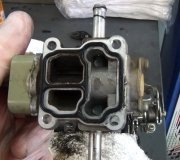
You can also use the scanner to run the engine idle speed up to 2000 rpm in 200 rpm increments. That will prove the idle speed motor is working and the air passage isn't blocked with carbon. We don't run into that much anymore with the better fuel additives. If you see the throttle plate inside the throttle body is heavily coated with black carbon, wash that off with carburetor cleaner in a spray can.

Also look at the map sensor voltage. It has the biggest say in how much fuel is commanded from the injectors. Usually they fail completely over the course of less than a day, and their failure rate is extremely low compared to the early '90s, but while they're in the process of failing, they can develop the wrong signal voltage that is still within the acceptable limits. It has to go to 0.0 or 5.0 volts to set a fault code and turn on the Check Engine light. With any reading between the normal, (approximate), 0.5 to 4.5 volts, the computer will deliver fuel based on that reading even though it might be wrong.

Tiny Answered by caradiodoc (expert)
17,324 answers provided

Replied on December 14, 2012

i topped up the transmission fluid and she runs perfectly know no problems nothing.

Tiny Response from codymcmillan1
1 question asked
Replied on December 15, 2012

Transmission fluid has nothing to do with idle speed. If anything, severely low fluid level will make the engine less likely to stall because there will be less load on the engine. I suspect a minimum throttle relearn took place.

Tiny Answered by caradiodoc (expert)
17,324 answers provided