Logo Automobile Information Add Site to Favorites  
Auto Repair
Auto Repair Home
Auto Repair Ask a Car Repair Question
Auto Repair Car Question Forum
Auto Repair Questions by Manufacturer
Auto Repair Questions by Topic
Auto Repair First Things to Check
Auto Repair How to Repair or Service
Auto Repair Car Repair Manuals
Auto Repair How Does it Work
Auto Repair Car Repair Video Series
Auto Repair Auto Maintenance
Auto Repair Car Sound Problems
Auto Repair Auto Term Abbreviations


Popular Site Links


Auto Repair Automobile Safety Inspection
Auto Repair Brake Replacement Guides
Auto Repair Service Engine Soon Light
Auto Repair Belt Routing Diagrams
Auto Repair Avoid Car Repair Rip Offs
Auto Repair Trouble Code Table
Auto Repair How to use Diagnostic Tools
Auto Repair Smog Test Preparation
Auto Repair Hybrid Car Information
Auto Repair Test Equipment Store
Auto Repair Auto Parts
 
Search Website
 
 
Recent Repair Topics


Auto Repair1986 Gmc C1500 No Back ...
Auto Repair2001 Dodge Van Steering...
Auto Repair2003 Dodge Ram Injector...
Auto Repair2001 Jeep Cherokee Batt...
Auto Repair2001 Dodge Caravan No S...
Auto Repair1988 Honda Accord Alter...
Auto Repair2003 Jaguar S-type Soun...
Auto Repair More Repair Topics...


Car Repair Advice by Professional Automotive Experts


Troubleshooting / White Smoke from the Exhaust

Why Does White Smoke or Steam Come from the Exhaust Pipe?

Introduction

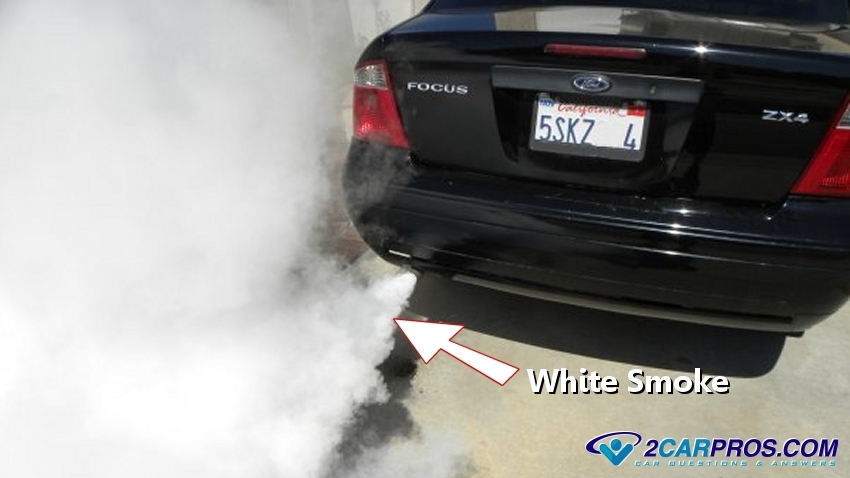
White smoke or steam is a natural by-product of the combustion process. As the engine and exhaust system heat up the steam is completely dissipated before it exits the exhaust system, becoming undetectable. The amount of steam produced from the tail pipe while the engine is cold varies due to outside temperature and humidity. Although if a massive amount of white smoke or stream is present even long after the engine has been warmed up this could mean you have a problem. Coolant/antifreeze is used to cool the engine during normal operation. If coolant is allowed to enter the combustion chamber, the engine will burn the coolant creating white smoke and steam. When this white smoke/steam is being produced it will be accompanied by a sweet, pungent odor. This will be accompanied by engine coolant. loss with no visible leaks. There are four reasons engine coolant will enter the combustion chamber.

 Car Repair Guide - READ COMPLETELY BEFORE BEGINNING!

  • Inspection 1 - The engine intake manifold is used to direct air and fuel into the cylinder head combustion chamber. Most intake manifolds utilize engine coolant to help cool and distribute coolant into the cylinder head (s) and then down into the engine block. If the gasket that seals the intake manifold to the cylinder head fails it can allow coolant to enter the intake port and then the combustion chamber. To check for this condition the intake manifold will need to be removed. Once the intake manifold has been removed inspect the gasket. If the gasket has rotted or dilapidated between the intake port and the cylinder head it could allow coolant to transfer into the cylinder head. Replace the gasket with a new unit and reassemble. If the intake gasket is ok continue to the next step.
     
  • Inspection 2 - Anytime you have coolant in the combustion chamber and the intake gasket is ok, the engine must be disassembled to locate the failure. These options are not so pretty. There are three remaining causes for coolant to enter the combustion chamber and all require engine disassembly. This can be tricky because the repairs overlap and it is difficult to tell which one is causing the problem before disassembly. For example: A repair shop has told you the cylinder head is cracked, and as they start disassembly they can discover it was the intake manifold gasket that has failed. It's up to the honesty of the repair shop to alert the customer the repair will be less. Or the opposite can happen, example: A repair shop has told your engine has a blown head gasket, once the disassembly is complete they inform you the head gasket is ok, and the cylinder has been pressure checked and is ok. This only leaves the engine block as the failure and must be replaced to repair the problem, and that can be costly. If the head gasket has failed, be sure to have the head pressure tested to be sure it is ok internally and surfaced to be sure it is flat so as to mate evenly with the engine block.

For exact specific repair procedures for any of the steps above visit our car repair manual page.

WARNING! Always have the vehicle under inspection on level ground, in park with the emergency brake on. Always wear protective eyewear, gloves and necessary clothing before inspection or work begins. Never crank an engine over when anyone is near the battery or engine. Always have an operational fire extinguisher close by, obey all first aid instructions in the event of an injury. Never stand in front or behind a vehicle when starting or running. When engine is cranked over keep hands and clothing away from rotating components. Anyone with a heart pacemaker should not perform these tests.

Troubleshooting / White Steam from the Exhaust

Additional Resources

Check Manufacturer Specific White Smoke or Steam Questions and Answers

Related Subjects

ASK A CAR REPAIR QUESTION - Join our question and answer forum where over 10,000 free auto repair questions are answered every month, after you have completed our free signup you will able to ask a question and receive an answer from one of our many forum members. If you elect to donate any small amount of money we will assign one of our 2CarPros Certified Repair Technicians to answer your question. Questions with donations are answered promptly and 100% of the donation is awarded to the technician helping you.

GET AN ONLINE CAR REPAIR MANUAL - Get instant access to your vehicles wiring diagrams, firing orders, component locator, vacuum diagrams, repair procedures, specific testing and diagnostics for troubleshooting, steering and suspension information, heating and air-conditioning problems, safety belt and airbag restraint repair, factory bulletins and general information and much more. We recommend that anyone needing technical repair information should have a quality auto repair manual for their car.


Popular Service Repairs
Test Fuses
Replace Front Brake Pads
Check Engine Light
Rear Brake Shoes
Rear Brake Pads
Test Alternator
Replace Air Filter
Test Battery
Tune Up
More Service Repairs...
Advertisement
Car Questions
Acura
Alfa Romeo
American Motors
Audi
BMW
Buick
Cadillac
Chevy
Chrysler
Citron
Daewoo
Daihatsu
Dodge
Eagle
Ferrari
Fiat
Ford
Geo
GMC
Honda
Holden
Hummer
Hyundai
Infiniti
International
Isuzu
Jaguar
Jeep
Kia
Land Rover
Lexus
Lincoln
Mazda
Mercedes Benz
MG
Mercury
Mini
Mitsubishi
Nissan
Oldsmobile
Opel
Peugeot
Plymouth
Pontiac
Porsche
Renault
Rolls Royce
Rover
Saab
Saturn
Scion
Seat
Skoda
Subaru
Suzuki
Toyota
Vauxhall
Volkswagen
Volvo

Home l Help l Privacy Policy l User Agreement l About Us l Computer Repair Question l Contact Us l Link to Us l We're Hiring l Affiliate Program
  Copyright © 1999 - 2009 2CarPros.com - Professional Mechanics Online