1999 Honda Civic won't start - distributor?

1999 HONDA CIVIC
225,000 MILES • 4 CYL • 2WD • AUTOMATIC
Avatar
SUNCARS
  • MEMBER
  • 14 POSTS
History is that electrical system, lights, engine etc pulsed. The harness that rubs on the manifold bracket was repaired but still have pulse. Have had grounding issues, car wouldn't start grounds corroded at body/frame, cleaned up and additional grounds added. Car started and ran fine but still have pulse. Recently while driving car instantly went to half power, sluggish then died. Wouldn't start seemed to "skip" when turning i.e. did not sound like it does normally when starting as if no spark. Diagnosis revealed that distributor was not generating spark. Replaced distributor with reman, did not replace rotor or cap, both appeared to be in ok shape and based on way car died it seemed to be something that developed immediately i.e. not a rotor or cap wear type issue. Car ran fine up to that instant. After putting new distributor in, the car turned over normally - sounded normal - but would not start. Shortly later went back to skip type turnover, checked for spark from spark plug cables - no spark. Fear that something is killing the dist. Could short in the h/a to the distributor kill distributor? Car has been in two different shops multiple times and no one can diagnose the pulse problem. The distributor problem was correct but I don't think it is the only issue.
Sep 18, 2010 at 8:37 PM

Advertisement
Avatar
KHLOW2008
  • CAR REPAIR CONTRIBUTOR
  • 41,814 POSTS
Hi suncars,

Thank you for the donation.

Pulsing of the electrical system could be due to the alternator, PCM or ignition switch.

Was the charging rate tested? If charging rate seems out of specs, check the harmonic balancer if equipped. Note if the crank pully is moving in a wavy pattern and check alternator belt tension.

Distributor can only be damaged if the fault is internal. Did you test if power is present at the distributor with ignition switch turned ON? If yes, test if power is available while cranking.

A faulty ignition switch can result in power supply disruption to the distributor while cranking. There was a safety recall on the igniton switch and it can cause intermittent stalling and non starting.

Did you test if the rotor is turning while cranking? Hope it is not a bad timing belt.

Does the Check Engine Lamp comes on and goes off after 2 seconds when ignition switch is turned on?
Sep 18, 2010 at 10:31 PM
Avatar
SUNCARS
  • MEMBER
  • 14 POSTS
the alternator has been tested and reportedly ok.

where should I check for power at the dist? at h/a, plug at unit?

I checked the timing belt and it is intact.

The engine light does come on for 2 seconds when switch is turned on.

thanks for the help
Sep 18, 2010 at 11:23 PM
Avatar
KHLOW2008
  • CAR REPAIR CONTRIBUTOR
  • 41,814 POSTS
At the distributor there is a Black/Yellow wire. That is the power supply from the ignition switch. Unplug the connector, attach a test lamp to it and turn ignition ON. If test lamp turns on, power is available. Turn the ignition to crank and note if the test lamp goes off. It should stay on indicating nothing wrong with the power supply.

Do not rule out a faulty replacement reman distributor.
Sep 18, 2010 at 11:49 PM
Avatar
SUNCARS
  • MEMBER
  • 14 POSTS
Can you tell me what voltage to expect?
Sep 19, 2010 at 1:44 PM
Avatar
KHLOW2008
  • CAR REPAIR CONTRIBUTOR
  • 41,814 POSTS
It should be battery voltage.
Sep 19, 2010 at 1:47 PM
Avatar
SUNCARS
  • MEMBER
  • 14 POSTS
Ive got 11.5 V both with switch on and when cranking - unless intermittent.

I can believe that I got a bad reman dist. but its strange that even when the turnover sounded normal i.e. when dist. was first put in the car wouldn't start and then the turnover sounded bad again i.e. bad dist.

can the cap or rotor work intermittently or instantly die?
Sep 19, 2010 at 1:56 PM
Avatar
SUNCARS
  • MEMBER
  • 14 POSTS
other interesting facts:

backup lights and power mirrors don't work? - have checked fuses.
Sep 19, 2010 at 2:12 PM
Avatar
KHLOW2008
  • CAR REPAIR CONTRIBUTOR
  • 41,814 POSTS
To test if sparks are intermittent and eliminate the possibility of the rotor or cap, remove the distributor cap. Attach a spark plug cable to the ignition coil output while grounding the other end with a spark plug or spark plug tester and crank engine. If sparks are available and consistent, the rotor or cap is bad if it is not getting to the spark plugs.

If sparks are available and not starting, check the firing order. Sometimes reman distributors are installed incorectly and the rotor is facing 180 degrees out of time. Swapping the position of spark plug wires between 1 with 4 and 2 with 3 should allow you to start.

Did you check the reverse bulbs? With ignition switch turned on, does the R indicator light comes on? If yes, remove the reverse light bulb and test for battery voltage at the socket.

Power mirror shares the same fuse as rear defoger relay. Pull out the mirror switch and test the Black/Blue wire for battery voltage with ignition switch turned on. If power is available, you have either :
1. Faulty switch.
2. Faulty power mirrors.
3. Bad ground circuit.
Sep 20, 2010 at 1:10 PM
Avatar
SUNCARS
  • MEMBER
  • 14 POSTS
second dist. still no start
with spark cable connected to the coil contact and spring, spark plug in cable, spark plug body grounded - no spark.

Reading about 10 V DC to ground at coil contact while cranking - V ok - seems low?

tested continuity on all of the pins on the engine dist. h/a i.e. from car all open i.e. high resistance except black and low resistance on black/yellow. Voltage drops from 12 to 10.5 on black and yellow when cranking. are these numbers ok?

Could there be a problem with something at the other end of the h/a wires such as a control module, computer etc. that wasn't allowing dist. to spark or short circuit...?

Have new rotor but don't think thats the prob.

tested each cable and spark plug - no spark while cranking.

Bulbs ok - had misplaced one of fuses while checking. found fuse map on-line and checked everything.
Sep 20, 2010 at 4:53 PM
Avatar
KHLOW2008
  • CAR REPAIR CONTRIBUTOR
  • 41,814 POSTS
The voltages are correct and should not be the problem.

If you had done any repairs, check the ground circuit connection for the PCM. It is located at right side of engine, on thermostat housing.
Sep 21, 2010 at 9:31 AM
Avatar
SUNCARS
  • MEMBER
  • 14 POSTS
I will check.

If I am getting the correct V (10.5 V DC) on the spring/contact for the coil at the distributor then could it be the rotor? Wouldn't think it fail entirely but possible I guess. I would have imagined a higher V at the coil - is the spark plug generating the high V spark itself?

Thanks
Sep 21, 2010 at 9:40 AM
Avatar
KHLOW2008
  • CAR REPAIR CONTRIBUTOR
  • 41,814 POSTS
Sparks are generated by the ignition coil. Rotor and distributor cap are only for distributing the sparks.

Did you test the ignittion coil primary and secondary resistance?
Sep 21, 2010 at 10:22 AM
Avatar
SUNCARS
  • MEMBER
  • 14 POSTS
Good ground on PCM.

I only have access to the contacts on top of the coil - getting 1 ohm. This distributor has a number of electronic parts including an ignitor, I believe, so I am assuming that the coil has the contact that goes directly to the dist. cap.

Should I be checking the V at the coil in A/C settings or DC i.e. is it dc or ac voltage and what should I be seeing?
Sep 21, 2010 at 11:17 AM
Avatar
KHLOW2008
  • CAR REPAIR CONTRIBUTOR
  • 41,814 POSTS
All voltage test should be done in DC.

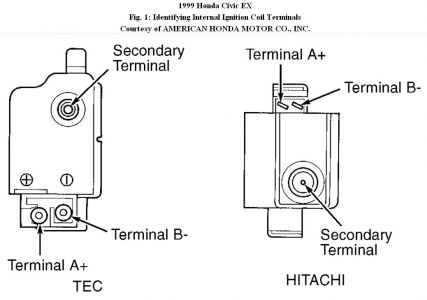
The ignition coil primary resistance should be 0.45 - 0.55 ohms and secondary resistance is 22,400 - 33,600 if it is a Hitachi distributor.
TEC distributor resistance is 0.63-0.77 with secondary 12,800 - 19,200 ohms.

Coil output point has a spring that is the contact for the distributor cap.
Sep 21, 2010 at 11:32 AM
Avatar
SUNCARS
  • MEMBER
  • 14 POSTS
I don't have access to the secondary w/out dissassembling dist. I'll take a look.

What V should I see at the coil - is 10.5 V ok?

If coil is ok what else could it be? Is there any other signal, sensor etc. that could keep dist from firing?
Sep 21, 2010 at 11:45 AM
Avatar
SUNCARS
  • MEMBER
  • 14 POSTS
There are only two contacts/wires going to the coil. I get about 16.5 kohms between the dist. contact on the coil and the terminals at the coil. The 1 ohm was read between the two contacts at the coil. Is there another place to check the secodary?
Sep 21, 2010 at 12:26 PM
Avatar
KHLOW2008
  • CAR REPAIR CONTRIBUTOR
  • 41,814 POSTS
Ignition Coil Resistance Test Turn ignition off. Remove distributor cap. Remove primary leads from ignition coil. Using an ohmmeter, check primary resistance between ignition coil terminals "A+" and "B-". See Fig. 1 . Resistance should be as specified. Check secondary resistance between ignition coil terminal "A" (+) and secondary output terminal (coil tower). If readings are not as specified, replace ignition coil.


https://images.2carpros.com/forum/automotive_pictures/192750_IgnitionCoil99AccordFig01_1.jpg

Sep 22, 2010 at 7:53 AM
Avatar
SUNCARS
  • MEMBER
  • 14 POSTS
primary is around 1 or a little below - ohm meter not precise enough to measure better than that and around 16.5 k on secondary.

Will distributor for this engine D16Y8 have blue wire as shown in the manual on pg 23-109? Shows wire connected to one of the ICM connectors.
Sep 22, 2010 at 12:34 PM
Avatar
SUNCARS
  • MEMBER
  • 14 POSTS
the test proc. on this page states that there should be continuity between the tach test conn. and the blu wire at the icm. THere is no continuity between the the tach test conn. and any pins on the engine h/a that connects to the dist. h/a

The tach does not register when turning engine over either?
Sep 22, 2010 at 1:19 PM
Avatar
SUNCARS
  • MEMBER
  • 14 POSTS
is it possible to connect pwr and ground from the engine h/a to the distributor i.e. jump from the h/a to the dist h/a - will the dist still work - at least create spark or does it need the TDC... sensors etc to fire?
Sep 22, 2010 at 1:49 PM
Avatar
KHLOW2008
  • CAR REPAIR CONTRIBUTOR
  • 41,814 POSTS
If it is a TEC brand distributor, the resistance should be good, unless the primary is higher than 0.7 ohms.

The ICM Blue wire goes to the tach test conn and tach gauge in meter cluster. If you have no sparks, there would be no pulse for the tach to work.

At least one sensors ( crank or TDC ) have to be working to provide pulses for the ICM to trigger the ignition coil.

Were there any trouble codes retrived?
Sep 23, 2010 at 8:42 AM
Avatar
SUNCARS
  • MEMBER
  • 14 POSTS
One thing I realized is that the area in the manual which talks about the blu wire and the tach is just for D16Y5 and B16A2 engines and mine is a D16Y8, so I don't think the dist. and the wiring is going to be same - there doesn't appear to be anything in the manual for the Y8 specifically for how the tach gets its signal. There is a second sensor in the dist. similar to the one for the TDC/CKP... sensor and it has a blue wire to it and I'm guessing that it is for the tach but not sure. I know that I don't have continuity to any of the eng. h/a pins at the dist. and the test tach connector.

Should I?

Is there any where in the manual which shows the wiring for this engine for where and how the tach gets its signal?

I don't have any engine codes. Wouldn't have codes if the sensors in the dist. were not working? The CEL light does come on when key is turned on and then turns off after 2 seconds.

If the ECM/PCM is bad i.e. not sending signals or something would I have codes for that?
Sep 23, 2010 at 9:35 AM
Avatar
KHLOW2008
  • CAR REPAIR CONTRIBUTOR
  • 41,814 POSTS
Wiring system are similar.

The tachometer receives its signal from the PCM which is notified by the Yellow/Green wire from the ICM.

How many wires do you have at the distributor?
How many sensors are there?

The sensor with the Blue wire is NOT for the tachometer. It is the CKP ( crankshaft position ) sensor
Sep 23, 2010 at 9:59 AM
Avatar
SUNCARS
  • MEMBER
  • 14 POSTS
I was able to get this thing running - difficult starting at first - probably had gotten flooded some but is running. Not sure of the exact fix but believe it must have been bad dists.

I adjusted timing but exhaust smells funny - fuel smell - running rich? and I have a CEL and code P0420 catalyst efficiency "below threshold bank 1"?

Is this a timing issue?

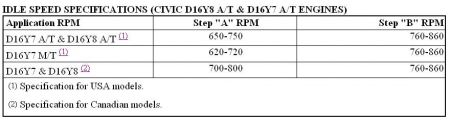
Unable to locate timing procedure and specs in manual do you have one?
Sep 24, 2010 at 5:46 AM
Avatar
KHLOW2008
  • CAR REPAIR CONTRIBUTOR
  • 41,814 POSTS
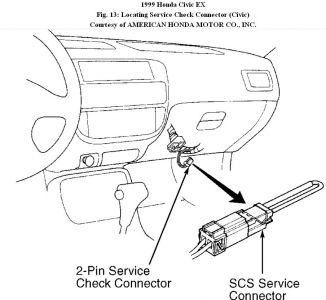
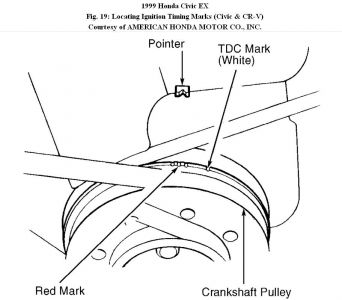
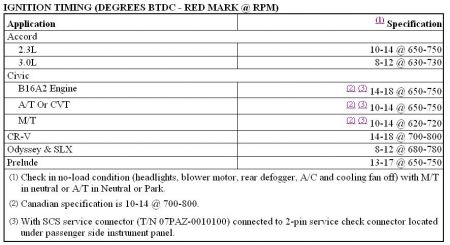
P0420 is a fault with the catalytic converter or O2 sensors and can smell funny if the catalytic converter is bad. Ignition Timing 1. Set parking brake. Start engine and ensure idle speed is correct. Turn ignition off, connect SCS Service Connector (07PAZ-0010100) to 2-pin service check connector. Connect tachometer. Run engine at 3000 RPM with no electrical loads (headlights, blower motor, rear defogger, A/C and cooling fan off) and transmission in Park or Neutral. When radiator cooling fan comes on, allow engine to idle. 2. 2-pin service check connector is located under right side of instrument panel. See Fig. 13 . Service check connector on uses a Brown wire and a Black wire. 3. Connect timing light to No. 1 spark plug wire. Check base ignition timing at specified engine idle. See IGNITION TIMING (DEGREES BTDC - RED MARK @ RPM) table. Red mark indicates degrees BTDC. White mark indicates No. 1 cylinder Top Dead Center (TDC). See Fig. 19 . 4. If timing is not as specified, loosen distributor hold-down bolts and rotate distributor to adjust timing. Rotate distributor counterclockwise to advance timing and clockwise to retard timing. Recheck timing after tightening distributor hold-down bolts. 5. Tighten distributor hold-down bolts to 13 ft. lbs. (18 N.m). Remove timing light, tachometer and SCS service connector.


https://images.2carpros.com/forum/automotive_pictures/192750_SCS99CivicFig13_1.jpg


https://images.2carpros.com/forum/automotive_pictures/192750_IgnitionTimingMark99CivicFig19_1.jpg


https://images.2carpros.com/forum/automotive_pictures/192750_IgnitionTiming99Civic_1.jpg


https://images.2carpros.com/forum/automotive_pictures/192750_IdleSpeedCivicD16y8_1.jpg

Sep 24, 2010 at 7:50 AM
Repair Safety Notice: This information is for general instructional purposes only. Vehicle repair can be dangerous. Verify all information, follow manufacturer service procedures, use proper tools and safety equipment, and consult a qualified repair shop when needed.