

1999 Honda Accord Engine Light on

1999 HONDA ACCORD
120,000 MILES • 6 CYL • 4WD • AUTOMATIC
Avatar
SRINUPRAKASH
  • MEMBER
  • 2 POSTS
Hi,
My Honda '99 Accord has a Engine Check Indicator On recently.
I don't know what has to be done. Please suggest a mechanic to repair. Also, i want to know how much would be the cost for the repairs..
I live at Edison, NJ.

Thanks,
SrinuPrakash
Dec 24, 2008 at 5:29 PM
Advertisement
Avatar
ZACKMAN
  • CAR REPAIR CONTRIBUTOR
  • 4,202 POSTS
Autozone
561 Route 1 South
Edison, NJ 08817
(732) 572-1461

Advance Auto Parts
485 Route 1 South
Edison, NJ 08817
732-985-3308

Go to either one of these stores, and they can pull the codes from your PCM. Get back with us with the code numbers and descriptions..
Dec 25, 2008 at 12:13 AM
Avatar
SRINUPRAKASH
  • MEMBER
  • 2 POSTS
Hi,

My 99 Honda Accord has a Malfunction Indicator Light ( Engine) On and i went to the Mechanic and he has done the diagnostics and gave me the code
Po1457.
And told me to get the evaporation valves to be replaced.
How much could be the total repair costs be..?
Please answer.

Srinu Prakash
Jan 7, 2009 at 9:10 PM
Avatar
ZACKMAN
  • CAR REPAIR CONTRIBUTOR
  • 4,202 POSTS
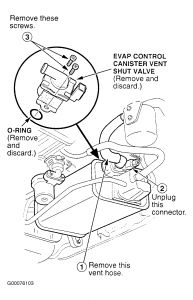
***This is a common problem with Accords, especially ones that is driven around the snow-belt area. The EVAP system can often corrode causing the check engine light to go on. As your vehicle has out of warranty for a long time, I highly doubt that the warranty appies to you, but hey, it doesn't hurt to ask. It is a well-known defect/malfunction. You have to order the parts from Honda anyway (no aftermarket parts store carries the part). I included a partial description of the Technical Service Bulletin provided by Honda.*** MIL COMES ON WITH DTC P1457 TECHNICAL SERVICE BULLETIN Reference Number(s): 01-011, Date of Issue: June 26, 2001 Superceded Bulletin(s): 01-011, Date of Issue: March 6, 2001 Related Ref Number(s): 01-011 ARTICLE BEGINNING SYMPTOM The MIL is on, and DTC P1457 [leak detected in EVAP control system (EVAP control canister system)] is set. PROBABLE CAUSES The symptom could be the result of any of these causes:  An EVAP system component fails.  The PCM does a diagnostic test on the EVAP system before the primary heated oxygen sensor (HO2S) is active. If this happens on two consecutive driving cycles, the MIL comes on and DTC P1457 falsely sets.  The EVAP system depends on operation of the EVAP control canister vent shut valve for the diagnostic self-test. If the valve does not function properly, the MIL comes on and DTC P1457 sets. This condition can occur with vehicles normally driven in any of the states listed in the "Applies To" heading. Failure of this components does not affect the performance of the EVAP system. VEHICLES AFFECTED PCM Failure: 1998-99 Accord - L4 models with A/T EVAP Control Canister Vent Shut Valve Failure: 1998-99 Accord - All models normally driven in any of theses states: Illinois, Indiana, Iowa, Maine, Massachusetts, Michigan, Minnesota, New Hampshire, New York, North Dakota, Ohio, Pennsylvania, Vermont, or Wisconsin CORRECTIVE ACTION HONDA: 1998-99 Accord CATEGORY: Fuel/Emission APPLIES TO: 1998-99 Accord - See VEHICLES AFFECTED NOTE: Supersedes 01-011, dated March 6, 2001 MIL COMES ON WITH DTC P1457 Retrieve the DTC with the PGM Tester, and review the Freeze Data. Depending on whether the feedback condition of the primary HO2S reads "open" or "closed," take the appropriate action described in DIAGNOSIS. PARTS INFORMATION 1998 Accord L4 LX (KL) PCM : P/N 37820-PAA-L50, H/C 6286363 1998-99 Accord L4 LX/EX (KA) PCM: P/N 37820-PAA-L50, H/C 62863.63 1998-99 Accord L4 DX (KA) PCM: P/N 37820-PAB-A60, H/C 6286389 1998-99 Accord L4 DX (KL) PCM: P/N 37820-PAB-L60, H/C 6286405 1998 Accord L4 EX (KL) PCM: P/N 37820-PAA-L80, H/C 6286421 1999 Accord L4 LX/EX (KL) PCM: P/N 37820-PAA-L80, H/C 6286421 1998-99 Accord (KA/KL) EVAP Control Canister Vent Shut Valve: P/N 17310-S0X-A02, H/C 6197370 WARRANTY CLAIM INFORMATION In warranty: The normal warranty applies. WARRANTY CLAIM INFORMATION Failed Parts: P/N 37820-PAA-L73 H/C 5859889 Defect Code: 032 Contention Code: B03 Skill Level: Repair Technician Out of Warranty: Any repair performed after warranty expiration may be eligible for goodwill consideration by the District Service Manager or your Zone Office. You must request consideration, and get a decision, before starting work. Use the PGM Tester, with SN122P or later software, to retrieve the DTC. Check the primary HO2S feedback condition. Data will be displayed as "open" or "closed".  If the primary HO2S feedback condition reads "closed" refer to S/B 99-074, Diagnosing DTC P1456 and DTC P1457, and if appropriate, to S/B 99-075, Troubleshooting DTC P1457, both filed under Fuel and Emissions. Make any needed repairs. If the vehicle is normally driven in any of the states listed in the "Applies To" heading, also go to REPAIR PROCEDURE B, and replace the EVAP control canister vent shut valve.  If the primary HO2S feedback condition reads "open", go to REPAIR PROCEDURE A, and replace the PCM. If the vehicle is normally driven in any of the states listed in the "Applies To" heading, also go to REPAIR PROCEDURE B, and replace the EVAP control canister vent shut valve. REPAIR PROCEDURE A 1998-99 ACCORD L4 (MODELS WITH A/T) 1. EX models only: Make sure you have the anti-theft code for the radio. 2. Write down your customer's radio station presets. 3. Disconnect the negative cable from the battery. 4. Remove and discard the PCM. 5. Install the appropriate new PCM. 6. Reconnect the negative battery cable. 7. EX models only: Enter the anti-theft code for the radio. 8. Enter your customer's radio station presets. Reset the clock. 9. Store the immobilizer system key codes in the PCM with the PGM Tester; see Service Bulletin 00-049, Immobilizer System (Type 2), filed under Body Electrical. PROCEDURE B 1998-99 ACCORD (MODELS NORMALLY DRIVEN IN ANY OF THE STATES LISTEN IN "APPLIES TO" HEADING) 1. Raise the vehicle on a lift. 2. Remove and discard the EVAP control canister vent shut valve and O-ring. See Fig. 2 . 3. Install the new vent shut valve and O-ring. 4. Lower the vehicle. Fig. 2: Removing EVAP Control Canister Vent Shut Valve


https://images.2carpros.com/forum/automotive_pictures/55316_P1457_1.jpg

Jan 7, 2009 at 10:39 PM
Repair Safety Notice: This information is for general instructional purposes only. Vehicle repair can be dangerous. Verify all information, follow manufacturer service procedures, use proper tools and safety equipment, and consult a qualified repair shop when needed.