[quote:ec205adcd9]
Regarding my question about the 02 Ford Ranger starting problem after running out gas. I did check the inertia switch and it did not seem to be tripped. Just follow up question, if the inertia switch had been tripped would the fuel pump come on at all. It does when the ignition switch is turned on until the pressure builds up.[/quote:ec205adcd9]
Based on the wiring diagram, the fuel pump gets its power from fuse #23 20A in battery junction box, left rear of engine compartment through the fuel pump relay which gets its trigger from the PCM relay (powered by fuse #7 30A). From the fuel pump relay power travels to splice S111. S211 splits to 2 wires:
1. #16 dark green/yellow piggybacks to the PCM
2. #26 dark green/yellow to inertia fuel safety cutoff switch. From there it goes to fuel pump and to ground G205. There is a second trigger from the PCM through #12 yellow/white wire to splice S222 to the fuel sensor and grounds to G204.
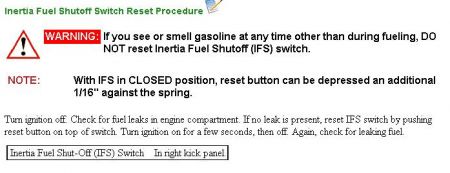
Initial diagnostic always asks that we check the IFS switch. Looking back at the diagram, I believe your fuel pump relay may be at fault. There should a few relays under the hood that are similar to the fuel pump relay. Switch them around and see if that works.
Feb 9, 2009 at 8:33 PM