LOW VOLTAGE TEST
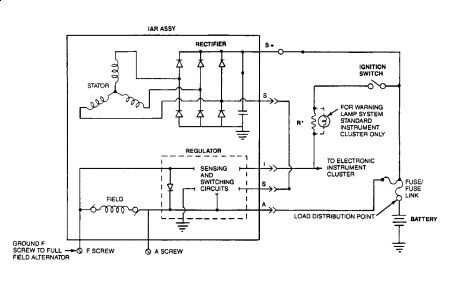
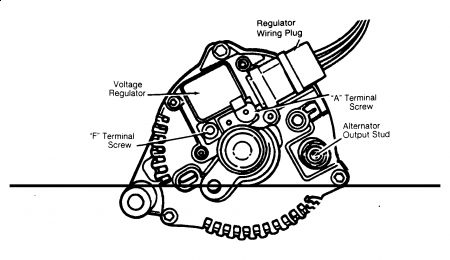
If voltmeter does not indicate greater than 0.5 volt more than base voltage, unplug harness connector from regulator. Connect ohmmeter between regulator "A" and "F" terminal screws . If resistance is not greater than 2.4 ohms, a short in the field circuit or a grounded rotor coil is indicated. Replace alternator.
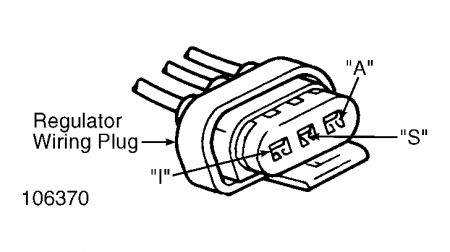
If resistance measured in step 1) is greater than 2.4 ohms, reconnect regulator wiring plug. Connect negative voltmeter lead to ground. Contact positive voltmeter lead to regulator "A" terminal screw. If voltmeter does not indicate battery voltage, repair open or high resistance in "A" wiring. Perform load test after repairs.
If battery voltage is indicated at terminal screw "A", ensure ignition switch is in OFF position. Connect positive voltmeter lead to regulator terminal screw "F". If battery voltage is present, go to step 4) . If battery voltage is not present, replace alternator.
Turn ignition switch to ON position. Contact positive lead of volt-meter to regulator "F" terminal screw. Voltmeter should indicate 2 volts or less. If voltage is greater, check circuit between "I" terminal and ignition switch. Repair if necessary. If "I" circuit is okay, replace regulator.
Perform LOAD TEST after repair. If voltmeter does not indicate at least a 0.5 volt increase more than base voltage, move positive volt-meter lead to alternator output terminal. Load-test system. If voltmeter indicates at least a 0.5 volt increase more than base voltage, repair high resistance between output terminal and battery.
Connect a jumper wire from regulator "F" terminal screw to rear housing. Load-test system. If voltmeter indicates at least 0.5 volt greater than base voltage, replace regulator.
Apr 29, 2009 at 5:45 AM