If you haven't actually jumped time, then.
Apparently a lot of Chrysler 300M's at one point or another go through a problem similar to this. The symptoms include (often in this order):
Acting like the rev limiter is turning on at greater than approximately 2,500 RPM
Rough idle followed by engine shutdown and inability to start
The Fuel Shutdown and/or Automatic Shutdown Relay clicking on and off multiple times per second or every couple of seconds
Intermittent spark when cranking the engine
Trouble codes for crankshaft position sensor fault, camshaft position sensor fault, or both
People will try replacing the crankshaft position sensor, the camshaft position sensor, or both, followed by the ECM (Engine Control Module), and the car may start up, then stop working again. This will make you pull your hair out.
I just went through this problem myself, and I was finally successful in correcting the fault. If you follow this procedure, you will be too.
Pull the battery and clean and tighten the terminal clamps. Clean the negative cable jump terminal on the passenger side fender under the hood. Clean the terminals connected to the positive jump terminal in front of the air cleaner assembly. Clean the positive cable terminal feeding power into the power distribution center (PDC). Test your battery and make sure it is charged. Lack of power due to a discharged or bad battery or corroded terminals will prevent adequate spark and will stop cranking. After cleaning these terminals, try starting the car. If the car still doesn't start, proceed to step 2.
Test fuel pressure at the fuel rail while having an assistant crank the engine. Upon startup, the fuel pump will pressurize for approximately 3 seconds, so this test is simply to eliminate a bad fuel pump as the cause of your non-start. You will probably read in the neighborhood of 50-60 PSI if the fuel pump is working.
Test for spark at one of the coil packs. If you have no spark, your ASD relay is probably not getting a ground.
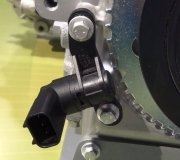
Following the procedure outlined in the Haynes or Chilton's repair manual for your car, test your camshaft position sensor and your crankshaft position sensor. One wire feeds approximately 8 VDC to the sensors, one wire grounds the sensors, and one wire sends a square wave (approximately 5 VDC) to the ECM. This test involves “backprobing” the connectors, but you can simply use a voltmeter and push GENTLY through the wire insulation (if you push too hard, you'll break the copper wires inside and create a high resistance wire which will be more of a pain to fix) and test for power and/or ground as specified by the manual.
Test the ASD relay.
Resistance test terminals 85 and 86. You should read about 75 ohms of resistance.
Resistance test terminals 87 and 30. They should read open (infinite resistance).
Jumper terminal 86 of the relay to 12 VDC, and jumper 85 to ground. Resistance test terminals 87 and 30. You should read continuity (roughly 0 ohms of resistance).
If the relay meets these specifications, the relay is good. If not, replace the relay.
Test the Fuel Pump Relay using the same procedure as with the ASD relay (the terminal numbers are the same and the relays operate the same, even thought the Fuel Pump Relay is narrower).
At this point, you'll have established that you have a good battery, good power distribution, a good fuel pump, a good crankshaft position sensor, a good camshaft position sensor, and good ASD and Fuel Pump relays. If your car still won't start, and you're still reading bad crankshaft and camshaft position sensor codes, and you're still getting “chattering” ASD and Fuel Pump relays, it's because the relays are getting an intermittent ground through the ECM. Most likely your problem is that there is a fault in the engine wiring harness that has shorted and ruined your PCM. The harness must be repaired and then the ECM must be replaced. If you just replace the ECM without repairing the harness, odds are you'll just fry the new one.
To remove the harness, first remove the upper intake manifold. Place clean rags in the intake holes on the lower intake manifold to prevent debris from entering the manifold. Disconnect the C1 connector from the ECM (this goes to the engine, the C2 connects to the PDC). Follow the harness and disconnect it from the PDC connectors, the alternator, fuel injectors, coil packs, upstream O2 sensors, throttle body, etc. Note the portion of the engine harness that passes under the upper radiator hose connection at the lower intake manifold. On my 300M, the insulation on about half of the wires at this point had been melted due to the heat from the engine coolant passing through the hose.
Repair the harness. Separate the individual wires from each other. Wire by wire, cut out any parts that have melted or brittle insulation. Solder and heat shrink replacement wires into place.
After repairing the damaged portions of the wiring in this section of the harness, inspect the rest of the harness for cracked, brittle insulation, melted insulation, chafed insulation, etc. Repair the wires as necessary (this part took me a couple of evenings in my shop). Inspect all of the connector plugs for damage, missing lock tabs, or any other damage. You can still get most of the connectors at a dealer, so replace them as necessary (I found about half a dozen wires that were chafed at the connector plug and were probably grounding out on my harness; any of these could have fried my ECM), although if you need a C1 connector, you're going to have to go to a junkyard and splice it in (I didn't need one). Use solder and heat shrink, or you'll just end up redoing the job when your crimped splices corrode out.
After repairing all the wires in your engine harness and replacing any connectors as necessary, chafe wrap your rebuilt harness. Between Auto Zone, O'Reilly's and Harbor Freight, I got plenty of 1/4”, 3/8”, 1/2” and 3/4” plastic anti-chafe corrugated tubing (or whatever it's called). Chafe wrap every sensor lead right down to the sensor and secure the chafe wrap with zip ties. After chafe wrapping the entire harness, use plenty of electrical tape where sections of chafe wrap meet to secure the sections together.
At this point, you have a harness that's probably better than factory. Reinstall the harness, rerouting it ABOVE the upper radiator hose and pushed forward more so you don't get melted wiring again anytime soon from radiated manifold heat. Reconnect the harness to your ECM (you might get lucky and NOT have a fried ECM). Try to start the car. If you're still getting the chattering relays, your PCM is shot. I recommend going to Auto Zone for a new one. Dodge wanted $500 for the part, plus another $100 to flash program the ECM; they wanted $900 to install and program the ECM themselves. O'Reilly's wanted $130 for the ECM, $20 to ship it in from out of state (plus a three-day wait), and then I'd have to take it to Dodge to flash program it. AutoZone had the part I needed for $130, and when I went in, I brought in my VIN and my mileage, they got me the part in three days already flash programmed from the remanufacturer. It works like a charm, plug-n-play. Just install the part and you're ready to go.
SPONSORED LINKS
Friday, October 18th, 2013 AT 7:10 PM