Logo Automobile Information Add Site to Favorites  
Auto Repair
Auto Repair Home
Auto Repair Ask a Car Repair Question
Auto Repair Car Question Forum
Auto Repair Questions by Manufacturer
Auto Repair Questions by Topic
Auto Repair First Things to Check
Auto Repair How to Repair or Service
Auto Repair Car Repair Manuals
Auto Repair How Does it Work
Auto Repair Car Repair Video Series
Auto Repair Auto Maintenance
Auto Repair Car Sound Problems
Auto Repair Auto Term Abbreviations


Popular Site Links


Auto Repair Automobile Safety Inspection
Auto Repair Brake Replacement Guides
Auto Repair Service Engine Soon Light
Auto Repair Belt Routing Diagrams
Auto Repair Avoid Car Repair Rip Offs
Auto Repair Trouble Code Table
Auto Repair How to use Diagnostic Tools
Auto Repair Smog Test Preparation
Auto Repair Hybrid Car Information
Auto Repair Test Equipment Store
Auto Repair Auto Parts
 
Search Website
 
 
Recent Repair Topics


Auto Repair2000 Ford Crown Victoria...
Auto Repair1989 Chevy Suburban
Auto Repair1994 Jaguar Xj6 Brake L...
Auto Repair1999 Buick Century In R...
Auto Repair1993 Jeep Cherokee Jeep...
Auto Repair2002 Ford Explorer Tran...
Auto Repair1999 Dodge Truck Engine...
Auto Repair More Repair Topics...


Free Car Repair Advice by Certified ASE Technicians


How Does it Work / Starter and Solenoid

How Does a Starter and Solenoid Work?

Introduction:

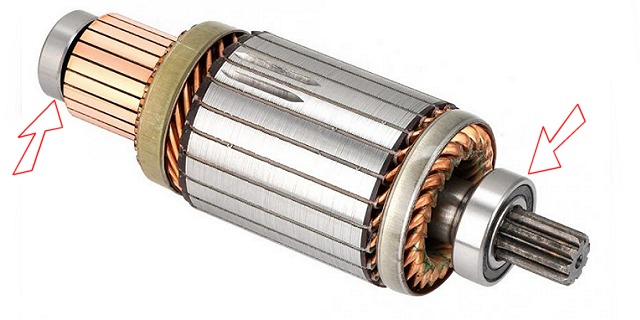
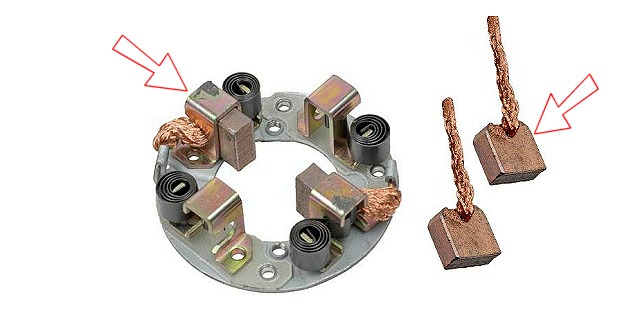
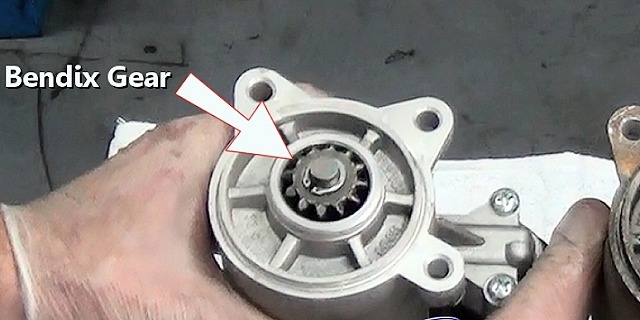
An engine starter is designed to utilize a 12 volt, high amperage electrical system made to turn an engine over for starting purposes via a flywheel. Basically a starter is an electric motor with a small pinion gear and bendix assembly. This starter bendix drive is designed to extend and mesh with the flywheel teeth when the ignition key is turned to the "crank" position and then retract when the ignition key is released after the engine has started. A starter motor is constructed with a main outer housing that contains the armature magnets, the armature contains the starter windings, a brush set that is used to contact the armature to transfer the electrical energy. The starter bendix is directly connected to the starter pinion gear. A starter solenoid acts as the main power switch to begin the starter operation. Because the starter motor draws such high amperage a conventional switch would short circuit very quickly. Most starter solenoids are located on the starter motor itself. Some Ford models have located the starter solenoid on the inner fender panel near the battery. The electrical system that controls the starter motor is comprised of an ignition switch, neutral safety switch (automatic transmissions only) a clutch engagement switch (manual transmissions only) a battery, battery cables, anti theft system and the starter itself.

Starter Motor

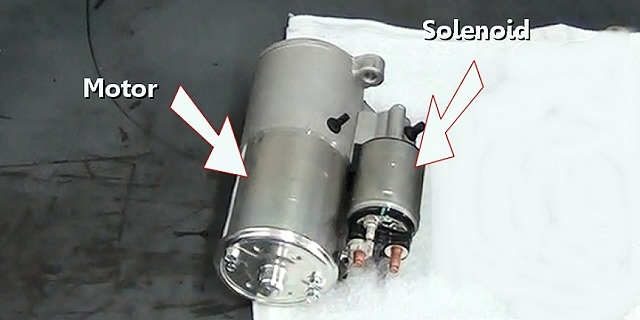
Typical Starter Motor

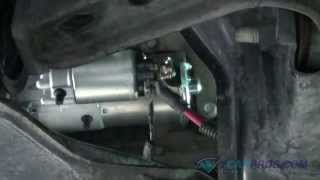
Most starter motors are mounted underneath the car near the flywheel on either the left or right side. The flywheel is located between the engine and transmission. Some models have located the starter under the intake manifold, which makes replacement difficult. When the ignition key is turned to the "engine crank" position a 12 volt low amperage electrical signal is sent to the anti-theft system which in turn can monitor the gear selection or clutch safety switch position. Only then will the signal continue to the starter solenoid that activates the high amperage side of the electrical system to engage the starter motor.

Starter Solenoid
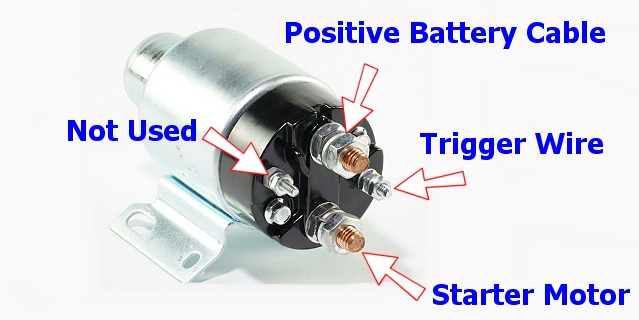
Starter Solenoid (appearance will vary)

Once the starter motor has been engaged the starter bendix senses the armature momentum and is forced to extend into the flywheel. Once the engine has started and the ignition key released the bendix loses momentum and the bendix is forced to return to idle position. If the flywheel is worn it can cause a grinding noise when the starter bendix/pinion gear is engaged. The objective of the starter motor is to rotate the engine between 85 and 150 rpm's necessary for engine ignition process. A starter will typical last between 60,000 and 100,000 miles and is a normal replacement item.

Starter Bendix
Starter Bendix (appearance will vary)

Replacement Guide

Tools needed:

  • Set of sockets and socket wrench with extensions
  • Phillips and standard screw drivers
  • Pliers
  • Wrench set

Replacement Procedure:

  • Start with engine cold
  • Remove the negative battery cable at the battery
  • Remove all electrical wires that lead to the wiring harness and main battery cable connections. (note: sometimes this step is easier after the starter motor has been removed)
  • Remove all accessories (if any) to access starter motor mounting bolts, next remove starter motor mounting bolts, remove the starter.
  • Clean starter mounting surfaces thoroughly
  • Install new starter and tighten evenly
  • Reconnect wiring and cable
  • Reconnect the negative battery cable (note: if major spark are present when the battery is re-connected the starter battery connection needs to be inspected)
  • Recheck starter operation (note: if the starter motor operation is excessively noisy the starter motor may need to be repositioned using shims)

Starter Wiring
Typical Starter Wiring Circuit

Related Replacement Components:

Basic Checks

The starter will not operate properly without the correct voltage needed. To test the electrical system voltage use a voltage meter (voltmeter). Attach the voltmeter leads to the positive and negative terminals of the battery. To check a battery surface voltage, remove the positive terminal protective cover and connect the +positive side meter lead (red) to the positive side battery terminal then connect the - negative (black) side meter lead to the negative battery terminal. With the vehicle not running and sitting over night the battery voltage should be between 12.4 and 12.6 volts. To test the system without a volt meter activate the headlights, if they illuminate brightly the electrical system probably has sufficient voltage. If the headlights are dim or not working the battery charge is either low or the battery has failed and needs replacing. Starter electrical system inspection

Common Problems

  • Starter Drag: This condition exists when the start motor rolling bearing has failed allowing the armature to contact the outer starter motor case creating a scraping noise.
  • Starter Motor Rapid Clicking Sound: When the starter motor makes a rapid clicking noise it can mean the battery is too low on charge. Check battery condition
  • Starter Motor Grinds When Cranking: This condition exists when the starter bendix or flywheel has worn and is causing the gear mesh to fail creating a grinding noise.
  • Starter Makes a Ticking Noise: This condition is created when the starter solenoid connection plate has shorted not allowing the electrical flow to continue through to the starter motor itself. Or the starter brushes have failed also not allowing the electricity through to the starter armature.
  • Starter Clunk/Bang Noise: A clunking/banging noise when the starter is engaged could mean the starter is working ok but the engine is not turning over. Manually try to turn the engine over to confirm engine failure. Engine failures can include blown head gasket, crankshaft failure, intake/exhaust valve failure, connecting rod failure or piston failure.

How Does it Work / Starter and Solenoid

Check Manufacturer Specific Starter and Solenoid Questions

Related Subjects

ASK CAR REPAIR QUESTIONS - Join our question and answer forum where over 10,000 free auto repair questions are answered every month, after you have completed our free signup you will able to ask a question and receive an answer from one of our many forum members. If you elect to donate any small amount of money we will assign one of our 2CarPros Certified Repair Technicians to answer your question. Questions with donations are answered promptly and 100% of the donation is awarded to the technician helping you.

GET ONLINE CAR REPAIR MANUALS - Get instant access to your vehicles wiring diagrams, firing orders, component locator, vacuum diagrams, repair procedures, specific testing and diagnostics for troubleshooting, steering and suspension information, heating and air-conditioning problems, safety belt and airbag restraint repair, factory bulletins and general information and much more. We recommend that anyone needing technical repair information should have a quality auto repair manual for their car.


Popular Service Repairs
Test Fuses
Replace Front Brake Pads
Check Engine Light
Rear Brake Shoes
Rear Brake Pads
Test Alternator
Replace Air Filter
Test Battery
Tune Up
More Service Repairs...
Advertisement
Car Questions
Acura
Alfa Romeo
American Motors
Audi
BMW
Buick
Cadillac
Chevy
Chrysler
Citron
Daewoo
Daihatsu
Dodge
Eagle
Ferrari
Fiat
Ford
Geo
GMC
Honda
Holden
Hummer
Hyundai
Infiniti
International
Isuzu
Jaguar
Jeep
Kia
Land Rover
Lexus
Lincoln
Mazda
Mercedes Benz
MG
Mercury
Mini
Mitsubishi
Nissan
Oldsmobile
Opel
Peugeot
Plymouth
Pontiac
Porsche
Renault
Rolls Royce
Rover
Saab
Saturn
Scion
Seat
Skoda
Subaru
Suzuki
Toyota
Vauxhall
Volkswagen
Volvo

Home l Help l Privacy Policy l User Agreement l About Us l Computer Repair Question l Contact Us l Link to Us l We're Hiring l Affiliate Program
  Copyright © 1999 - 2009 2CarPros.com - Professional Mechanics Online